Nice to have a story I wrote about our trip to Japan’s Yamanashi prefecture in today’s Des Moines check it out there
Or below:
Iowa farmers’ highlights from trip to sister state Yamanashi
Betsy Rubiner, Special to the Register11:50 a.m. CDT August 2, 2016
(Photo: Betsy Rubiner/Special to the Register)
After jumping at an invitation from Iowa farmers to tag along on a July trip to Japan’s Yamanashi Prefecture, I got even more excited when my guidebook had no mention of Yamanashi. I love traveling off the beaten path.
But Iowans – farmers, students, business leaders, governors – have beaten a path to Yamanashi since the 1960 “Iowa hog lift,” when Iowa donated breeding hogs and feed corn to help the region about 80 miles west of Tokyo recover from a typhoon.
So began the Iowa/Yamanashi sister-state relationship, the first between the United States and Japan. Exchanges of people, agriculture products and kindness have followed. (On the State Capitol grounds in Des Moines, check out the monument sent by Yamanashi residents in 1962.)
Our group from the Iowa Farm Bureau (where my husband works, hence the invite) was warmly welcomed with unusual opportunities, including an agriculture tour through a fertile valley surrounded by mountains, with stops at a peach orchard, rice paddy and grape greenhouse (rebuilt with some Iowa aid after a 2014 snowstorm).
But here are activities available to all:
Experience Mt. Fuji: Catching sight of Japan’s highest peak (12,388 feet) is thrilling – and not guaranteed, we soon learned. Among Japan’s most iconic images, the snow-capped, cone-shaped volcano can be found on everything from famous woodblock prints to hand towels and cookies. The real Mt. Fuji greeted us full frontal, with only a wispy cloud drifting across its mid-section, when we arrived at the Highland Resort Hotel, in the small city of Fujiyoshida, about a 33-mile drive north of the mountain. The next day, Fuji was gone, gobbled up by clouds. “She’s very shy,” explained our charming Japanese guide.
July and August are peak Fuji hiking season, including popular overnight climbs. Although I wasn’t among the Iowa farmers who went on a short, well-reviewed day hike, I joined a mid-mountain visit, arriving by tour bus after an hour’s drive south. Although the “fifth station” parking area was packed with visitors and buses (private cars weren’t allowed), being on Fuji and peering down into its spooky, dense green forest from the visitor area decks was a kick.
Japanese bathing: Yamanashi is a good place to try Japan’s famed communal bath houses, many with water from natural hot springs or onsens, thanks to the area’s volcanic activity. (Fuji hasn’t erupted since the early 1700s.) Yes, this is nude bathing. But there’s one area for women, another for men. (Some onsens offer private rentals for coed bathing.)
A typically American, solo shower gal, I discovered that lounging around in shallow pools of water (indoor, outdoor, hot, tepid, cold, rosemary-infused) is a relaxing way to end a day as a Yamanashi tourist, especially in hot-and-humid July. It’s also a very Japanese experience, with well-defined and obeyed rules that newcomers pick up, sometimes after a mishap or two. (Word to the wise: Wash yourself before entering the pools. And no people with tattoos allowed.)
Peach picking time in Yamanashi: One of Japan’s top fruit-producing regions, Yamanashi’s famous softball-sized, white-fleshed peaches are sold at roadside stands, indoor markets and pick-your-own orchards. (Look, too, for delicious peach ice cream.) We also spotted peaches hanging low from trees, each wrapped in paper. The result: pricey peaches pampered to perfection, rosy and blemish-free on the outside, sweet and juicy inside, sold in expensive Tokyo department store food halls.
Visit a traditional farming village, sort of: To Iowa eyes, Saiko Iyashi no Sato – a recreation of a farming village destroyed by a 1966 typhoon – brings to mind the Des Moines area’s Living History Farms. But this open-air museum/crafts showcase in the woods above one of the Fuji Five Lakes is distinctly Japanese, with traditional thatched roofed houses along winding paths dotted with purple hydrangea. Inside many are shops selling artwork and food, from Mt. Fuji depictions to green tea ice cream. (Yamanashi’s Fujiyama Museum specializes in Fuji art.)
Roller Coaster Riding: I hate roller coasters. But plenty of farmers were game to try the coasters – billed as among the world’s steepest – at Fuji-Q Highland, an amusement park well-known in Japan and located right behind our hotel.
Japanese dining – or not: Familiar restaurants near our hotel include a Big Boy, KFC and McDonald’s. But word has it, the hamburgers were less familiar – bun-less and more like meatloaf with gravy. All the more reason to eat Japanese classic cuisine at our hotel’s restaurants or at Aiya, a chain restaurant with an encyclopedic menu worthy of an Applebee’s, featuring greatest hits such as sushi, tempura, Udon noodles, karaage (chicken nuggets) and tonkatsu (akin to Iowa’s pork tenderloin). Fortunately, Aiya’s menu also has point-to photos, since our Japanese is pathetically limited to words like “arigato” (thank you) and “Ohayo” (good morning). And refreshingly, no one in the restaurant spoke much English.
Betsy Rubiner, based in Des Moines, writes the travel blog TakeBetsywithyou.
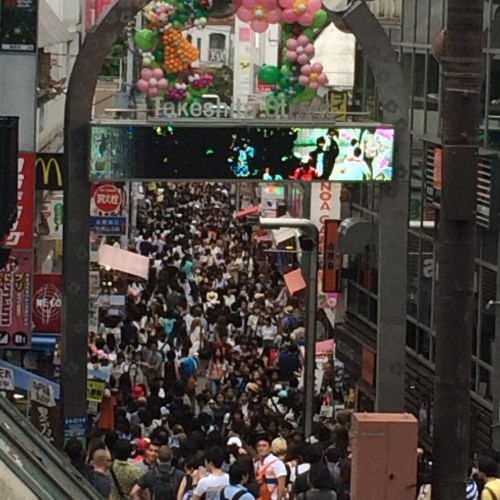
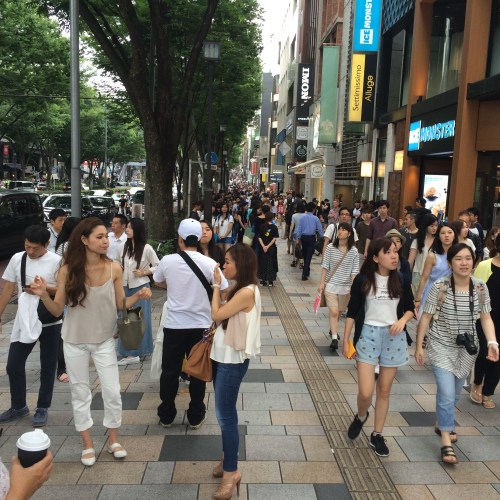
 see more Japanese kid culture. Instead we ended up at a Brazilian festival, complete with performances by martial arts dancers and drummers and Brazilian churrasco (grilled meats). Like the Japanese, we went with the flow and it felt like we were in Central Park at times, except for the giant shrine nearby, Meiji Jingu, which was very Japanese and hosted several elegant wedding parties. From there we walked in the general direction of Shibuya, where we encountered more crowds. It’s pretty astonishing how many people there are out and about in this city.
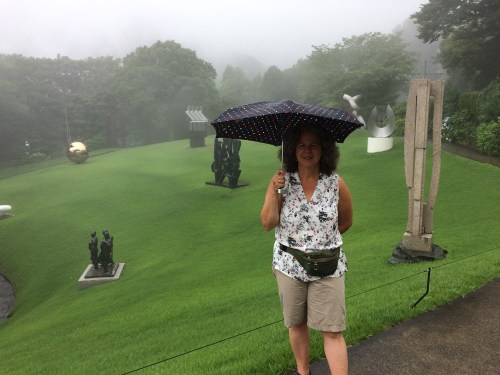 We found the Hakone that lived up to the hype today. After a haphazard journey that involved a bus (the wrong one, apparently) and then a train (which turned out to be the famous narrow gauge train through the mountains), we arrived at the Hakone Open-Air Museum in a downpour. Fortunately there were several closed air (indoor) galleries and several fantastic museum shops to explore until the rain finally became mist and then fog and then a few hopeful patches of blue sky that never really panned out.
 Indoors was a really interesting exhibit of work by a contemporary Japanese artist (Tadanori Yokoo), another interesting permanent Picasso exhibit and a way cool exploratory exhibit on sculpture that included two podiums where you could stand and move around and a sculpture on a video screen would duplicate your position. Amazing.

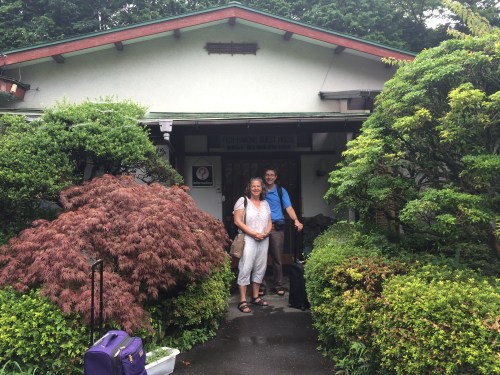 We’re not in Tokyo anymore….The Fuji Hakone Guesthouse is in a lovely secluded spot in dense woods on the side of a mountain in the hot springs resort area of Hakone, about a 2.5 hour trip from the frenetic Tokyo Station this morning, by various forms of public transportation including a subway, train and bus.