We counted eight bald eagles at Gray’s Lake on a spectacular day with blue sky and sun beaming down on the water and deep snow. Sometimes winter isn’t all bad in Iowa. This photo, some avid eagle photographers told us, is of an “immature” bald eagle, without the white head. Word has it, it takes five years to get the white. And pssst…the eagles weren’t in their usual spot. They’re a little north of the north entrance to the park in bend in the river heading toward MLK.
(From early November) Reality set in as we drove home to Iowa from Bentonville. Our balmy weather suddenly turned cold and rainy. We listened to too much news about our awful current president denying the results of the election that booted him. And his awful Republican enablers. We also were clearly heading back into major Covid spread territory in Iowa.
But I am cheered by Biden’s steady leadership and ability to withstand Trump’s provocations. We stopped in the small Missouri town of Adrian to pick up a late lunch in Pecan country (and apparently in Trump country too,judging from the yard signs). We were the only folks wearing masks at Byrd’s Pecan Delights. fortunately we were also almost the only people in there. Not to be confused with Byrd’s Hoot Owl Pecans (great name), a farmers market in nearby Butler, Mo. Solid sandwich fare (chicken salad with, yes, pecans; a BLT) and bought some candied pecans for gifts and a slice of incredibly sweet chocolate pecan pie. Stopped at Gates in Kansas City for ribs to go and Dirck’s receipt came up with a STAR on it so he got a $10 bill. Only took 35 years of Gates visits to get that lucky! before we left Bentonville, we took me more bike ride, ending up for coffee at The Meteor, a cool little place in a bike shop near the Momentary. (Another one nearby is called theairport.)
Because of Covid, I booked an Airbnb with a kitchen and dining space so we have eaten all but one of our meals dans Airbnb, on a little wooden deck at a turquoise-colored metal table overlooking a sloping lawn with trees and a big stone mansion in the distance. We ordered takeaway from Oven & Tap, which made for two dinners – excellent flash-fried edamame, fried chicken and a margarita pizza. We had to wait a half hour beyond our pickup time, but other than lousy service, no complaints about the food! We also got excellent bread (orchard bread, rosemary polenta bread) from Ferrere, a bakery in Kansas City’s quality Hill neighborhood (near bluebird cafe)which has served us well.
Crystal Bridges’ North Forest Lights did not disappoint. At our scheduled time (8:15) we joined a socially distanced crowd to walk 1.5 miles along a lit path in the dark woods, stopping at 5 installations that combine music, lights, trees and sometime sculpture. It was mesmerizing. The woods was also dotted with sculpture, illuminated by lights. Loved this!
Today we rode bikes to Crystal Bridges proper and showed our timed tickets on my phone to get in. The museum is free. We paid $ 12 per person for an interesting show of photography by Ansel Adams and a host of contemporary landscape photographers. It took me awhile to figure out how to best see the art, given we must wear masks. I thought contacts would be best but after getting warm riding my bike, my vision was blurry with the contacts so I switched to glasses. Next issue, my glasses kept fogging up so I’d have to wait until the fog cleared to see the photos. I finally figured out a way to put my mask a little lower on my nose so my glasses didn’t fog. For the most part, other people kept their distance but every once in awhile some clueless person would get too close. I just moved away. We did eat lunch in the museum’s cafeteria because there were only a few tables with people, we found a table far from everyone, the space is huge with high high ceilings and glorious views of the ravine and yellow and orange leaves on the trees.
As a travel writer (and as a traveler), I seek out the places that feel emblematic of the place I’m visiting, with a storied history and local cuisine, with atmosphere, character and grit. Some of those places, sadly, have been felled by the pandemic as I learned in a NYTimes story yesterday. Oddly, we drove past The Rieger restaurant in Kansas City during a day trip there on Saturday and vowed to return once we can to eat at a place that not only had inventive food but allegedly a bathroom that gangster Al Capone once peed in. Sadly it is no more, as the NYTimes story reported. I had been to three of the nine restaurants mentioned in the story – including the Brookville Hotel in Abilene and the Cake Cafe in New Orleans.
End of an Era in Kansas
I first went to the Brookville Hotel – which specialized in fried chicken and biscuits – in the mid-1980s when I lived in Wichita. The 1.5 hour drive to the tiny worn town of Brookville was worth it, to eat in the old tumbledown hotel that was mostly (or maybe completely) a restaurant by that time. I took many a visitor there as well, since it was so evocative of old time Kansas. A lot of atmosphere was lost when the restaurant moved to a faux hotel recreation on the edge of Interstate 70 in Abilene but the chicken and biscuits were still great. Our memory is the wait staff only asked two questions: What kind of salad dressing do you want? What do you want to drink? Otherwise the order was chicken and biscuits.
I wandered into the Cake Cafe a few years ago while exploring the Marigny and Bywater districts. It was a cheerful alternative feeling coffee house, painted yellow on a quiet corner. Very cozy and they were advertising their NOLA-classic King Cakes with the little plastic baby in them. I had only an orange juice, resisting the tempting pastries (which I now regret) and sat outside, back in the pre-pandemic days when you didn’t do this for your health and safety.
The pandemic has caused so much devastation – first and foremost, deaths and lasting health consequences for people, but also devastation to businesses and livelihoods, some that make a place distinctive. On a happier note, we did get carryout at two Kansas City classics that appear to be hanging in there — ribs from Gates BBQ and a chicken dinner with cinnamon buns (not biscuits) at Stroud’s. We need to remember to keep patronizing these places, helping them to survive.
When we learned it would be 54 degrees in Kansas City, we were there. Turns out it was 59 degrees and so nice to have a change of scenery after a strange shut-in Christmas for two, pandemic-style. Hoping there will be more weekend days like this within a 3 to 4 hour drive of DSM during the next few months when otherwise, we are likely not going anywhere.
Nelson-Atkins Museum, 59 degrees, dec 26!
We had a scenic picnic at a pretty park high atop a bluff with a panoramic view of the city and Missouri/Kansas river confluence just east of the Quality Hill neighborhood , complete with WPA stonework and old concrete picnic tables and statues of Lewis & Clark and James Pendergast (we think father of big KC boss Tom).
The Nelson Atkins has an interesting photo exhibit of Muhammad Ali in London during a big fight in the 1960s, with photos by famous Kansan Gordon Parks. We got a timed ticket (free) to the museum online and found it comfortably (under) populated, everyone socially distanced and wearing masks. We spent much of our time outside, walking along a curving path along the top of the (not so) new wing, dotted with sculpture and little kids having a great time rolling down the grassy berms lining the grand lawn leading up to the imposing original museum with its grand columns. Cool new site specific squiggly stone wall by Andy Goldsworthy.
We discovered a new (to us) neighborhood with elegant homes —Hyde Park, just east of the Gates BBQ on Main. Janseen Place reminded me of Boston Blvd. in downtown Detroit. A short stretch of elegant old stone homes with an imposing entryway of columns. We also stumbled upon a beautifully restored tan brick building with spectacular terracotta reliefs and chic businesses including Billies Groceries (more a restaurant), a spa and boutique. Our car is full of carryout food from classic KC plates – ribs from Gates and chicken from Stroud’s.
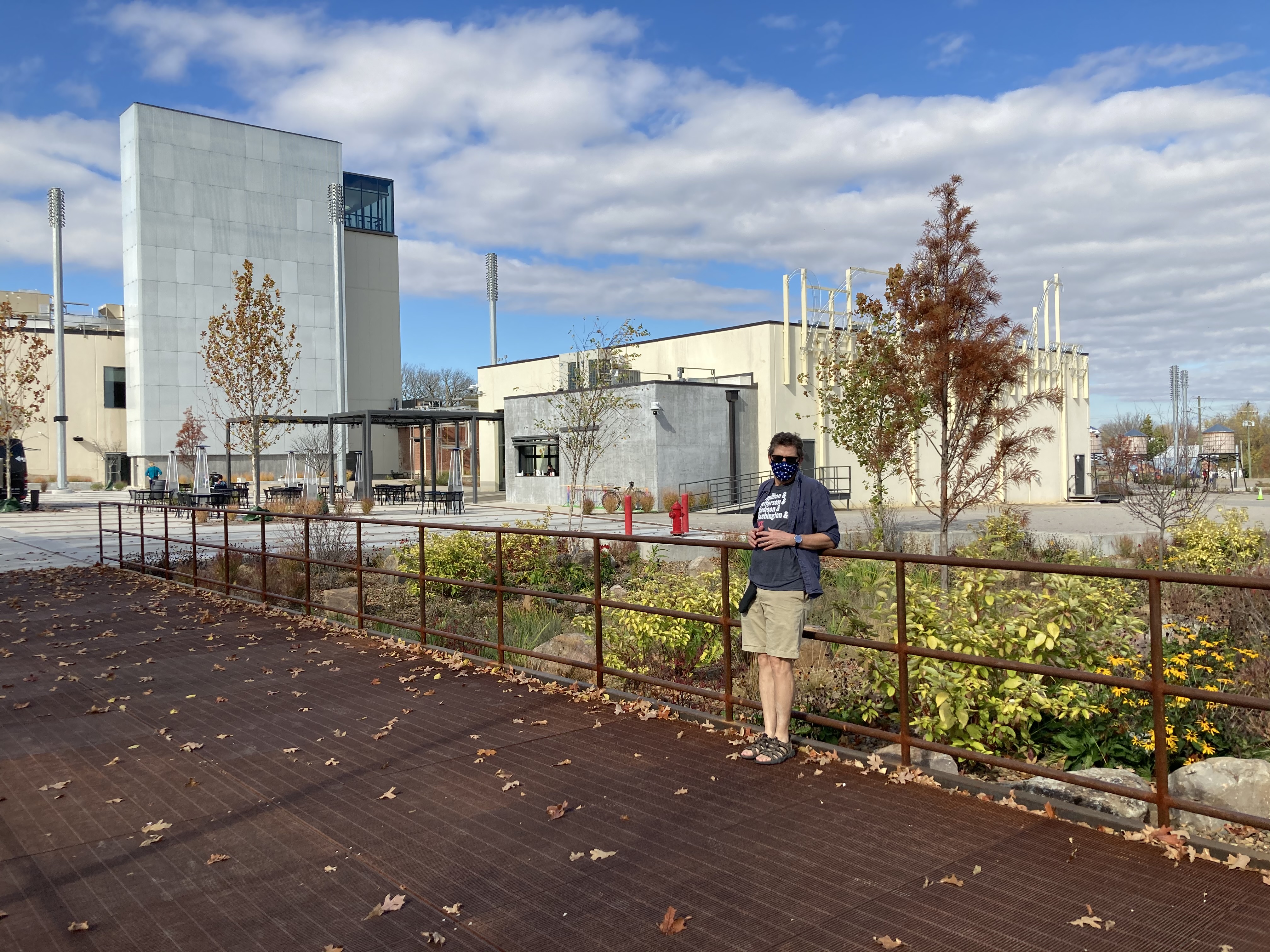
Sorry for the confused posts. WordPress is mucking up. Anyway, here is Dirck at The Momentary, a contemporary art space in Bentonville. Below is a scene at North Forest Lights, a spectacular sound and light show in the forest north of Crystal Bridges Museum, here.
On our third visit, Bentonville continues to intrigue us. It’s an unlikely mix of small town and boom town, of traditional values and cutting edge contemporary art, of dare devil mountain bikers and artsy looking visitors, hymns played on the 5 p.m. Sunday church bells and a wild Nick Cave avant-garde installation at an industrial chic museum in a former Velvetta cheese factory.
With Covid raging across the land (Arkansas is slightly less beet red than Iowa on the Covid map…although it may as well be the political map too), this has been an easy place to social distance. We rode our bikes up down and around the Razorback Greenway trail that is right near our Airbnb and runs north-south, curving through dense hilly woods along a ravine by Crystal Bridges museum, past sculpture along the “art trail” and paralleling a crazy off-road dirt trail with jumps and platforms that draws daredevil teens and adults.
In town, the trail skirts the pristine town square, lined with well-tended old brick buildings, and heads through neighborhoods with a remarkable mix of architecture, from tiny unassuming shacks and ranch houses to massive elegant old mansions and new modern mansions that sit close to the street but are block-deep and high, lots of tin, wood, porches. Some newbies tower over their smaller older neighbors. One house in our neighborhood must be four times the size of its neighbor.
Our Airbnb is just northeast of the square in what seems like the newer part of town on NE 2nd St., which feels a little more rural with huge lots than the east side. We are behind our Airbnb owner’s attractive ranch house, in a spacious studio apartment tacked onto a barn-like garage. It is country chic inside and incredibly well-equipped, down to the homemade marshmallows, Hershey bar and graham crackers for s’mores, using the brick fire pit in our very private back yard.
We also have an outdoor deck where we have eaten all our meals because it has been so incredibly warm (and we are not eating out during a pandemic). Our view looks out onto woods and a ravine. Past the ravine is an intriguing stone mansion with a French mansard roof. We finally walked around the block to see it. Turns out it’s even more enormous than we thought, on a street with three more huge tasteful houses with private electronic gates. As D says, we are in Hamptons Territory here, which is weird because this is, or used to be, small town northwest Arkansas. We assume many of the new fancy homes being built all over town are for Walmart bigwigs.
I haven’t even gotten to the museums, which is why we came here. We biked about five minutes south to The Momentary, the dramatic industrial cool museum that opened last spring as a hipster offshoot of Crystal Bridges Museum. It’s an industrial retrofit, with poured concrete walls and large high-ceilinged spaces for huge installations so it was well-suited to Nick Cave’s over-the-top concoctions. We started in one large room filled with dangling cut tin ornaments in many colors and shapes, that grew and shrank and shined with the breeze.
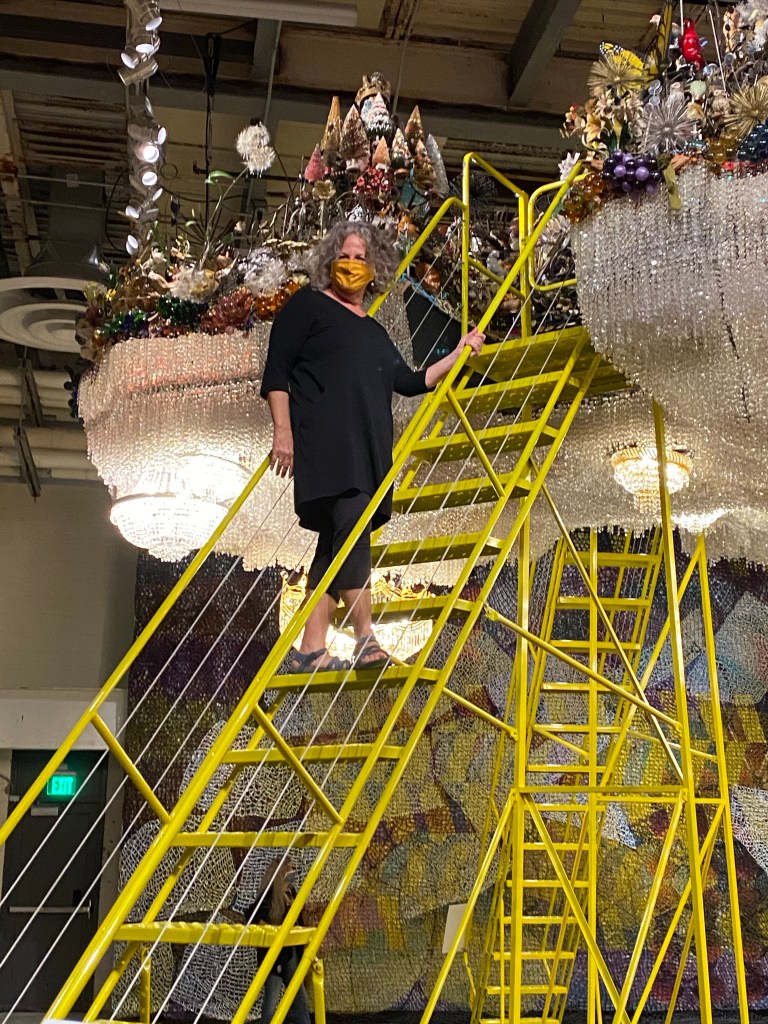
The main attraction is an enormous hodge podge of kitschy stuff – – ceramic birds, beads, old sambo sculptures and black-faced jockey lawn ornaments (the very un-PC ones) crowded astop an enormous tacky chandelier. To see it up close, we could climb one of three yellow metal ladders to a small clearing. Given Covid, we had to wipe our hands with a sanitary wipe before and after climbing. We also went to another viewing platform on a balcony, which we had all to our own. (There were few visitors to begin with.)
Outside, on a vast lawn with a huge tarp/tent, there was supposed to be activities like yoga and meditation but they never seemed to materialize, even though I signed up for something called sound and light. Circles were drawn on the lawn to help people sit six feet apart. We rode bikes to a nearby former industrial space, that had a few shops and food place, including 8th street market which was mostly closed on a Sunday. We walked through one space called Holler where a few young people were playing shuffleboard on a glossy wood floor in the middle of a space lined with a bar and tables to eat burgers and ramen ordered on a computer screen. Not sure where the food was coming from. There were a few food trucks outside. We went in one lovely shop specializing in textiles and wool, with beautiful indigo dyed cloth and paper like we saw in Japan.
We rode around the market district surrounded The Momentary , another interesting mix of old housing and new contemporary homes. Then we rode north on the razorback greenway trail through the prettiest stretch, winding through the woods past and north of crystal bridges. A bit hairy to navigate at times with strollers and mountain bikers on crazy trails parallel to our more sedate trail. The northern bit of the trail that leads to a small lake was closed due to construction. We ended up taking another trail (north Walton) back. Although it runs parallel to highway 71, most of the time we were hidden in the woods and it was far less crowded than the Razorback greenway. Once we got to town, We rode on a combination of what felt like country roads and trails. Later this evening we took a long walk, admiring the mix of architecture and homes east and west of the square.
We made an unexpected stop in Kansas City (en route to Bentonville Arkansas) soon after hearing the news that Joe Biden and Kamala Harris were declared the winners of the 2020 presidential election. I had to find somewhere to get out of the car and dance and cheer. I found it at the big fountain in Mill Creek Park near The Plaza. About 35 of us stood in the warm sunshine (73 degrees on November 7) and cheered, danced and waved our hands and flags as cars drove by, honking their horns and people of all skin colors and ages thrust their arms and Biden-Harris flags in the air. Pure joy. Oh happy day and one that I have been dreaming of (and trying to make happen) for four years. P.S. picked up excellent rustic artisan bread (orchard, rosemary polenta) at Fervere bakery in Kansas City’s quality hill neighborhood.
Easy drive home from Burwell, Nebraska with a few stops, starting with Fort Hartsuff, an 1880’s U.S. Army calvary outpost fort from 1974 to 1881 on the edge of town. It’s a well-preserved state historical park on the edge of the windswept Sandhills but several buildings were closed due to Covid-19 precautions. Further east in Omaha, we found even more happening in the Blackstone District since we were last there in 2018 including a new attractive food hall, The Switch Beer & Food Hall, (a clean, ultra-modern space on bottom floor of a clean, ultra-modern new high-rise) which has several good dining options (complete with outdoor seating)! We opted for the well-reviewed Ansel’s Pastrami & Bagels where we had the famed pastrami sandwich (delicious but seemed more like brisket than pastrami) and bagel with dill cream cheese and lox. Bagels are good – heavier and chewier than I’m used to but that’s fine. Next time, I’ll try the Vietnamese Street Food option. Over the Iowa line in Council Bluffs, we stopped for some Jonathan apples at Dittmar’s Orchards, which was full of families picking apples and pumpkins. (We were the only ones wearing masks…)
Lovely fall getaway, meeting the Chicago branch of our family (15-month-old grandson Linus and parents) in the old river town of Galena in northwest Illinois. Galena proved a perfect near-middle meeting spot between Chicago and us in Des Moines, a three/three and a half hour drive for each. We didn’t realize how hilly and bucolic this corner of Illinois is, but learned it is Illinois’s only county in the Midwest’s 4-state Driftless Area, so named because the land-flattening glacier didn’t pass through during the Ice Age, therefore not leaving behind “drift,” i.e. glacial deposits or smashed down the rolling landscape. The Driftless moniker never sounds right to us.) The area looks like nearby southwest Wisconsin to the north and northeast Iowa to the west, with high ridges overlooking forests, river valleys, waterfalls and streams.
We stayed close to our Airbnb, given the pandemic, cooking and eating in our cozy 2-bedroom townhouse-ish dwelling in “Galena Territory,” a vast resort development fashioned out of rolling hills dotted with farms outside town. It was tastefully done, meaning not over done, with small clusters of earth-colored contemporary housing scattered in woods and valleys, here and there.
On Saturday morning we strolled down Galena’s Main Street, which is lined with well-preserved 19th-century red brick buildings with restaurants and enticing shops. (Not as many antique stores as when we were last there 30 years ago. More upscale home decor and fancy food shops.). Given the pandemic we entered only one store, an excellent kitchen store, The Grateful Gourmet, and got coffee, hot cider and pumpkin donuts at a cute cafe, the Trolley Depot, where we sat outside, on a chilly but sunny day. Everyone wore masks, which we greatly appreciated. When we return I’d like to visit some of the grand old historic homes, including President Grant’s . There’s also a branch of the Chicago Atheneum, a design/architecture museum. Next trip we’d also like to go to the classic looking supper club we passed in East Dubuque, Illinois, which is perched high above the Mississippi,
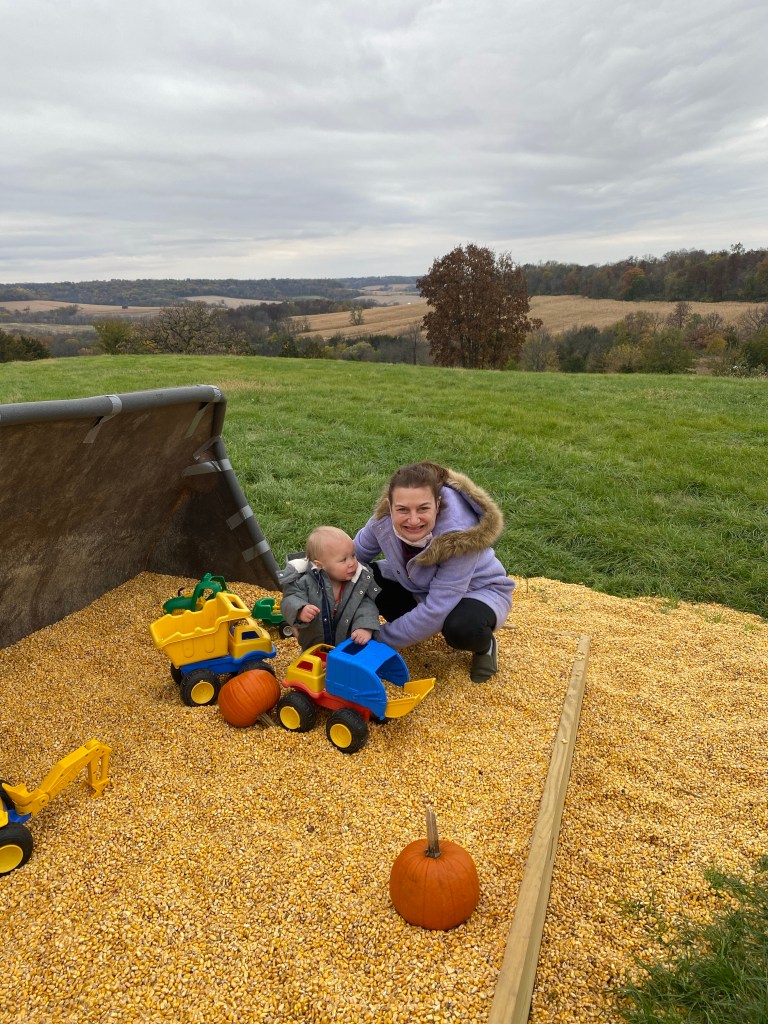
On the way out of town, we stopped briefly at Terrapin Orchards in Elizabeth, Illinois for apples. Linus loved the sweet little play area fashioned out of an old Cat bulldozer whose scoop was filled with field corn kernels and tonka toy trucks. Paradise for a little boy (or girl). Then we parted ways, with the Chicagoans heading southeast and us Iowans heading southwest.
We drove the scenic route along the Great River Road through the old worn Mississippi River towns of Hanover and Savanna, past Mississippi palisadesstate park, with its high wooded bluffs. In Savanna, we stopped at Fritz’sFinds, a funky junk/antique shop in an old brick opera house with stained glass windows. To our surprise we had pass through a dark bar to get to the few rooms with junk. We didn’t linger, given the pandemic, but it was odd to be in a bar where people sat shoulder to shoulder mask-less at the bar and at a few tables, listening to a 6-piece band. Wish we could have stayed. The band was good and made me miss live music all the more.







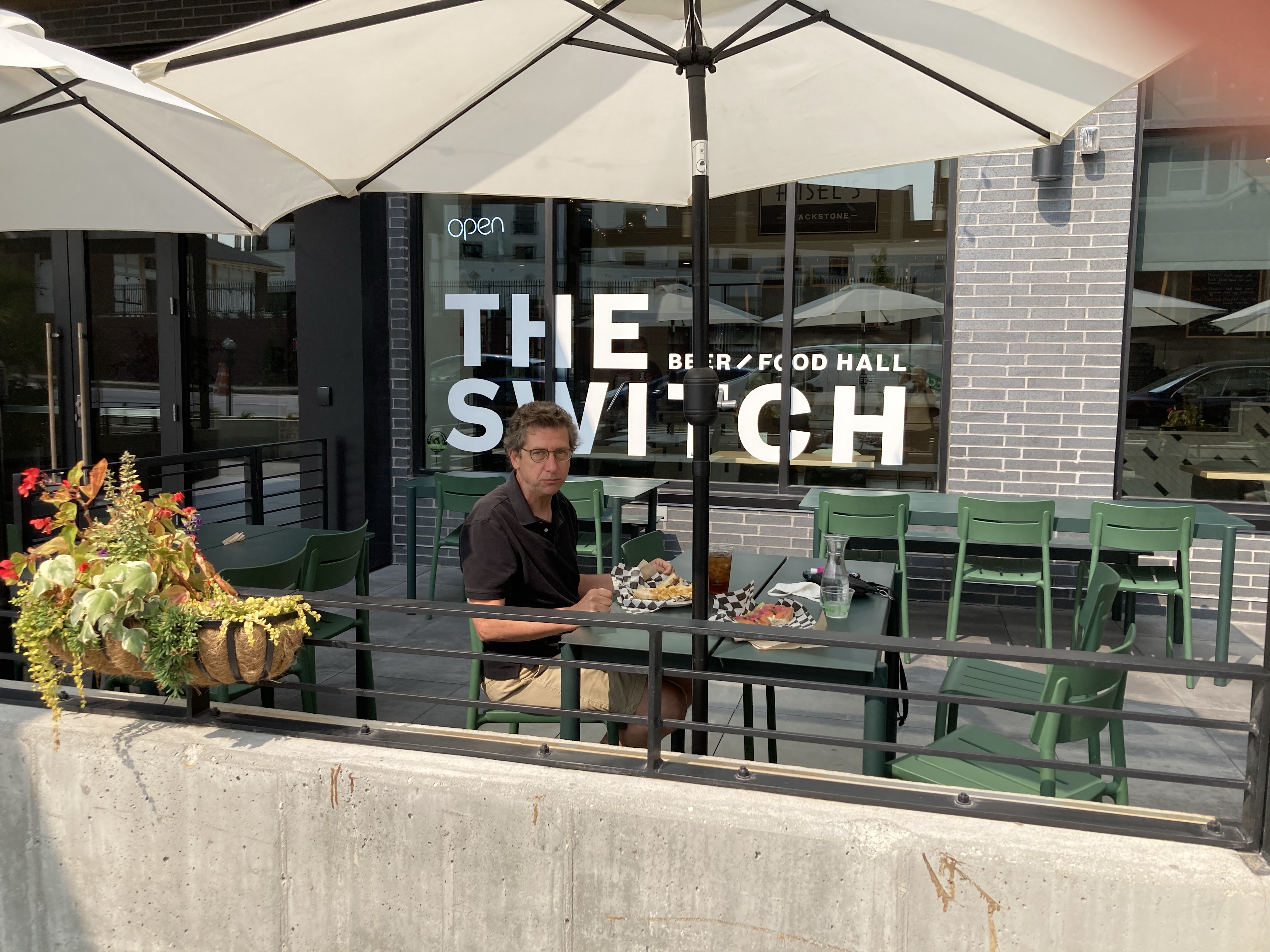 Easy drive home from Burwell, Nebraska with a few stops, starting with Fort Hartsuff, an 1880’s U.S. Army calvary outpost fort from 1974 to 1881 on the edge of town. It’s a well-preserved state historical park on the edge of the windswept Sandhills but several buildings were closed due to Covid-19 precautions. Further east in Omaha, we found even more happening in the Blackstone District since we were last there in 2018 including a new attractive food hall, The Switch Beer & Food Hall, (a clean, ultra-modern space on bottom floor of a clean, ultra-modern new high-rise) which has several good dining options (complete with outdoor seating)! We opted for the well-reviewed Ansel’s Pastrami & Bagels where we had the famed pastrami sandwich (delicious but seemed more like brisket than pastrami) and bagel with dill cream cheese and lox. Bagels are good – heavier and chewier than I’m used to but that’s fine. Next time, I’ll try the Vietnamese Street Food option. Over the Iowa line in Council Bluffs, we stopped for some Jonathan apples at Dittmar’s Orchards, which was full of families picking apples and pumpkins. (We were the only ones wearing masks…)

 TakeBetsywithyou