
As a kid driving from suburban Detroit to eastern Pennsylvania with my mom, I was excited when we first crossed the Ohio border into western Pennsylvania, only to soon discover (or remember) how long Pennsylvania is. Still, as we drive on I-80 today, decades later, I’m happy to leave the flat straight Ohio turnpike behind, in favor of a mountainous stretch of I-80 lined with trees (although preferably not driven in the rain).


Unlike Iowa I-80 rest stops which have many appealing amenities (trust me), the Ohio turnpike rest-stop west of Cleveland offered no picnic tables or outdoor spaces to eat our picnic fare, let alone with a dog. Grrr. So we ended up taking a brief detour to the small town of Milan, west of Cleveland, which we learned is the home of Thomas Edison. We didn’t see his house, that we know of, but we saw many stately wood Victorian and 19th century red brick homes.
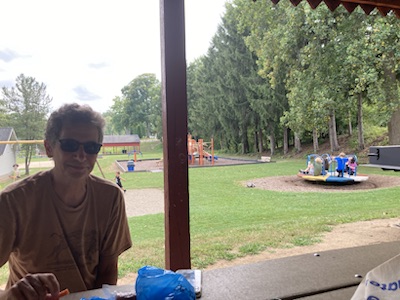
The town was packed with people attending the annual Milan Melon Days (as the street banner we drove under informed us). We found a public park with many picnic tables under a shelter, old playground equipment, and a pleasant view of a grassy slope lined with willow and pine trees. Worked.
Why does it always rain on highway 80 along the scenic but scary stretch through the mountains of western Pennsylvania? At least this trip, the rain was intermittent and Dirck was driving. (I had a much scarier ride years ago while driving solo with the kids in a downpour. Lots of trucks, curving road.)
We got lucky with a terrific dog-friendly pub (thanks Bringfido.com) m, the West End Ale Haus, in the small town of Bloomsburg, where we showed up just before the kitchen closed at 9 p.m. The server couldn’t have been nicer and the cheese burgers were perfect. We were the only diners outside on a Saturday night, with the occasional souped -up car dragging Main Street. Millie enjoyed her strawberry Greek yoghurt frozen treat.
Now we are at a somewhat grim but dog- friendly red roof inn a few miles east (Bloomsburg-Mifflinville).The woman at the front desk looked miserable and when I asked how she was doing, she said she had a headache and no Tylenol so I fished some ibuprofen out of the glove compartment for her.
No breakfast so I won’t get my on-the-road Raisin Bran fix. No carpet in our spacious but spartan room, disabled accessible, which was okay until about 1:45 am when people arrived above us in what I’m guessing was also an uncarpeted room. They sounded like a bunch of elephants dragging roller bags and rearranging the furniture for hours. Who needs sleep?

 Wish I had discovered the $3 day public transport pass earlier here. Then I wouldn’t have overdone it by walking miles and miles on Sunday. I bought a pass with cash on the St. Charles Streetcar and used it all day to wander around the city. When I got tired or when the walk to the next spot was too long, I hopped on a streetcar or bus. And I did my old trick of hopping aboard the streetcar when walking became an issue, riding all the way to the end of the line and back which is a great ride, past gorgeous stately homes and Tulane and Loyola Universities and Audubon Park and the gated streets across the street (Audubon Row).
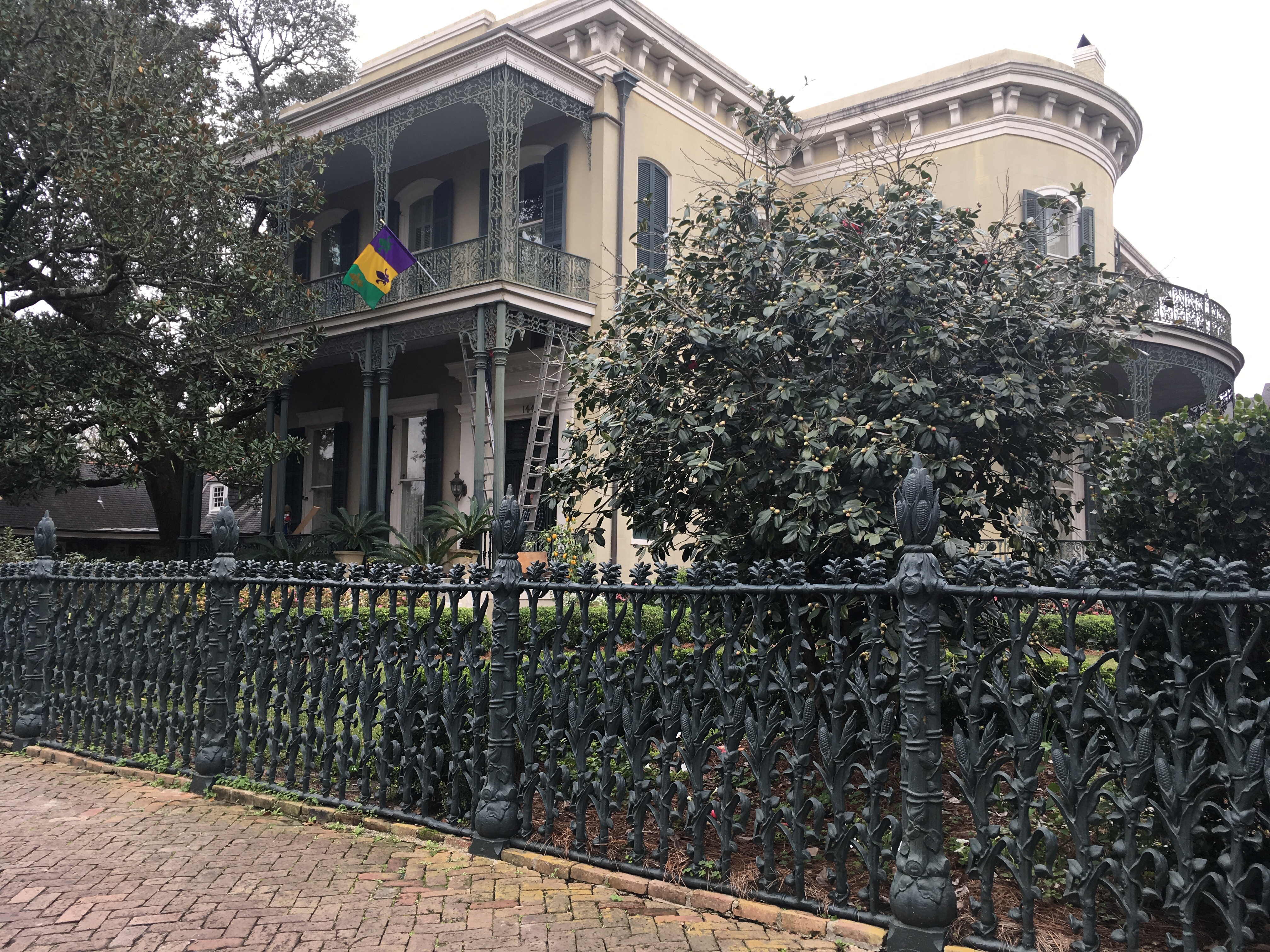
 I followed the Fodor’s walking tour in the Garden District, which took me past a number of beauties, some homes of famous folks, from the former confederate president Jefferson Davis to the actor John Goodman and the author Ann Rice. (Along Prytania and Coliseum Streets between Washington Avenue and First Street; First Street between Prytania and Camp Streets.) I also went past Lafayette Cemetery #1 which I meant to revisit (next trip) and Commanders Palace, where we ate during my first NOLA trip in the late 1980s. Lunch was a corned beef sandwich at the funky Stein’s Deli on Magazine Street, where I also did a little birthday shopping for my daughter at Grandma’s Buttons (jewelry made from old buttons) and Funky Monkey (vintage.) I really wanted to eat at Turkey and Wolf but it is closed on Tuesdays…
 I got off the streetcar in the Warehouse District, had some hot chocolate (it’s still cold here but the sun finally came out around 3 p.m. What a difference!) while sitting in a mod comfortable chair in the coffee shop of the Contemporary Arts Center and browsed briefly in the gift shop of the Ogden Museum of Southern Art (both look well worth a visit), which had some lovely work by, yes, southern artists. But the biggest shock was when I was strolling casually past the galleries nearby on Julia Street. First I spotted new work by Eric Fischl, one of my favorite big name artists. But in the next gallery I chanced upon a solo show of work by an artist I know — Elliott Green, who I went to high school with my brother and is his close friend/former NYC roomate circa the early 1980s. Crazy. And I loved his new work!


