About 10 years ago, we marked Valentine’s Day by doing something nutty — we went zip-lining high above a ravine in Boquete, Panama. Never again. Today was much better. We also went high, this time into Albuquerque’s jagged Sandia Mountains, but we were inside a large glass tram that climbed 10,378 feet to the crest, where we ate lunch, tried unsuccessfully to hike (too icy) and glided back down into the valley in our glass cocoon.
The weather was clear and not too windy, the temperature was the warmest it’s been during our stay here, low 60s, although as promised it was 20-30 degrees colder at the top of the mountain and icy snow kept us from a short hike to a CCC cabin on the ridge.At 2.7 miles in horizontal length, the Tramway is reportedly the world’s longest passenger tramway. The tram came very close to the mountain at times which took some getting used to and the guide pointed out the debris from a TWA plane crash long ago, but we could see only jagged granite and limestone peaks, dotted with ponderosa pine and oak trees, scrubby pinyon juniper, dusted with snow.
Tram viewTram arriving up top
We had a good lunch in the restaurant Ten-3 (a reference to its elevation, at 10,300 feet above sea level) at the top, an attractive contemporary space with huge picture windows offering spectacular views from on high of the valley and mountains in the distance north of ABQ — part of the 11,000 square mile panoramic view.
The food was very good in the casual restaurant. The fancier restaurant was being readied for Valentine’s night diners. The contemporary artwork, including large thickly coated oil forest landscapes by Frank Balaam turned out to be from Ventana Fine Art, a gallery we visited earlier this week in Santa Fe. (Some prints of southwest ruins, in bold unnatural colors, by Mary Silverwood that we are still considering buying were hanging in the women’s restroom).
Sandia means watermelon in Spanish, a reference to the stunning pink of the mountains at sunset.
Yes, that is a tram employee riding outside atop the tram. We don’t know why.
Always fun to wander around lovely sophisticated Santa Fe, especially on a crisp sunny day in February. We visited a few old favorites and discovered some new places to add to our list:
La Boca – a little Spanish tapas restaurant near the plaza. Excellent garlic shrimp, grilled artichoke with goat cheese, chicaronnes (deep fried chunks of pork belly), red wine sangria.
Oldest church structure in the US, ca 1610, San Miguel Church.
Ventana Fine Art, a Canyon Road gallery where we bought a painting years ago and were tempted to buy from again, this time a boldly colored red and blue print by Mary Silverwood of one of the Salinas Mission Pueblos we visited last week, south of Albuquerque. Looking at the print we realized it was the same view (minus me) of the Quarai ruin that we captured in a photo, although maybe a different time of day since the shadows differ.
A few new discoveries:
Mille Creperie – we didn’t have the crepes at this small rustic chic French place (Santa Fe is the essence of rustic chic) but the coffee, salad Nicoise, ham sandwich on baguette and hefty buttery croissant were delicious. People watching was fun too, lots of well-heeled octogenarians and young boho moms with cute kids.
Mille
Form & Concept gallery in Railyard Arts District/Guadalupe Distict (unclear of the boundaries), big bright space with eclectic collection of contemporary artwork where we met another interesting woman working with textiles, not braiding this time (as in ABQ) but sewing together pieces of vintage silk, linen and cotton clothing and table cloths to refurbish a high wire-framed sculpture outside the gallery that was set on fire by an unknown arsonist. A heap of the original burned cloth, salvaged post-fire, was not far from the artist, aka Anastazia Louise, working at her sewing machine. The replacement cloth is flame resistant. Anastazia is also a costume designer and performance artist from California, I learned here: https://vimeo.com/278524898?embedded=true&source=vimeo_logo&owner=86974487
Chocolate + cashmere —- the name drew us in but the prices kept us from indulging, as is often the case in this affluent town. Beautiful stuff though, on both fronts. We also found a rare freeparking spot in a pretty, lowkey neighborhood of adobe homes (where we think we may have stayed 35 years ago with a friend attending St. John’s college here) near Mille (water and west alameda streets) and Guadalupe church, which was unfortunately closed on a Wednesday, as was the contemporary art museum SITE. Another good free parking along one side of a small triangular pocket park at Marcy and Paseo de Peralta.
Kakawa chocolate house – with fantastic Mexican hot chocolate varieties served in pretty blue and white Mexican ceramics. There’s even a hot chocolate flight, offering tastes of several varieties, some hot in more ways than one (i.e. laced with chile.) The chocolates also come with southwest dashes, including chile and piñon. And there’s organic chocolate ice cream too. No wonder there was a line snaking almost out the door on the sunny late afternoon we visited. (much quieter mid-morning.)
San Marcos Cafe and Feed – We have passed this rustic adobe cafe and farm operation on the Turquoise Trail (highway 14) south of Santa Fe before but it wasn’t open or it wasn’t lunch time. This trip, it was both so we went inside, found a cozy atmospheric old adobe cafe with several other diners who looked more local than us. D finally got his huevos rancheros and I decided to go New Mexican too and try the blue corn enchiladas. Both good but my stomach is still rocky. Much of Madrid seemed closed on Tuesday including our favorite rug shop Serrapin and daughters. (There was a number to call to summon a salesperson. We opted not to.) South of Madrid we did drive past what appeared to be a movie set, overlooking a spectacular panorama view.
The New Mexico Museum of Art – we’ve also passed this gorgeous old adobe building off the plaza in Santa Fe several times but this was our first visit. The architecture (1917 Pueblo Revival) and art are impressive. We saw some 20th century New Mexican portraits and landscapes by artists who visited or lived in this area. There was also a temporary exhibit of 21st century protest art. (We got into the museum free with our Des Moines art center membership.)
Lovely San Miguel Church, built in 1610 by Tlaxcalan Indians “under the direction” of Franciscan padres (according to the sign out front).
If you are a fan of underdog cities and their entrepreneurs (as I am, having grown up in the Detroit area with art gallery-owning parents and having lived in places like Royal Oak, MI, Wichita , KS and Des Moines, IA, you will love Albuquerque and its Saturday morning free downtown walking architecture/history tour. Eight people showed up (including a French women living outside St. Louisand new ABQ residents from Wyoming) for a 2-hour walking tour today of a seven-block stretch of Central Ave, aka Route 66, led by two knowledgeable and engaging volunteer docents. Who knew there was so much cool history and architecture in this deserted (on a Saturday) stretch of downtown between 1st and 8th streets?
I had already noticed the multicolored decorative terra cotta facade of the KiMo Auditorium (1927) but had no idea a hotel just north of central was a gem inside, full of carved wood, Native American designs, vintage furnishings and great stories. Zsa Zsa Gabor married her second husband (of nine) in what is now the Hotel Andaluz, one of the first Hilton Hotels, started by San Antonio, NM native Conrad Hilton. Word has it you can stay in the room she and new husband Conrad Hilton stayed in their first night of their marriage (which lasted five years).
Another interesting story: apparently the hotel was the site of an infamous spy exchange involving Ethel Rosenberg’s brother David Greenglass, the atomic spy for the Soviets who worked at Los Alamos, NM, building the atomic bomb in 1944-1946. David was the one who divulged the bomb secrets but implicated his sister and brother-in-law Julius in exchange for immunity. He alleged that Ethel typed up the spy info. Ethel and Julius were executed for espionage/treason in 1953. After jail time, David was released in 1960. In 1996, he admitted to falsely implicating his sister in order to save his wife who apparently had typed up his notes. He died in 2014. What a schmuck, (excuse my Yiddish.)
In 1945, The early atomic bomb (not sure if it was “Fat Man” or “Little Boy”) was also towed through this stretch of ABQ (without any advance warning) to the Trinity Nuclear testing site near San Antonio, NM, where we were a few days ago .
inside the Hotel Andaluz
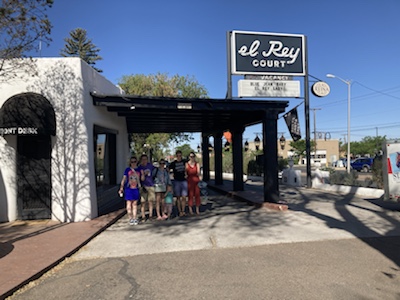
Further down the street, we stopped at the El Rey Theater built by the cousin of the Italian opera composer Giacomo Puccini, who also visited ABQ. The Puccini family built another building here (and Puccini descendants still live here) but not the stunning Occidental Life insurance building, built in 1917, clad in white terra cotta clad, and designed to mimic Venice’s Doge’s Palace.
Andaluz “curio collection by Hilton” where Zsa Zsa married husband #2 (of 9)
At the former Sears building, we learned of a young girl/aspiring shoplifter who hung out in the building past closing time, got locked inside, freaked out and set a fire, severely damaging the Sears.Another building is still home to a famous hat store, with a sign still touting its “mens hats.”
The imposing 1910 yellow brick building bears the name Rosenwald, for Jewish merchants Aron and Edward Rosenwald. It’s not clear if they are related to Chicago’s Julius Rosenwald, (1862-1932) an early Sears Company leader and doer of good deeds, including funding schools for African American kids in the Deep South. The ABQ building was designed by the same architect as the Doge’s Palace-esque building.
A Maisel building frescoArt Deco building now a holocaustmuseum
In an Art Deco storefront that now houses a tiny holocaust museum, we met Hiddekel Sara Burks, a retired Chicago nurse and veteran hair braider/“ethnic folk artist” (Singer Roberta Flack was a braiding client), who was braiding as she explained her quest to break the Guinness record for world’s longest handmade textile braid. She needs to reach 6000 feet and was at 5220. She told us various sections of the multicolored braid were an homage to various prominent African Americans including congresswoman Shirley Jackson. Her handiwork honors Black natural hairstyles (Afros, braids, locks) and aims to combat discrimination against those who sport them. (ABQ passed a measure in 2021 banning discrimination against people with natural hair styles, following LA’s measure.)
On the art and architecture front, we looked more closely at buildings that are easy to overlook but turned out to have spectacular details. The 1930s Maisel Building is the home of an iconic Indian jewelry and craft store run by built by another Jewish entrepreneur. The business recently closed, a victim of Covid. But the building has been bought, with restoration promised. Good to hear. It has spectacular frescoes on its facade by a series of young Navaho, Apache and Pueblo artists.
Going for the world record in braiding At the Maisel building, a fresco done by a protege of Frida Khalo and Diego Rivera
KiMo Auditorium remains my favorite and it was great to see it up close and personal and learn more about its history. (We had to walk around a homeless man laid out on the pavement and were told someone was en route to provide help. Homelessness is a big issue here.) KiMo is reportedly a Native American word for mountain lion/king of its kind.) The auditorium still hosts concerts but not much during Covid. It’s apparently amazing inside, which we got a taste of from the ornamentation around the outside lobby and office box which we peered in at through metal gates.
We also went to an intersection where Route 66 crossed Route 66. That’s not a typo. Apparently Route 66 through Albuquerque first went north-south but was rerouted in 1937 to east-west.
Outside lobby ornamentation of the KiMo
Now on our list (from what we learned during the tour): a visit to a hotel terrace north of Bernadillo with great sunset views of the Sandia Mountains and to the Castañedahotel inLas Vegas, NM, (closed 70 years ago, restored and reopened around 2019). It was part of a chain of architecturally impressive hotels built and operated by Fred Harvey along the route of the Atchison, Topeka & Santa Fe Railway, known as Harvey Houses.
The same restoration-minded developer also recently fixed up architect Mary Colter’s self-proclaimed masterpiece La Posada, in Winslow, Arizona. A pioneering female architect, Colter (1869-1958) designed the gorgeous ABQ train station hotel that was ignominiously knocked down in the 1970s and replaced with a less glorious replica. (Why? Why?) Colter was the chief architect and decorator for the Harvey company. Her many other impressive works include: the interior of Santa Fe’s La Fonda Hotel and The Grand Canyon’s Hopi Bright Angel lodge.
The county building and the convention centerin ABQ also apparently have great interiors full of artwork and likely an interesting history too. I also heard the city is planning a Sign Museum, which sounds great especially given all the city’s great Neon signs!
Somehow I missed really visiting Albuquerque’s Old Town during previous visits, dismissing it as too touristy and a pale imitation of Santa Fe’s old plaza area. My bad. Wandering around the small pocket of oldness dominated by a huge adobe San Felipe de Neri Church (Spanish Colonial, 1793) in the central plaza, past adobe buildings dating from 1870 to 1900, we found some touristy place but also fun shops with local crafts and goods including (thanks to a recent Travel and Leisure mag story): Tiny Grocer ABQ, a little hole-in-the-wall stuffed with local meat, jalapeño hot sauce, baked goodies, homemade soups; The silver artichoke, selling jewelry made with turquoise and a lovely orange shell from Mexico by a mother-son duo; Nizohoni Soap – run by a young woman born in the Great Navajo Nation (ship rock, NM) that sells products with resonant names such as “REZ dirt soap,” “blue corn Pollen lip scrub,” “piñon pine needle foam wash” and “Navajo Sage and Wild Rose Chi’shie Oil w/Eucalyptus”; and Back Alley Bruhas, a fun boutique with vintage and locally designed clothing, jewelry and home goods.
Old Town plaza’s church
From a historical marker in the plaza I learned that ABQ was even harder to spell in olden days: AlbuRquerque. We also wandered down one courtyard in Old Town and ended up in the sculpture garden next to the Albuquerque Museum.
The weather is warming! It was around 60 as we walked Millie around the Rio Grande Nature Center, and I mean around since we learned the center itself doesn’t allow dogs. We ended up on a nice length of the River shaded by cottonwood trees where the only other visitors were birds.
Heading north on Rio Grande (the street not the river), We found one big southwestern estate after another, huge houses set back from the street, surrounded by long fields and often a stable. Moneyland, ABQ style.
Other ABQ finds:
IkhatovBread & coffee, new Nob hill bakery, Good egg salad sandwich, Quiche, kakawa (Santa fe) hot chocolate.
Takeout brisket tacos from Casa Azule.
Fantastic special occasion meal (dirck’s belated bday, my signing with a literary agency, early Valentine’s Day at Farm and Table. Trout with crunchy flavor packed quinoa (how does that happen?); pork chop with a savory sauce, even the bread was delicious. (Discovered a good dry cider from Michigan — Rose co-op 39
Today was a road trip day. We drove 1.5 hours north from ABQ sanctuary in the interesting mountain town of Chimayo to visit the lovely old sanctuary, on the National Historic Register, dating back to the early 1800s (which we somehow missed on our first visit there a few years ago). A major Catholic shrine, it gets thousands of visitors during its annual Good Friday pilgrimage.
We also chanced upon another small adobe church, Santo Nino Chapel , circa the mid-1850s that I hadn’t visited before – devoted to the Holy Child. In a small room off the small chapel, small children’s shoes left by pilgrims line the spaces between the ceiling beams and photos of young children line the walls.
Then on to the also famous 50+ year-old Rancho De Chimayo restaurant, in an old country house set back from a winding road, the 2016 James Beard Foundation’s “America’s Classics Award” winner (awarded to locally distinctive restaurants that have withstood the test of time), with its famous New Mexican food, red spicy pork adovado, very hot red chile salsa, fluffy sopapillas served with local honey, perfect flan, prickley pear frozen lemonade, eaten in a lovely old dining room with heavy wood ceiling beams and antiques, near a fire burning in an adobe fireplace. Across the road is its hacienda/country inn, inside a century-old adobe home. We also dropped in at Ortega’s to check out the locally made woven rugs.
Kids shoes between the ceiling beams and kids photos on the walls of the Santo Nino chapel
Continuing on the famous “high road to Taos” (all the more spectacular with the mountains dusted with snow, but the winding two-lane road was thankfully snow-free), we stopped in Truchas, a farm town/artists haven where the film “Milagro Beanfield Wars” was shot, perched on the edge of a mountain looking down across another valley with distant mountains. We stopped at Hand Artes Gallery, where we bought a painting by a local years ago, located in a private home with a view of the distant peak where Georgia O’Keefe lived and painted. Good to see its still going and still has great stuff (this time, we were struck by the wood and glass handiwork of local furniture makers).
Instead of continuing to Taos to the north, we drove west about 10 miles north of Truchas, turning onto tiny winding highway 225 through Dixon to Highway 68 south, which dovetails the narrow Rio Grande, bordered by ranchland and dusty barns, with cattle grazing in brown fields. Highly recommend the drive!
Truchas (Georgia Okeefe’s mountain in distance)Rancho de Chimayo hearty fare
The weather finally warmed up – at one point it was 67 but more often in the 50s – which made a 2.5 mile hike in gorgeous Bosque del Apache wildlife refuge nearly perfect. We had the Canyon trail to ourself – being here off season has its perks – walking on a deep dirt path through a valley and into a deep canyon and then, the one tricky bit, zigzagging up the canyon on a narrow path to walk along a ridge with a spectacular view of the vast valley, with blueish mountains in the distance, then zigzagging back down. The landscape reminded us at times of the hikes we love in Tucson’s Catalina State Park, with desert vegetation, mountains, dirt trail (but no Gumby-looking saguaro cacti here).
We drove the north loop of the 14-mile scenic drive, stopping at a wide expanse of water full of migratory birds, a hotspot also for migratory birdwatchers. We watched as egrets and ducks dawdled in the water and stunning snow geese, white with black-tipped wings, took flight and soared over the marsh’s orange and red tall grasses, set against a blue sky.
In tiny San Antonio, we had our pick of two bars famous for green chile burgers, both with outdoor dining, which we needed with our dog in tow and to a lesser extent with Covid still in the air. We went with the Owl Bar and café, a no nonsense tan adobe building outside, a fantastic old-style bar inside with red leather booths, a long bar decorated with memorabilia and knickknacks, dollar bills donated by patrons (eventually going to charity) tacked up on the walls with handwritten notes in the booths. The burger was fantastic, as were the crispy fries and onion rings.
Odd fun fact: this dusty one (flashing) stoplight town with a handful of worn homes on dirt streets is the home of Conrad Hilton (grandfather of Paris) who in 1919 went on to found the Hilton Hotel chain (and marry Zsa zsa Gabor). Word has it as a young lad, Conrad would walk, rain or shine, from his dad’s mercantile shop (which burned down but its bar was spared and is now part of the Owl Bar) to the tiny train depot and carry passengers luggage to their hotel rooms.
Green Chile cheeseburgers with a viewOwl Bar and Cafe
The ruins of three pueblo missions scattered within a 30-mile or so radius of each other around Mountainair, NMwere particularly stunning on a crisp sunny day with white snow blending with yellow scrubland, a blend of colors that reminded me of lemon meringue pie. Visiting the Salinas Pueblo Missions National Monument in the Rio Grande Valley on a Monday in February also meant we had the ruins amongst entirely to ourselves. There was one other visitor at each of the two ruins sites we visited. (The visit is free of charge.)
We started at the visitors center in Mountainair, a small very quiet town in the middle of nowhere (with the best name ever!), where the helpful guide told us that the Gran Quivira site is her favorite (she loves the white stone and that it’s situated high on a mesa) but the fan favorite is the Quarai site, a more intact and massive red-walled structure, formerly a Spanish church. So we visited both, driving south 25 miles to the Gran Quivira, which rises seemingly out of nowhere but was once a thriving trading Native American center, hundreds of years ago. We ended up skipping the third site, Abo. The sites were thriving pueblos before Spaniards (conquering explorers and priests) arrived in the late 1500s and early 1600s and built their churches, among other intrusions. Our site brochure refers to the early inquisitors as “compassionate men,” contrary to the Inquisition’s deservedly bad reputation.
I can see why the Quarai site is so popular. Set against a stunning blue sky, with the added rare bonus of white snow, the place dazzled. Standing inside its former church, surrounded by high red stone walls in a huge courtyard, my mind wandered to memories of similar spaces…ruins in Peru and Cambodia, crumbling castles in rural Wales and Ireland, walled Tuscan cities in Italy.
Yet “Salinas” has a distinctly Southwest U.S. feel, thanks to the mountain landscape, high desert vegetation and light. (I’ve become a fan of juniper trees, especially their fresh almost minty smell. Juniper perfume anyone? Or maybe just a juniper candle or sachet?) Beyond the church (which looks more like a fortress), are the much lower, crumbled remnants of a village with round kivas and courtyard gathering places as well as small living quarters.
Because we were with dog, we couldn’t eat at the atmospheric old hotel in Mountainair but we found good sandwiches made to order in the deli at the back of the grocery store. I love visiting local grocery stores in these kinds of places! It’s a great way to get a feel for what life is like, what people eat, where they gather. I found some good homemake baked goods (blue corn muffins!) and local products (I brought a mesh bag of local dried pinto beans. Now I need to figure out what to do with them.)
“Salinas” is about a 90 minute drive south of Albuquerque, on very scenic two-land highways through the countryside. We drive through s few very battered small towns en route, one (Manzano) with a dazzling 1800s adobe church with what looked like fantastic stained glass windows. The Roots Farm Cafe in Tijeras, just outside ABQ, was closed because it was a Monday but looked as good as the write up I read in a the New Mexico visitors guide. next time!
Ok, not sure how to get back there. I am by the end of the dryer, heading to fridge.
To people who have visited Meow Wolf, this text exchange will make sense. (It makes me laugh.) Otherwise, probably not. But where else can you open a clothes dryer, slide in and down, ending up in an alternative world? Or open a refrigerator, walk right in and through, entering another portal into to a fantasy land.
Opened in 2016, Meow Wolf Santa Fe (there are newer knockoffs in Denver and Las Vegas) boasts 70 rooms of “immersive art” from a psychedelic cave to a moonscape, haunted forests, a fantastical treehouse, anime alcove, video light show and so much more, excess being a key aesthetic — created by Santa Fe artists, who must have very strange dreams at night? (And I likely will tonight too.)
It’s a crazy, trippy place, in a former bowling alley on the edge of Santa Fe, a so-called immersive art experience, with no prescribed course. You wander wherever strikes your fancy, through tiny alcoves with psychedelic art and light and sound shows, up and down narrow staircases, along curving passageways.
See you on the other side, whatever that is.There goes Dirck, into the dryer.
What I liked most was the sense of entering an alternative universe at every turn. You walk into an old-fashioned, conventional two-story haunted house (aka House of Eternal Return) but you can leave at any moment. Crawl through the living room fireplace or walk through a clothes closet or slide down the dryer or pass though the refrigerator and you are in a strange fantasy land, each portal leading you to yet another bizarre scape. And tantalizing you with views of other environs to explore below and above, if you can only figure out how to get there. For Game of Thrones fans, yes there is a connection to Meow Wolf. Thrones author George R.R. Martin, who lives in Santa Fe, helped this fantasy land take flight. Perfect fit.
We had a far more conventional experience dining at La Choza, which has delicious Mexican and New Mexican food including my favorite new mocktail made with grapefruit juice.
Casa San Ysidro was not entirely an indoor activity, as preferred due to lingering cold and snow. The restored 19th century adobe residence along a quiet dirt road, in a rustically chic village about 20 miles north of Albuquerque, has a lovely interior outdoor courtyard (or plaza) and a rear walled-in yard with stables, workers’ lodgings, a three-hole outhouse (not sure how that works) and a small livestock pen. The “territorial Period Greek revival rancho” from the area’s Spanish colonial past, circa 1875, is owned by the Albuquerque Museum which offers twice a day tours. We were joined by a couple visiting from Maine on a low-key tour by a former teacher who is a docent that took us inside the thick adobe walls into rugged atmospheric rooms with low-ceilings made of thick wood beams and cross planks, with period furnishings, Mexican pottery, cut and stamped tin wall hangings, New Mexican photos, portraits, and art. Well worth a visit.
At a nearby coffee shop, one of several enticing small businesses lining the two lane road through the quiet, well-heeled, village of Coralles, we found beautiful watercolor prints of dusty wildflowers painted by ABQ native (now in Nashville) Sheallean Louis and local pottery — natural cream-colored stoneware — from Hansellman Pottery, which is made a block away. We promptly visited and bought a few gifts, in an unusual self-serve manner.
Wandering along backroads, avoiding interstate 25, we ended up driving through Rio Rancho, with many large contemporary adobe homes in the shadow of the snow-dusted , pinkish brown-grey (depending on the time of day/light) Sandia Mountains, and then to Bernadillo, where we chanced upon the original Range Cafe, with rustic southwest decor, good New Mexican fare and pies, and walls lined with locally-inspired artwork. A host did let slip that the cafe is short-staffed due to sickness. “Covid,” I half-asked, half-stated. “I’m not at liberty to say,” she replied with a near wink.
It was a reminder of the still in-process pandemic, which we’d almost forgotten. As If. We were seated far from other diners and wore masks until eating. (Unlike Iowa, New Mexico has a mask mandate for businesses.THANK YOU!) We’ve decided to brave a few restaurants this trip but not without taking precautions and our government-provided Covid test arrived in the mail today.
Snow. Blowing snow. Bitter cold. Is this Iowa? No it’s New Mexico. At least it’s very pretty and the low temperature in Albuquerque today was the high temp in Des Moines. We shelved any hiking and looked for indoor activities. The Albuquerque Museum fit the bill, an airy contemporary building with an appealingly eclectic collection of New Mexican contemporary art and a new show on Indigo Textiles from around the world, something I fell for hard when we visited Kyoto, Japan awhile back. And during Covid 2021 I took a Zoom class in Shibori Indigo tie dying from the Des Moines art center. The Albuquerque show features textiles from Asia, South America, the U.S., vintage and contemporary, utilitarian and artwork. I loved a collection of giant-sized indigo-dyed costumes on display, accompanied by a video of the costumes worn by men on stilts, who danced and pranced in Brooklyn’s Bushwick neighborhood. The locals’ expressions: priceless.
“Our house” in ABQIndigo!
Back in the Sawmill District, we wandered around Spur Line Supply Co., a cavernous high-design space with cool furniture, home goods, clothing, paper products, some local, by New Mexicans, but others by small batch makers elsewhere, including Des Moines’ Moglea, a letterpress studio that makes irresistible handmade notebooks, stationary and cards. (The ABQ museum gift shop also sold Moglea notebooks. Who knew?)
Spur Line
Lunch was at Vinaigrette (which has a mean vegan mushroom stew/soup…fyi, my dear reader Charlotte) to celebrate Dirck’s 65th birthday. We were supposed to have dinner with dirck’s sibs at Farm and Table but we got snowed out. There’s not much snow by midwestern standards. A few inches. But the roads are slick with ice and the cold wind is harsh.