whither The Carmelcorn Shop in Easton PA? It’s alive!

I STAND CORRECTED. The Carmelcorn Shop LIVES! My friend C. reported that it was closed when she dropped by but is open otherwise. Phew!

C.  emailed me this photo of  the candy shop that I loved to go to as a kid when I visited my Grandma in Easton, Pa.  C. was in town on a college visit to Lafayette College.  She also reports that Jimmy’s Hot dogs  – another Easton hot spot – is still around. Last time I was in Easton, a few years ago, it had survived but was no longer across the Delaware in P-burg N.J. but in a strip mall in Easton. Not quite the same atmosphere but good dogs still!

1 Comment

Filed under Pennsylvania2

Antiques in eastern Iowa!

Squiers Manor Bed & B

Newly married and new to Iowa (way back in 1990), we used some of our wedding gift money to buy some furniture at Banowetz Antiques in Maquoketa, Iowa. We still use the chair, end tables, dresser and dining room dresser, which have not only added character to our home but proved very functional. (They must have made stuff well 100 years or so ago.) So the news that Banowetz is not going out of business – as I’d once heard – is good. They’re having a “grand re-opening sale” at their new location at 123 McKinsey Drive in Maquoketa april 14-29. If you want to stay overnight, check out the Squiers Manor B&B, a gorgeous place the Banowetz family operates in town that,yes, is full of antiques. And it is Squiers (named after J.E. Squiers who built the brick Queen Anne style mansion in 1882.)

Leave a comment

Filed under antiques, Iowa

from the Caipirinha to the Pisco, Brazil to Peru!

Andy Isaacson for The New York Times

From left, a pisco cocktail with golden berry at Huaringas Bar, a Chilcano at Maras in the Westin hotel and El Verdecito, front, at Cala.

My husband came home from a business trip to Brazil a few years ago raving about the Caipirinha rina – a Brazilian cocktail  that’s sort of like a very potent limeade (He brought home sugar can rum so he could mix it with sugar and lime to make us caipirinhas at a neightborhood gathering in Des Moines)  Now comes word from the NYTimes that we’ll have to try the Pisco – the Peruvian national cocktail when we’re in Lima visiting our son next fall when he is studying there.

We’re game! (Here’s the NYT story that ran in today’s travel section.)

Andy Isaacson for The New York Times

Cala, a beachfront spot.

Pisco has been made in the dry coastal valleys of southern Peru since at least the early 17th century, and has become inextricably linked to the country’s identity. The spirit must be served at Peruvian diplomatic functions around the world. The national drink, the pisco sour, is an indigenous marriage of pisco, the distinctive Peruvian lime, egg white and bitters derived from the bark of a Peruvian tree. (It even has its own national day of celebration.)

As Peru’s fortunes have gone, so have those of pisco, reaching a golden age during the flush mineral boom of the late 19th century, when an influx of Italians introduced refined winemaking techniques. In Lima’s bars, pisco flowed copiously back then, though it was Chile that first established the spirit as a denomination of origin in 1931, staking a marketing claim. (Chilean pisco is an altogether different product, with different ingredients and processes that yield a different flavor.) Bleak times followed: amid Socialist land reforms and often violent political conflicts that plagued Peru for most of the last century, the quality and reputation of pisco sank. Limeños defected to foreign whiskey and vodka — anything but pisco, then considered the tipple of old-timers and drunks.

In the last few years, though, as Peru’s circumstances have reversed, dedicated pisqueros are now producing excellent piscos, and the mixology renaissance that has touched many of the world’s cities has also landed in Lima’s bars. Here are four spots in the capital city that, in their own distinctive way, reflect how Peruvians have rediscovered their native spirit.

Cala

On a recent late Friday afternoon, this swank beachfront spot felt like Malibu: from a back patio suspended over the sand, well-tanned patrons sipped cocktails in view of surfers. The cocktails in hand are the creations of Enrique Vidarte, widely considered the city’s most inventive pisco mixologist. His well-balanced concoctions are a perfect showcase for the different pisco varietals: El Verdecito, a delicious green slurried cocktail served in a margarita glass, blends pisco Italia, with a bright citrus and sweet floral nose, together with mint leaves, sugar and Peruvian lime juice (22 nuevos soles, or $8 at 2.73 nuevos soles to the dollar).

The 42 cocktails on Mr. Vidarte’s menu are mostly his own, but there are a few classics, like the Capitán. A dry mix of pisco and red vermouth (the drink’s white and red stripes conjure a Peruvian naval captain’s insignia) and amaretto, the drink is a throwback to the spirited scene of the 1920s at Lima’s Gran Hotel Bolivar, where it was popularized — some believe in response to the drought of American whiskey during Prohibition.

Cala, Avenida Circuito Vial Costa Verde; Playa Barranquito; Espigón B2; Barranco; (51-1) 252-9187; calarestaurante.com.

Bar Inglés, Country Club Lima Hotel

No Peruvian cocktail is more classic than the pisco sour. Invented, paradoxically, by an expat Mormon from Utah named Victor Morris, the recipe was canonized in the 1930s at the Hotel Maury in Lima. These days, the Maury serves a warm, overly sweet version to tourists who don’t know it is not the real thing.

For that, I headed to Bar Inglés, a wood-paneled retreat inside the grand Country Club Lima Hotel, where the drink (26 nuevos soles) is mixed by Roberto Meléndez, and is a direct transmission of the original. (Mr. Meléndez’s father worked at Hotel Maury in the 1940s.)

Mr. Meléndez reached for Pisco Qollqe, one of the new-wave artisanal brands, and measured out a precise ratio: four parts pisco to one part lime, one part simple syrup and an egg white. Shaken and poured into a chilled wine glass, it ended up with a lovely topping of foam. He also added a few drops of bitters for fragrance.

“This,” he said with confidence, “is the same pisco sour that was served at the Hotel Maury.”

Bar Inglés, Los Eucaliptos 590; San Isidro; (51-1) 611-9000; hotelcountry.com.

Mayta

Leave a comment

Filed under Peru

getting from Newark Airport to Manhattan’s upper west side

Time to contemplate for real getting from Newark Airport to Manhattan’s upper west side since I’m going there next Thursday and it still looks like the Air Train is the best bet in terms of speed and price although I’m tempted to try the shuttle bus option on the way back to the airport. No way I’m paying $50-70 for a taxi.

Here’s what I picked off of, about.com (i think):

  • Air Train: The Air Train offers connecting service to NJ Transit and Amtrak trains which will bring you into Manhattan. Surprisingly, this can actually be much quicker than taking a cab or bus, and it is much more affordable. $11.55 one way will bring you from Newark Airport to Penn Station. AirTrain connects the NJ Transit “Newark Airport Station” to the airport terminals. Consult the schedule to determine the schedule of connecting trains. Service is available from 5 a.m. until 2 a.m.
  • Private Shuttles: Several companies offer shuttles to Manhattan, including:
    • Newark Liberty Airport Express : Available from 4 a.m. – 1 a.m., these shuttles leave every 15-30 minutes for midtown Manhattan and every 2 hours to downtown Manhattan (from 11:30 a.m. – 5:30 p.m.). One-way fare is $13, but you can save by buying round-trip tickets, as they are $22. One free child under 16 is included in the fare. You can choose to disembark at Grand Central, Port Authority or Penn Station, in addition to midtown hotels. The ride takes about an hour. Return schedules and more information are available on their website.
    • Super Shuttle: Available 24 hours a day, this shuttle provides door to door service for your party. Fares are $15 – $19, depending on destination. No reservations are required to get from the airport to your destination, but they are required for your return trip to the airport. Consult their website or call 1-800-258-3826 for more information. Book your SuperShuttle Transfer through Viator.

2 Comments

Filed under New York City

Archie Bunker’s chair! Ben Franklin’s Walking stick! American Stories exhibit at D.C.’s Smithsonian!

Fairmount Fire Company volunteer firefighting outfit

One of the more entertaining ways to soak in history is to study the history of things – so a new Smithsonian exhibit that presents history through a timeline of artifacts, including pop culture junk,  is right up my alley. The National Museum of American History’s new exhibit includes over 100 “iconic items” dating back to the Pilgrim’s arrival in 1620 (iconic item #1: a piece of Plymouth Rock.). Other items include a slave ship manifest, Dorothy’s ruby slippers from the “Wizard of Oz”,  and a Barack Obama campaign button written in Hebrew. (Hey, I have a Bill Clinton campaign button written in Hebrew!) There’s also a mobile app for the exhibit with more info on each object – in English and our new second U.S. language, Spanish. The exhibit is called American Stories and to see more of what’s in it (including the hat above) see: http://66.147.244.104/~amerifl5/americanstories/

I’ll be in DC in June and this is definitely on my list! I remember an exhibit at the Iowa State Historical Museum that took a similar approach to the sixties – that made me feel a bit like an relic myself as I pointed out to my then-little kids such once-familiar items as “hot pants.”

Leave a comment

Filed under Washington D.C.

a longtime fan of Iowa’s Loess Hills

While I’m at it, here’s a travel story I wrote about the Loess Hills many years ago for the DMRegister.

Loess Hills Loess Hills, Iowa (Sylvan Runkel Preserve)

A new observation area offers a glorious panoramic view of the short, soft hills.

By BETSY RUBINER
9/4/1997

Moorhead, Ia. – Talk about a deck with a view.

If you’re looking for a new way to take in a beautiful expanse of Iowa’s Loess Hills, check out the huge observation deck recently built near Preparation Canyon State Park, off Highway 183 between the small towns of Pisgah and Moorhead.

Several times the size of your average suburban back-yard number, this simple wooden deck sits on a hilltop overlook long known to locals as “The Spot.”

For good reason.

The spot offers a glorious panoramic view of the short, soft hills that are considered a geographical wonder. A narrow band of mini-mountains stretching from just north of Sioux City south to the Missouri border, the Loess Hills were fashioned from silt deposits or “loess” blown in from the Missouri River floodplain more than 14,000 years ago.

To find another area like it, you’d have to make a much longer trek – to China’s Yellow River.

Before the observation deck was built this spring, locals “used to just crawl up on top of the hill and sit there,” says 41-year Moorhead resident Pat Severson.

For good reason.

The spot marks the convergence of five different ridges. On high, the land seems to stretch forever, free of the stain of civilization. Sure, to the west, farms dot the Missouri Valley flatlands. But it’s still easy to pretend you’re all alone with the birds.

The deck extends outward, offering the kind of aerial view you get flying in a plane over Iowa. Looking down, you see a bumpy quilt, with alternating patches of lush green woods and grassy fields.

Getting to “The Spot” is half the fun. Driving south from Moorhead on Highway 183, you turn right on a road still described by locals as “the second right” even though it now sports a sign designating it as 314th Street (for the edification of the emergency medical service).

At the top of the hill, you jog to the right. (If you go left, you’re in the 344-acre Preparation Canyon State Park, the site of an 19th century Mormon settlement that’s now popular for hiking and picnics.) Soon after, you take another right onto a gravel road marked as Oak Avenue.

This puts you pretty much in the middle of nowhere.

But what ho! It’s a really big deck!

If you’re lucky – and chances are you will be – you’ll be the only one there. It’s so quiet you can hear the wind.

The deck is also wheelchair accessible, thanks to a long wide ramp winding up to it. There are also several benches on the deck from which to contemplate the view.

This spot really isn’t that hard to find but it’s wise to have more than a few gallons of gas in your tank when touring the Loess Hills. You may want to call the visitor’s center in Moorhead, in advance, to get a map of the area or drop by for one.

The map plots out several scenic loops through the Loess Hills; offers tips on highways most suitable for bicycles and cars; and marks Loess Hill attractions, large and small, from the De Soto National Wildlife Refuge to an abandoned country school.

Diligently detailed, the map also comes in handy for the adventurous traveler who likes to get lost. Plenty of remote roads winding through and around the Loess Hills will give you that impression. But just when you think you’re lost, you’ll come to an intersection – complete with street signs – and discover you’re not lost at all.

What ho! You’re at the corner of Olive Avenue and 235th Street. And there it is on the map.

2 Comments

Filed under Iowa

Iowa Loess Hills Prairie Seminar – one-of-a-kind seminar in a one-of-a-kind place

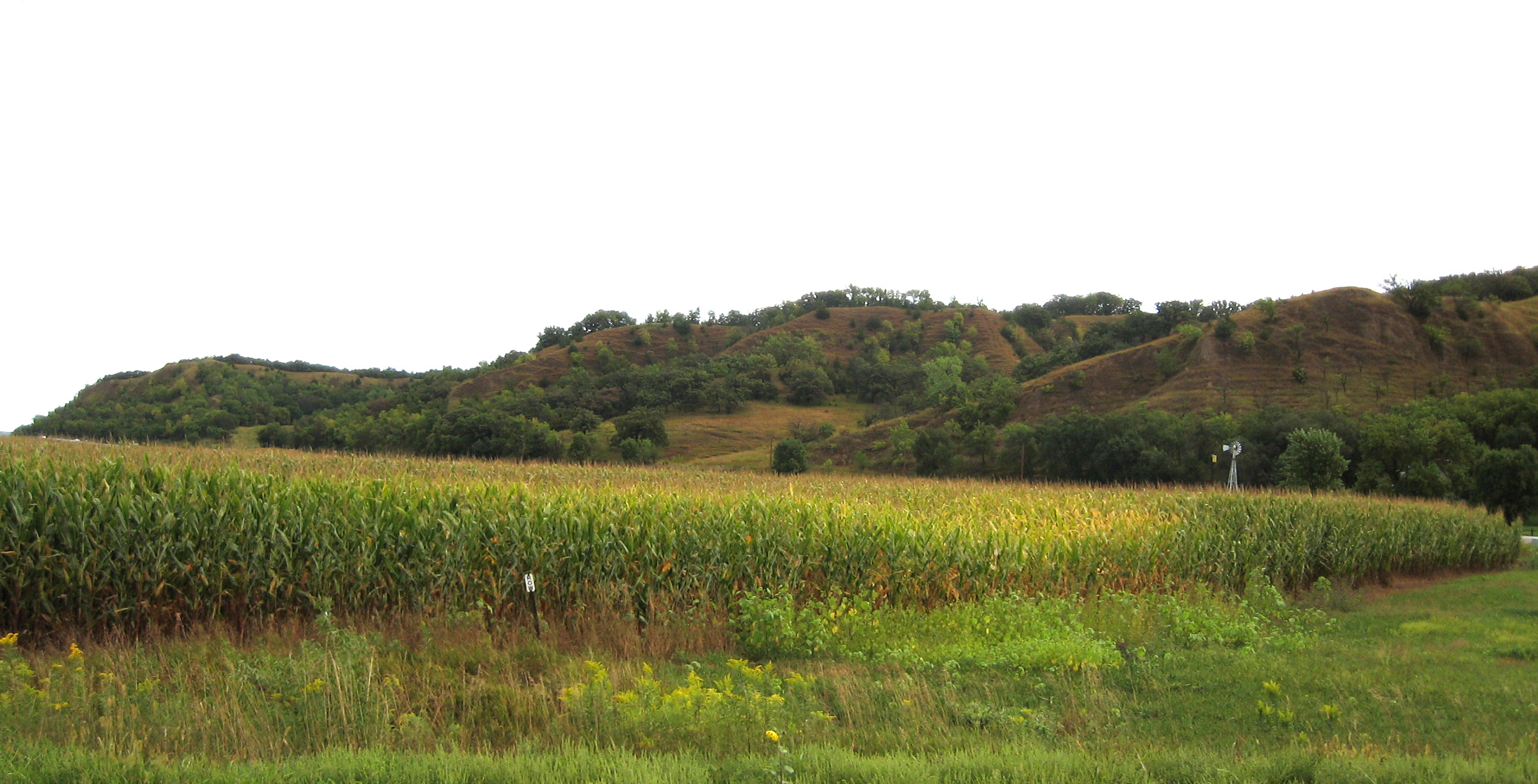
File:Loess hills.jpg

Okay there is one other place like Iowa’s Loess Hills but it’s far away in China. Considered a geographical wonder, the hills are a narrow band of mini-mountains stretching from just north of Sioux City south to the Missouri border, fashioned from silt deposits or “loess” blown in from the Missouri River floodplain more than 14,000 years ago.

We took our kids when they were little to the Loess Hills Prairie Seminar in western Iowa with two other families and it was, to say the least, memorable – we learned how to cook on an open fire, all about the flora, fauna and animals of the prairie, how to search for fossils. We camped, we ate a church supper in town and at a cookout under the stars.  One parent and several kids even got lost for a few hours while on a hike! Very glad to see the seminar is still up and running. Word has it there’s a Missouri River Ecology boat tour, which sounds pretty cool. For info about the 2012 seminar  and to register visit the Programs and Services section of the Northwest AEA website at:

Leave a comment

Filed under Iowa

Roanoke Island in Outer banks – maybe it’s fate?

So when I googled “quaint, historic, duck, outer banks” (or something like that) to find a place to stay with our English friends, google sent me to some sweet cottages in Manteo on Roanoke Island, which as fate would have it turns out to be  the site of The Lost Colony –  a 16th century colony of 117 Brits that disappeared mysteriously. So perhaps this is the perfect place to visit with our British friends (a little re-colonizing perhaps) or not?

Leave a comment

Filed under North Carolina, Uncategorized

Contemplating a fall trip to North Carolina’s Outer Banks: initial pros/cons

A pal from London is attending a conference in early October in Baltimore and I promised to meet her for a road trip. One early option – visiting the Outer Banks, which I’ve never been to – and long wanted to see. After some initial scrutiny of maps, airline websites and guidebooks, here are my initial pros and cons:

PROS:

  • – Fall is ideal for a visit to the Outer Banks, especially since the summer gets so crowded. The weather and even the water, often, remains warm in late Sept/early October. (see hurricanes below under CONS)
  • – There appear to be lots of good options for renting a cottage or staying at a b&b for a few days (if not a full week) – which would be good if our spouses join us.
  • –  Gorgeous seashore (175-mile ribbon of sandy islands plus national seashore with sand dunes and old lighthouses) , lots of history (including English history, plus hiding place of the everyone’s favorite pirate, Blackbeard, where the Wright brothers learned to fly and site of many shipwrecks – hence its reputation as “the graveyard of the Atlantic), quaint fishing villages, stunning beaches, things to do/see and places to eat (Carolina BBQ for the meat-eaters among us. local seafood – clam chowder, crab cakes, deep-fried hush puppies.)
  • – About that English history: Near the Outer Banks on Roanoke Island is the site of Sir Walter Raleigh’s “lost colony.”  In 1585, this was England’s first permanent foothold in the “New World” – a colony of over 100 Brits (men, women, kids). This was the location of the birth of the first child of English parents on what later became U.S. soil. The colonists appeared to disappear and history vague on details although there’s some talk of a horrific drought. (More reading advised.)

CONS:

  • – The Outer Banks are a bit of a pain to get to (which is of course, part of their attraction) and pricey to get to. The nearest airport is Norfolk, Va. which is expensive to fly to from here in Des Moines and not so easy from Baltimore (it appears that a connecting flight is necessary) – haven’t check into London. Even when you get to Norfolk the Outer Banks are still 80 miles away. Nor does there appear to be train service from Baltimore to anywhere near the Outer Banks (although I have not done exhaustive research on this.)
  • So the best bet appears to be: for me to fly from Des Moines to Washington (much cheaper than flying to Baltimore) and we meet up either in DC or Baltimore and drive – about 5/6 hours. Long, especially by English standards, but we’ve survived these drives before (including a five hour drive from London to the Lake District with five kids in tow.)
  • – The possibility of hurricanes

HOTSPOTS:

  • – Duck, Cape Hatteras National Seashore, Ocracoke Island, Beaufort (Kitty Hawk to Nags Head sound overdeveloped), Nags Head architecture tours of old beach cottages;
  • – Edenton (nearby colonial waterfront town
  • WHERE TO STAY:
  • When I looked for oceanfront rentals, I found large modern beach houses – some very pricey. When I looked up “quaint cottage duck north carolina) I found some sweet looking cottages including http://www.vrbo.com/334384#rates (Midgett House in Old Town Manteo on Historic Roanoke Island)
    Neva Midgett House corner of Uppowac and Budleigh
    Neva Midgett House corner of Uppowac and Budleigh – Manteo, North Carolina Vacation Home Near Restaurants and Shops
  • Duck b&B: Advice 5 cents. (strange name, I know) wwwadvice5.com; Cottage rentals in Duck: sun realty, Carolina designs realty, duck’s real estate (www.outerbanksrentals.com) http://www.twiddy.com

1 Comment

Filed under North Carolina

Another sight to see when in Bentonville Arkansas

So this isn’t technically open for tourists in Bentonville, but the house owned by the director of Crystal Bridges – the new museum of American art founded by a Walton heiress – sounds definitely worth a drive-by, if I can find it when we visit Bentonville in late May.  There’s a story about the house in the April 1st  NYTimes’ Sunday T Magazine and it looks fantastic – a glass and limestone-brick home designed in 1954 by Cecil Stanfield, the same “Modernist” architect, the Times reports,  who gave a “Jetsons”-esque touch to Oral Roberts University in Tulsa (which I’ve visited twice – when Oral was holed up in his “prayer tower” during the late 1980s. Wonder if the architect designed the tower – or the strange sculpture of giant clasped hands nearby on the campus).

Leave a comment

Filed under Arkansas