
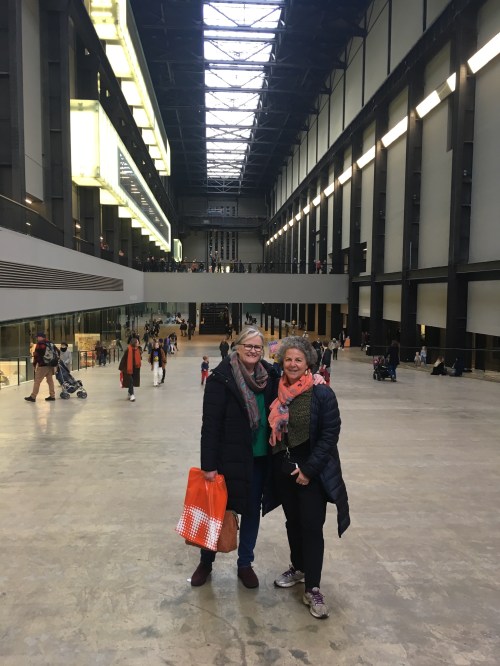
 I met another friend of 39 years, Jemima, who came all the way from her home in the northern town of Ludlow to meet up, for the first time in about four years. What a treat! She suggested an exhibit of work by Pierre Bonnard at the Tate Modern, one of my favorite London “it” spots. The exhibit itself turned out to be stunning (Go! Go!)

South Bank was packed with people, many speaking languages other than English, strolling along the Thames on a sunny day with a brisk wind. Such a buzzy place. London seems so vibrant, healthier than ever and yet Brexit looms, creating an odd sense of doom.
We had a good lunch at Zizzi, a chain Italian restaurant with surprisingly good food that, even more surprisingly, arrived at our table very quickly and still tasted good. (We shared pizza and a salad.) We also had a really nice view of the Thames and all the hubbub along the South Bank.
 on Saturday night, Francine, Russ and I had highly unusual vegan and veggie Brazilian food at Oliveira in East Sheen. We are now back on Shalstone road where Russ is engrossed in a chess channel on YouTube that he swears by (Power Play Chess, should you be so inclined.)
On my last day in London, Francine, Russ and I had a nice brunch (English breakfast for Francine and I) at Cote restaurant in the pretty Richmond village of Barnes and then were blown by an intense wind along the Thames path, back to Mortlake.
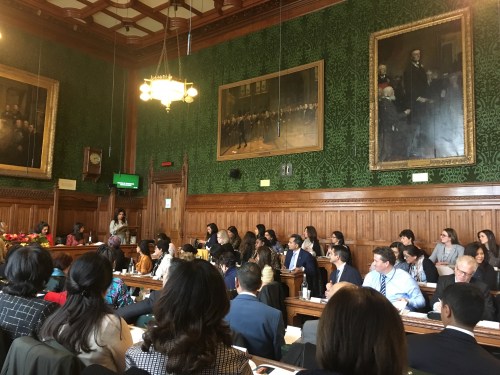
 Francine and I met 39 years ago when we were both working for Labour MPs in The House of Commons. Today we returned for a program marking International Women’s Day, featuring 25 people – most black, Asian and minority ethnic (BAME) women speaking in an elegant Commons meeting room on topics ranging from youth violence to sexual slavery to increasing minotity women participation in science, business and artificial intelligence.
 We drank tea and ate finger sandwiches, scones and macaroons afterwards at a reception in the House of Lords, overlooking the balcony and Thames on a rainy afternoon. Francine managed to get us back over to the House of Commons, through back hallways and we sweet-talked the nice guards into letting us join some other tourists inside the H of Commons chamber, which looked even smaller and more compact than I remembered. We walked through the glorious 12th century Westminster Hall, bits of it under repair. (Big Ben is completely shrouded in scaffolding.)
 Continuing on our sentimental journey, we walked up Whitehall, past Downing Street and other imposing government buildings to Trafalgar Square and then Covent Garden, where I bought a rain hat (like my friend Una’s, which I borrowed in Dover) from Barbour (quintessential British) and tried on some shoes at one of three Allbirds stores in the world. Then we walked in the dark and drizzle through the crowds and past the shops in Covent Garden to embankment (Gordon’s wine bar, an old favorite, had an overflow crowd) and over the bridge to South Bank and the train from Waterloo back to Mortlake where we had Indian takeaway with Russ. Ahhh London….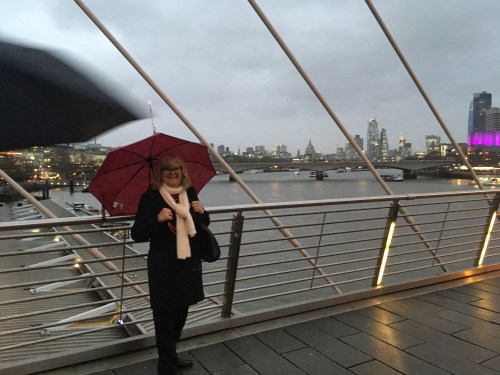
 We learned the hard way that you can’t pay cash to ride a bus, nor if you are American are you likely to be able to pay with your credit or debit card. (It’s missing some sort of chip that British cards have…and I don’t mean “the chip” of “chip and pin” which American credit cards now have.) We also learned that I can’t simply use my Oyster card twice on a bus to get a ride for myself and a friend (unlike in, say, NYC, where you can swipe your metro transit card twice or however many times needed to get your entire party through the turnstiles.)
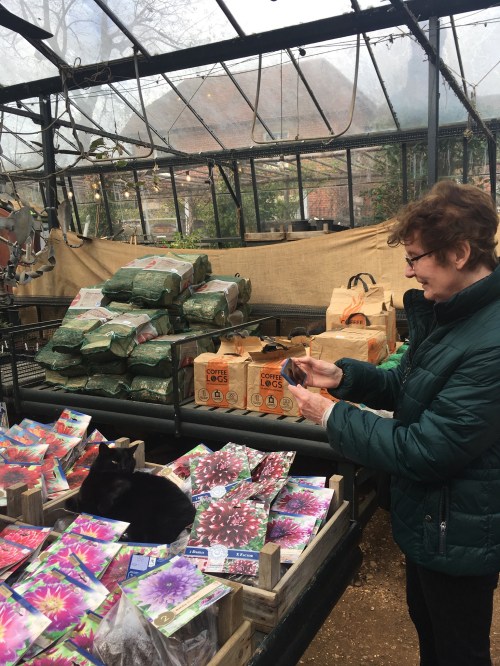
 We did finally make it to the sweet rustic cafe at Petersham Nurseries, where we learned (the hard way) that it doesn’t serve a proper English breakfast, as hoped, but we did have a nice flat white coffee and another scone with clotted cream and strawberry jam, surrounded by glorious flowers (hydrangea, camellia, daffodils) in bloom.
 Emerging from the Thames Path onto Kew Green, we stumbled into the nearest pub, The Cricketers, which turned out to be a winner. We had big glasses of hard cider, my pate and bread sufficed and we all enjoyed an “Eton Mess,” whipped cream with strawberries, bits of meringue and shortbread.
 Marion, Merida and I are bunking in a lovely Airbnb on Sandycombe Road in Kew, a pretty village in the London Borough of Richmond. Our friend Pam, who lives nearby, picked us up in her sweet little Fiat 500 and drove us around Richmond, where we stopped for coffee at the pleasant Richmond Hill Bakery, up the street from a glorious view from on high of Richmond Park (and near Mick Jagger’s house, we were told.)
 We Ubered over to Hampton Court, which hasn’t changed much since I last visited with my kids about 14 years ago, except for the experience itself, which combined high-tech (a handy audio tour headset) and low-tech (a staged play in William III’s living quarters featuring the same characters portrayed in the movie “The Favourite,” part of which was filmed there.)
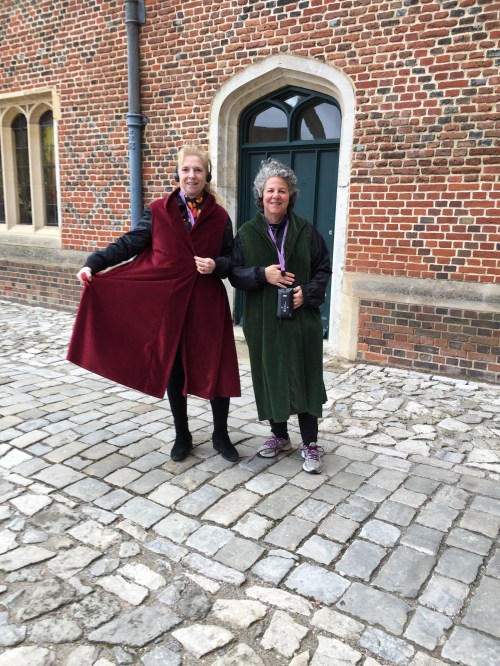 We got lost a time or two but it was a treat to be able to wander around on our own. We also had a good quick lunch in a cafe in an old room (baked potato with cheese, greens) and toured some nice gift shops, beyond the spectacularly ornate royal rooms and the great old kitchen rooms.
  Merida and I also wore borrowed long velvet capes, a nice option (that kept us warm) on a rainy day and made me feel a bit like a Hogwarts student. Undeterred by rain, we wandered around the formal gardens past bizarrely trimmed trees that looked like hedges on stilts.
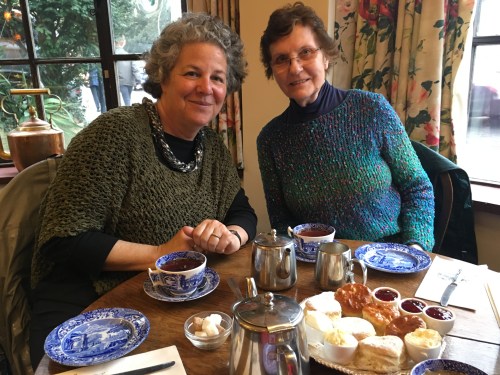 More memories of London visits with my kids when they were little cropped up when M, M and I had cream tea at the famous old Kew tea house, Maids of Honour. Fourteen years ago, D and I ended up here with the kids after an attempted walk to Kew Gardens from Francine and Russ’s house in Mortlake ended abruptly, due to a downpour. Thank God for the Maids of Honour, which 14 years ago we stumbled into soaking wet. This time we were also wet but not as wet. The scones were as light and the clotted cream as rich as I remembered.

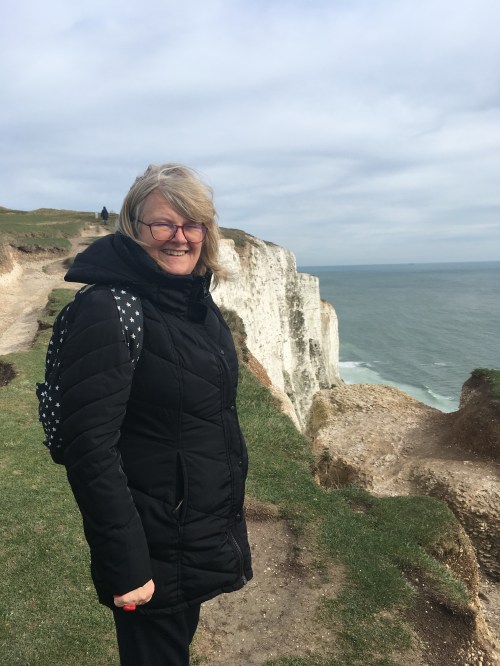 The skies cleared, exactly when we needed them to — for a glorious four mile walk atop the White Cliffs Of Dover. As recommended by our Airbnb host, we took a cab from Deal to the Cliffs National Trust visitors center, perched on the cliffs overlooking the bustling port of Dover, a poignant reminder these days of the looming disaster known as Brexit. If Britain does leave the E.U., Dover — the busiest British Port with the E.U. — will likely be a mess, with long queues of trucks, in particular, no longer able to drive through without a passport control stop.
 We had some coffee and shopped for upmarket souvenirs, then set off on the dirt and often muddy or soupy path across the grassy fields atop the dramatic white cliffs. We could see Dover Castle (worth a visit I’m told) to the southwest and, vaguely, the French coast, 21 miles across the sea to the east. Some flowers were in bloom, a sight for sore eyes, after unseasonably warm weather here last week.
 Our walk ended in the bay of the tiny village of St. Margaret’s at Cliff, where we had an excellent lunch (scampi and chips, Kentish sausage and mash, lemon curd creme brulee) at a cozy Pub called The Coastguard on-the-bay. After lunch, we walked on the beach of blue, white and tan stones bordered by a towering white cliff with a few homes perched on the top. And then we walked up a steep winding road to the cliff -top village green where we boarded a bus full of uniformed school kids for the ride back to Deal.
 By late afternoon, the sky was a dramatic darkening shelf, highlighted by a setting sun above the long row of terraced houses lining the coast for miles. You could see why Turner painted in nearby Margate, now home to a museum named after him. We shared a well-earned pot of tea at the trendy restaurant at the end of the pier.
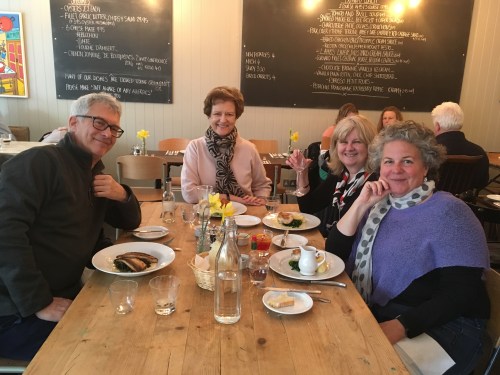 A rainy day in Deal and we were all happy to lounge around in this lovely house, reading the Sunday papers and drinking tea and catching up. I’ve also learned about some uniquely English television shows that no doubt will end up being copied in the U.S. My favorite is Goggle Box, a reality show about people watching television. I had to laugh. So English. But somehow the people sitting on their couch talking about what they are watching on the Telly are amusing. Although not sure I would be a regular viewer. Also learning to appreciate Steve Coogan’s satirical news show “This time with Alan Partridge.”
 As promised, this is a charming seaside village with narrow lanes leading to the sea, lined with beautifully tended cottages and terraced homes in pale blue and creamy white, made of old wood and narrow red brick. I can’t get enough of it. The town has enough sophistication to be well above average but also an unaffected, unassuming air. After waking up to my bedroom view of the pale green and blue sea, we walked down the lane a few blocks to the Saturday market, a small one-block gathering of bakers, fruit venders, cheese mongers and bric brac stalls, often with vintage goodies from nearby France including heavy linen smocks, berets and tablecloths. We bought some buns from a Swedish woman, some local tangy Kentish blue cheese and smoked cheddar, fruit and veg.
 Along High Street we popped into several small boutiques with carefully chosen and often pricey goods including silk kimonos, boiled wool slippers, lovely little cards and French country bread.
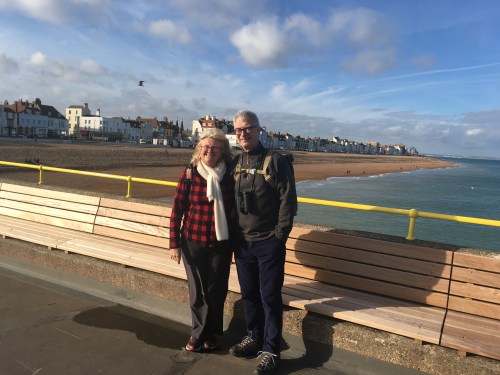 We walked for 1.5 miles past Deal Castle to Walmer Castle (both built by Henry the 8th in the 16th Century) which looked more like a country home with cannons and a moat. It’s early season so not too many tourists. We passed families with kids braving the beach, older folks with their dogs, even a few jet skiers but it was mostly quiet and peaceful.
 Una, our generous host, who discovered this village and whose friends own the house where we are staying, arrived from London, a sight for sore eyes. Russ and I cooked dinner — my pasta puttanesca, Russ’s salad — and we enjoyed a lovely meal.
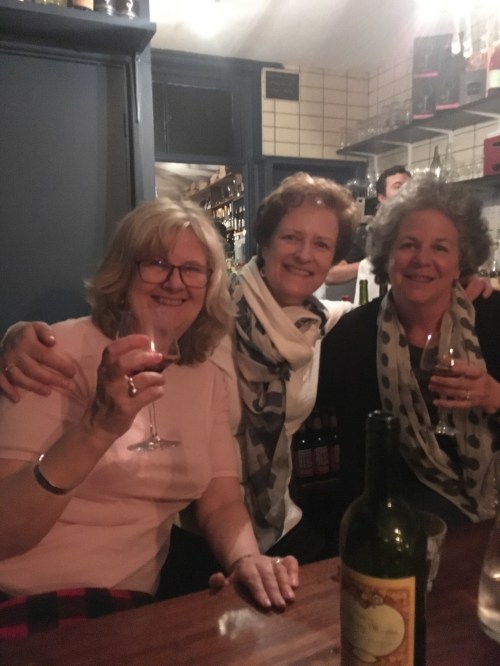 We walked back down to the High Street to hear some live music in a tiny wine shop/bar, Le Pinardier, a guy playing Irish, Scott and bluegrass banjo and guitar songs, a woman playing the fiddle, to about 15 people in the cozy place run by a young handsome Frenchman. A near perfect day and night. Only wish Dirck could be here but glad to hear he arrived safely in Beijing.
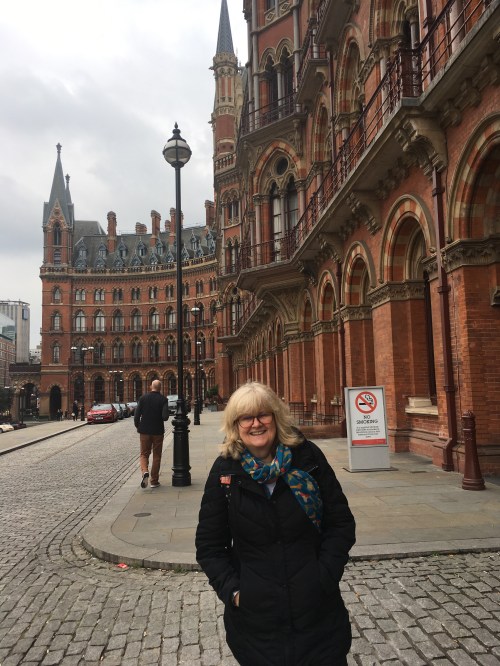 A very full day in London, first visiting the remarkable Great Diary Project at the Bishopsgate Institute, a quiet refuge in the bustling City of London that is home to a remarkable collection of diaries and scrapbooks donated by generations of ordinary scribblers dating back centuries. I spent some time talking to the director in whispered voice as she sat at a desk surrounded by presumably new dairy intakes in an austere old reading room and then looked through a few old diaries, one kept by a woman from 1957 through the 1990’s that began with the memorable words “Mother died today.” That grabbed me and kept me reading.
 Onto the gorgeously revived St. Pancreas and Kings Cross stations, in a once grotty but now rapidly gentrifying North London chunk of Camden. Francine and I had a pricey shared Ploughmans at Betjeman Pub in St. Pancreas, named after the famous writer John B. who helped save St. Pancreas from demolition. I walked around nearby Granary Square, bordered by massive old dark brick industrial buildings that have been spiffed up and converted into an art college (with hipsters playing ping pong in an entry way with stories-high ceilings), fancy shops, an amazing looking Waitrose, of course, clever site specific sculpture and on the day I visited, a craft and food market. It seems like every time I visit London, I find another new dynamic neighborhood– and this at a time when Britons are heavy-hearted and deeply worried as the deadline for Brexit fast approaches.
 Granary Square



 TakeBetsywithyou