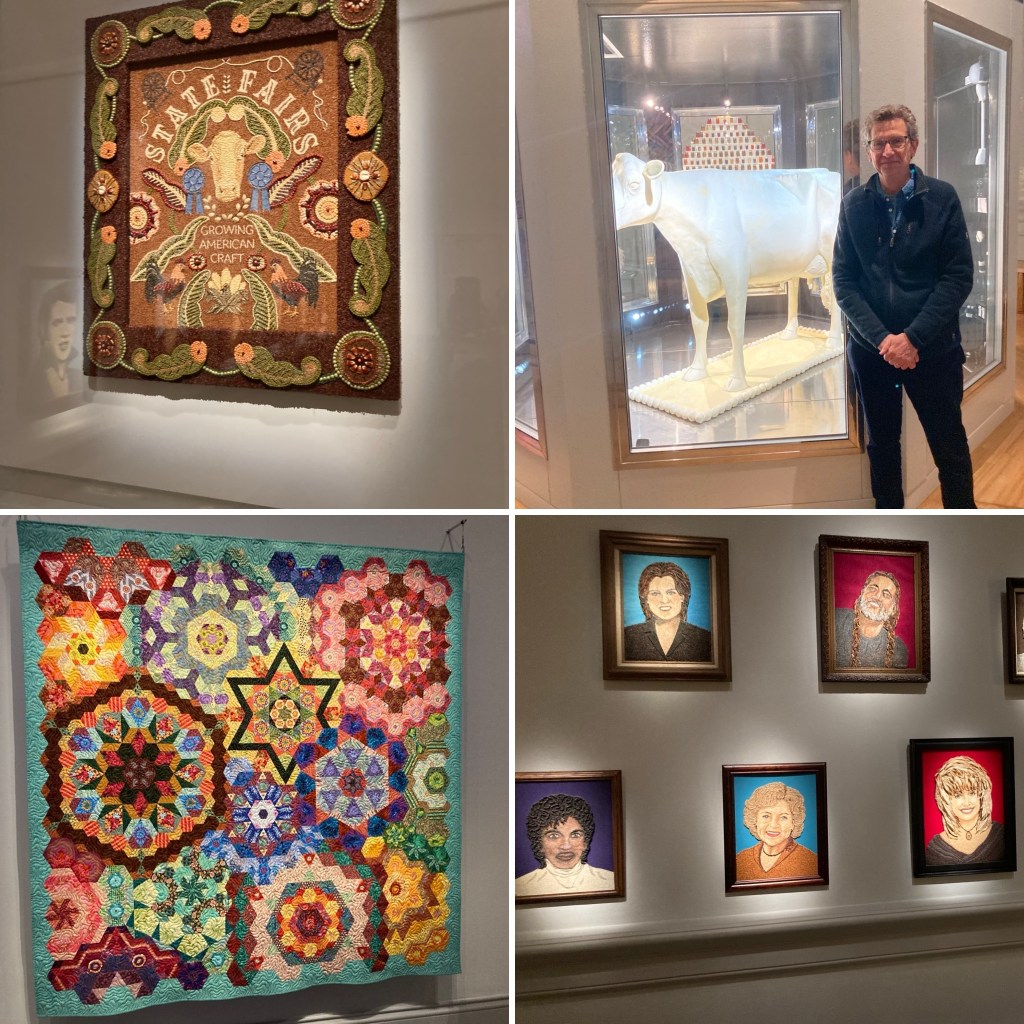
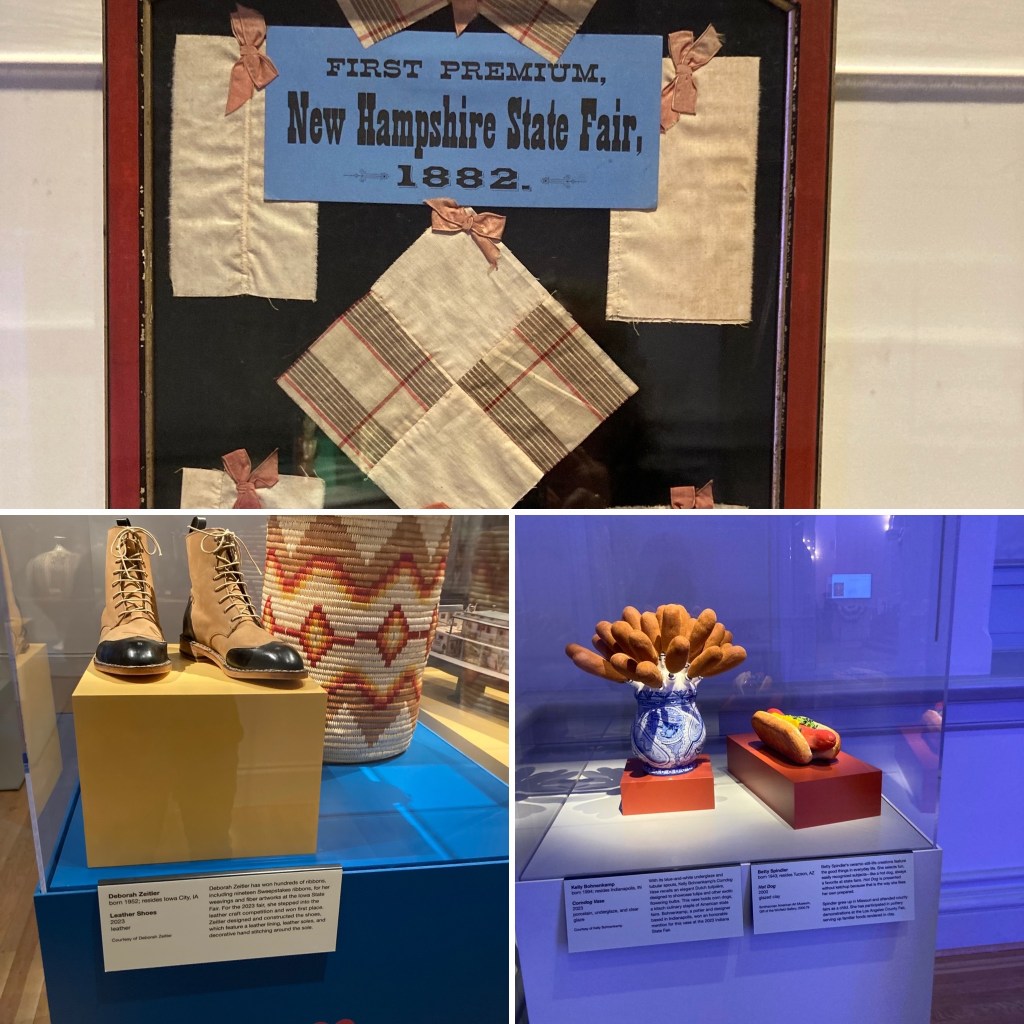
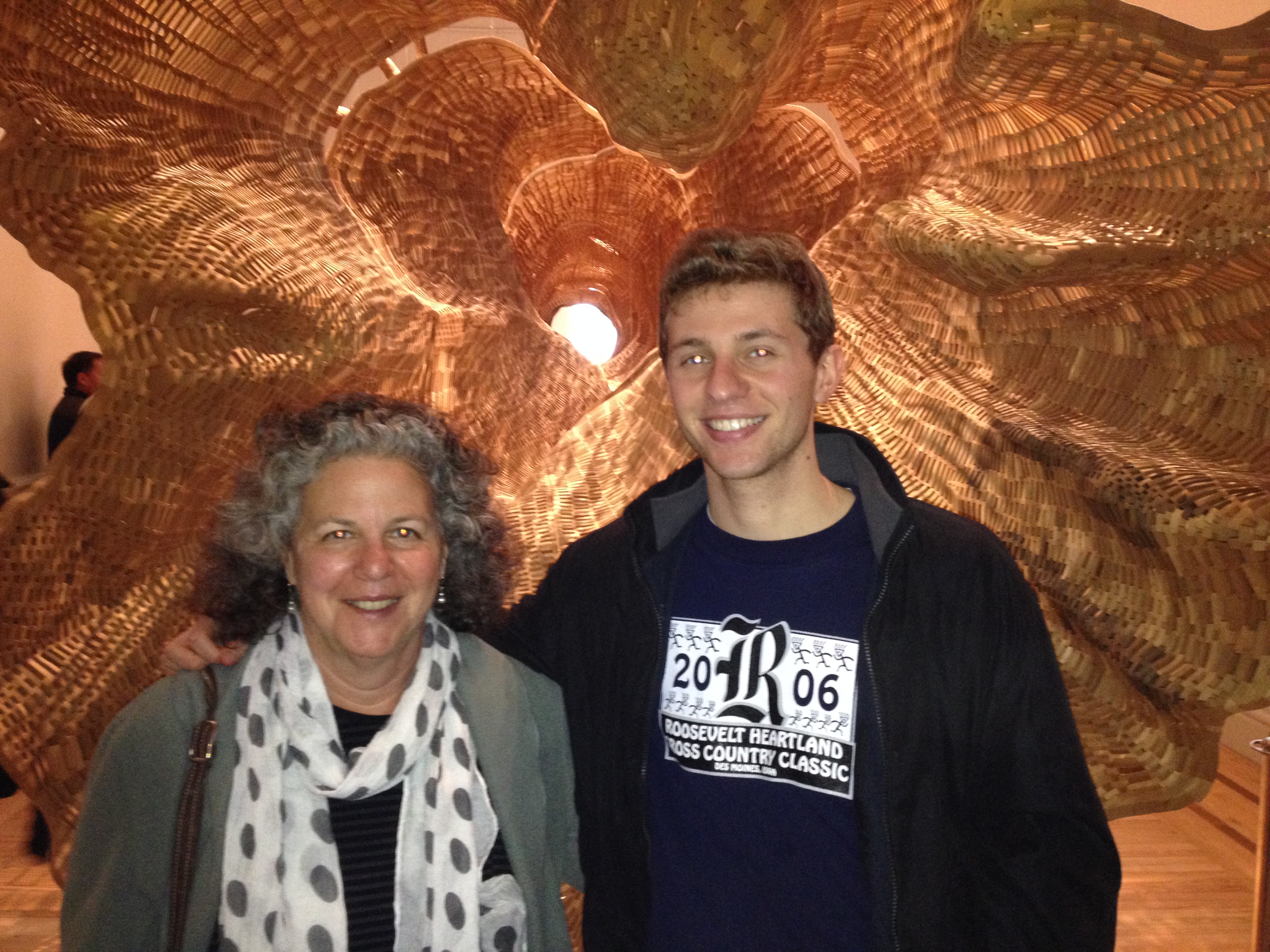
My sister was right: I loved the Renwick Gallery’s exhibit showcasing the arts and crafts of state fairs across the country. Think quilts, ceramics, basketry, hair weaving, sculpture, crop art, decoys, embroidery, beautifully canned vegetables, even the Iowa State Fair Butter cow in a refrigerated case on the second floor (which we almost missed. It’s not well advertised and we heard about it only from the guy at the gift store.)
Beyond Iowa, there is a lot from Nebraska (including from the fantastic international quilt museum in Lincoln which I visited in the 1990s), Kansas, New Mexico, Minnesota, Wisconsin, the Najavo Nation…
The show is a reminder of the artistic contributions of immigrants in rural America and the talents of this nation’s women. It’s all beautifully displayed.
Also a must see is a Justin Favela installation (also on the second floor) that uses an entire room for a tribute to maize, complete with lighting that dims and shines to capture the changes I light during a day.
Yes those are corn dogs, complete with a fake ant or two.
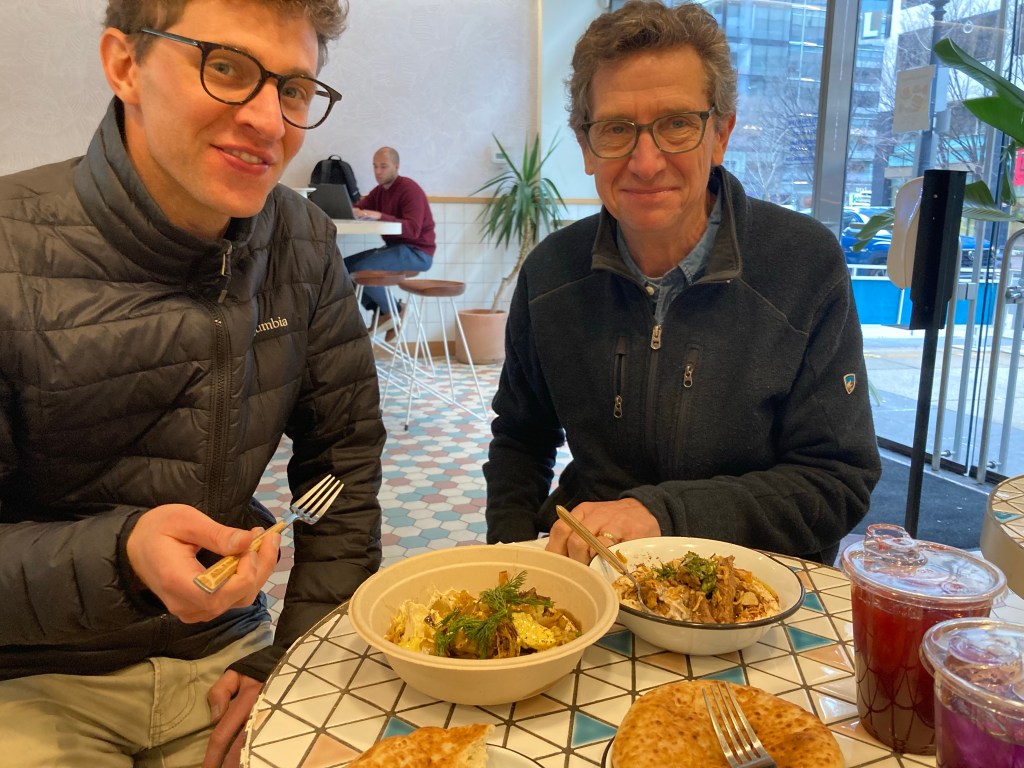
Lunch was excellent at a casual middle eastern place nearby called Little Sesame, with delicious hummus (the of us shared a bowl with harissa brisket and another bowl with grilled artichokes.) Perfect!
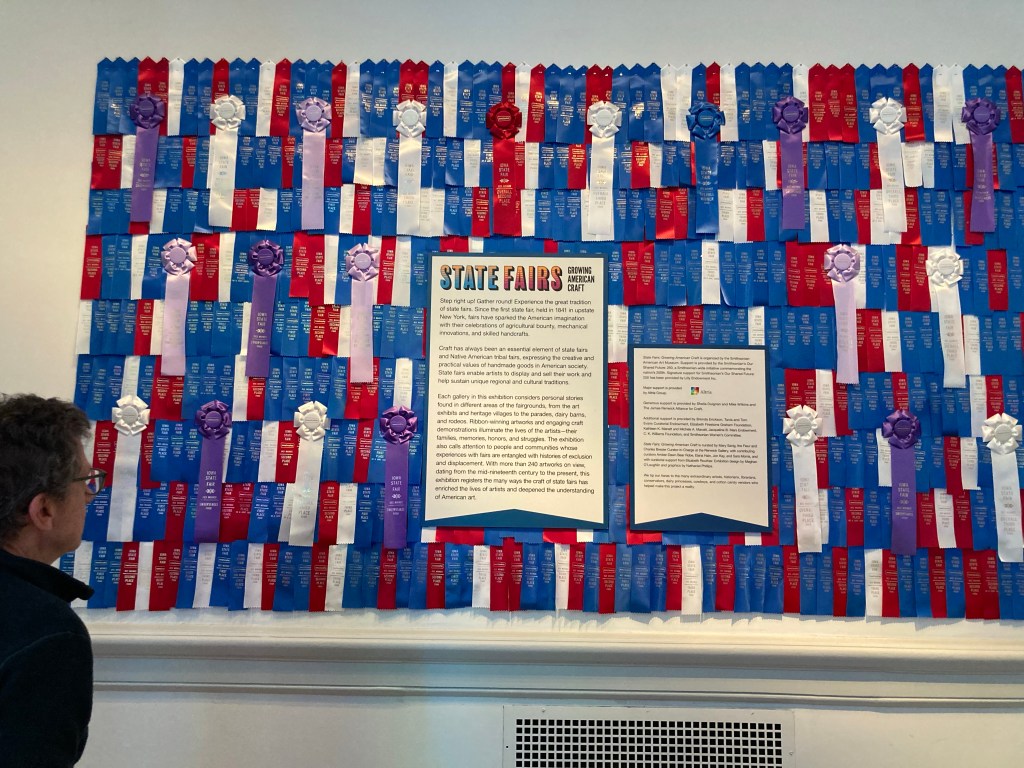
Made of Iowa state fair ribbons
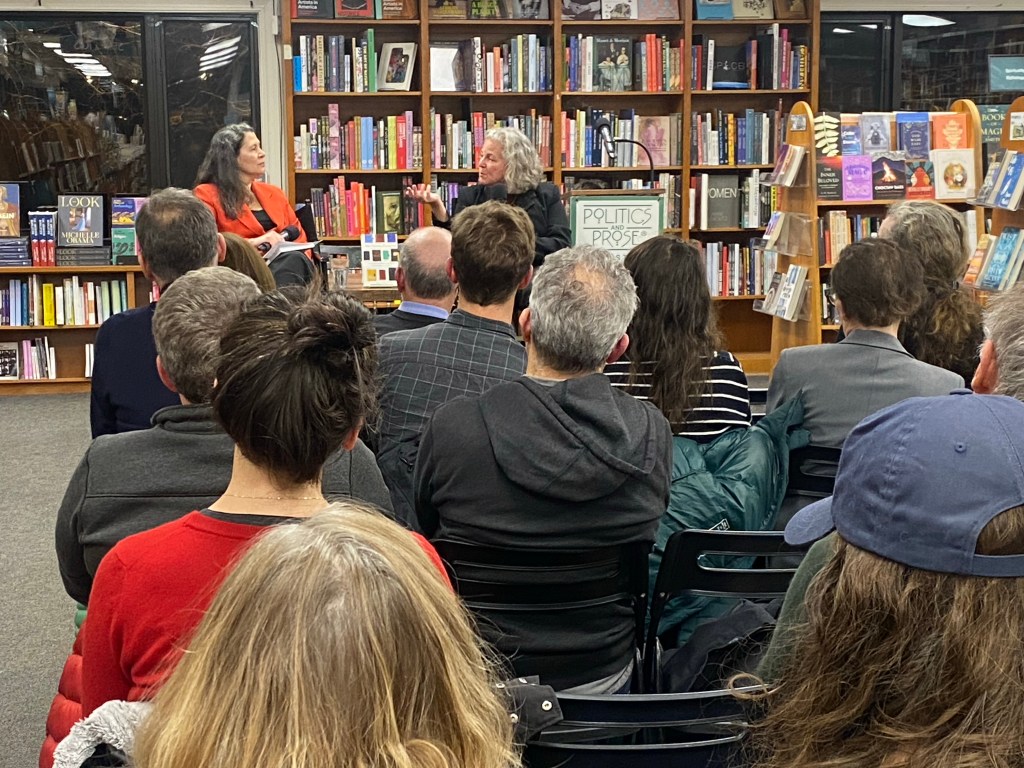
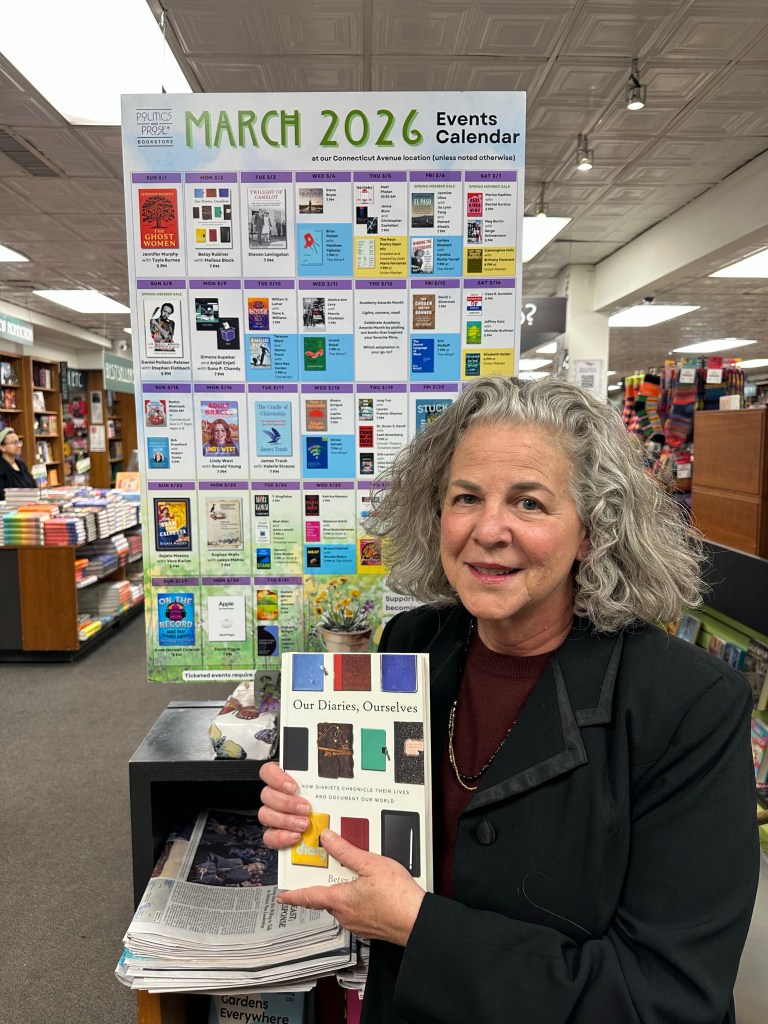
The fantastic Politics and Prose hosted by DC book tour stop for my new book Our Diaries, Ourselves! pizza afterwards with friends at nearby comet pizza.
Within walking distance of the trendy Los Angeles neighborhood of Los Feliz, this tiny park normally draws crowds for art classes and Friday wine tastings. But now visitors come for ambles around the landscape and architect Frank Lloyd Wright’s first and only L.A. opus, Hollyhock House, commissioned in the 1920s by oil heiress Aline Barnsdall. In 2019 the home and seven other Wright-designed buildings in the United States were added to the UNESCO World Heritage List.
Step into history and nature on these surprising summertime strolls in Los Angeles, Chicago, and Washington, D.C.
IN A SPRING and summer of coronavirus lockdowns and travel slowdowns, our usual modes of escape—planes, trains, cruise ships—have become fraught with health, ethical, and even legal perils. Suddenly, flying to see relatives in Arizona or Amsterdam or hopping a train to New York City for the weekend have become major life choices instead of simple vacation whims. And many types of trips (cruises, vacations to Europe for Americans) aren’t even possible during this Summer of Corona.
It’s no wonder that people from Paris to Pittsburgh have turned to their own two feet—and places in their own backyards—to get out and see the world. In the U.S., depending on where you live, that might mean hiking in a nearby state park, running on a local beach, or just strolling through deserted downtowns.
Still, with so many people getting outdoors, many popular paths and parks are overrun. These writers, in three cities across America, found unusual, less-traveled places to walk. Here’s how they got out of the house—and out of their heads.
Steep, secret staircases in Los Angeles
An introvert, I welcomed the stillness of quarantine. Yet, after months of being homebound with my sweet-tempered cat in Long Beach, California, I missed the outdoors. Apparently, so did thousands of equally stir-crazy Angelenos who, once spring stay-at-home orders lifted, poured out onto beach paths and hiking trails.
It was hard to avoid crowds, but I had an ace up my sweatshirt sleeves. All over Los Angeles, cement or wood outdoor stairways are sandwiched between apartment complexes and tucked away in unassuming neighborhoods. Dating back to the 1920s and 1930s, these pedestrian byways were incorporated into new residential developments built around light-rail lines and trolley systems.
“The stairs were erected when the city started expanding into the hilly neighborhoods of Echo Park, Silver Lake, Mount Washington, and Highland Park,” says Charles Fleming, who wrote the book Secret Stairs: A Walking Guide to the Historic Staircases of Los Angeles. “People moving into the hills often didn’t have cars, so, they needed an efficient way to get down to the Pacific Electric Railway trolley system, the markets, and the schools.”
A man runs up a set of stairs in the Silver Lake neighborhood of Los Angeles.
PHOTOGRAPH BY JONATHAN ALCORN, ZUMA PRESS/ALAMY STOCK PHOTO
While the trolleys were dismantled in the ’40s and ’50s, the stairs remained. Fleming’s book documents more than 275 of them, each with distinct views and quirks. In hip Silver Lake, where street art flourishes, the Murray Stairway is painted to resemble piano keys and the Micheltorena Stairs bear rainbow stripes. Nearby, The Music Box Stairs and Three Stooges Stairs have silver-screen pasts: starring roles in Laurel and Hardy’s 1932 Music Box and the Stooges’ 1941 An Ache in Every Stake, respectively. Both movies feature the hijinks of delivering heavy objects—a piano and blocks of ice—up the outlandishly steep steps.
One morning during quarantine, I headed to one of the oldest—and most challenging—set of stairs in the city. The view from the bottom of the Eldred Street Stairs alarmed me with its 33.3 grade, which rises and dips like a roller-coaster track. Located in Los Angeles’s Mount Washington neighborhood, it’s the steepest street in California, beating San Francisco’s famed Filbert Street by 1.8 percent.
I took a deep breath and started climbing, my movements comically slow as I steadily gained 219 feet in elevation during the short 0.1-mile hike to the top. Sweat trickled down my forehead, and I had to take frequent breaks to catch my breath. I spied 1920s Craftsman bungalows, preposterously built along the hill. How did early inhabitants drive up to their garages, presumably in Model Ts? The street felt nearly vertical.
The Baxter Stairs cross through the Echo Park neighborhood in Los Angeles.
PHOTOGRAPH BY RACHEL NG
The journey was likely even more arduous for residents on Cross Avenue, who had to scale an additional 196 steps up a wooden staircase past the peak of Eldred Street to get home. At the bottom of the Eldred Stairs, legs quivering, I considered turning back. But the mystery of the foliage-shrouded climb ahead beckoned.
Ascending the deserted stairs felt like stepping into the past. I imagined some silent film hero tipping his straw boater hat as I passed. But I was alone, joined only by Monarch butterflies and playful sparrows who darted among the blue morning glories and overgrown weeds peeking through the stair railings.
I finally reached the top, popping out onto a narrow residential street with a scenic overlook. I soaked in the cool breeze, plus spectacular views of craggy Mount Baldy and the San Gabriel Mountains. I was done for the day, but that first outing inspired me to conquer other climbs: the Mattachine Steps in Silver Lake, dedicated to Harry Hay, founder of the Mattachine Society, one of the earliest LGBTQ rights group in the U.S. Next on my list: an Echo Park trek that leads to Angelino Heights, a late 19th-century neighborhood dotted with Victorian and Queen Anne mansions that seem popped out of a storybook.
During the pandemic, I’ve dreamt of time traveling to life after the crisis or to the glorious before times. Venturing up these old stairways is, in a way, like journeying into a bygone Los Angeles. It’s been just the escape I needed. —Rachel Ng
Down by the river in Chicago
Ordinarily, the glassy expanse of Chicago’s Lake Michigan attracts both photo ops and crowds of people who walk, bike, run, or sun themselves along the shore. But when this spring’s COVID-19 shutdowns closed the lakefront, I found a different watery escape: strolling the connected parks and paths along the North Branch of the Chicago River.
The multi-forked, 156-mile river winds from Lake Michigan through a series of other waterways that finally connect with the Mississippi River. Historically, the Chicago River has been a route for both indigenous people and European settlers, allowing Chicago to flourish as a major industrial city. But for me, during this pandemic, trails along the river have transformed into a secret world where I can get my nose out of my phone and into nature. Well, at least for a couple of miles a couple of times a week.
Measuring 1,000 feet long, the new Riverview Bridge on the North Branch of the Chicago River is the longest pedestrian bridge over water in the city.
PHOTOGRAPH BY TODD BANNOR, ALAMY STOCK PHOTO
All it takes to get to my hideaway? A quick turn into what I think of as my personal portal: a cut in the railing of the Belmont Avenue Bridge near my home in the Avondale neighborhood. Just west of Western Avenue, I leave the busy road and zigzag down a concrete ramp to the meandering asphalt trail along the river.
The murky green water to my left, I walk through a thicket of trees and step inside a corner of Richard Clark Park called The Garden. Even during the pandemic, this hidden dirt-bike park was semi full of excited kids whooping and whipping their wheels over multiple mounds of soil, twisting and turning in an exhilarating escape from confinement. My 12-year-old nephew was often among them.
In the Garden, happy screams echo through the trees, a diversion from my doomscrolling on Twitter before I continue on my walks. And the land the bikes roll on has a long history of fun: it’s the site of the former Riverview Park. The legendary amusement park operated wooden roller coasters and toboggan rides from 1904 to 1967 under the slogan “laugh your troubles away.”
As I walk north on the trail, a contemporary grey stone building rises like a series of undulating waves. It’s the WMS Boathouse, designed by local architectural star Jeanne Gang, opened in 2013 as part of the city’s ongoing efforts to revitalize the riverfront. Gang used her trademark crisp engineering and green infrastructure elements (rain gardens, porous concrete that helps store and filter river water) to make a structure that’s both a design and environmental win.
RELATED: GARDEN CEMETERIES WERE AMONG AMERICA’S FIRST URBAN PARKS
1/10
VIEW SLIDESHOW
GREEN-WOOD, NEW YORK CITY
Founded in 1838 as one of America’s first garden cemeteries, Green-Wood later inspired the creation of Central and Prospect Parks. In its early days, it was a major national tourist attraction
… Read MorePHOTOGRAPH BY TODD HEISLER, THE NEW YORK TIMES/REDUX
SPRING GROVE CEMETERY, CINCINNATI
A recurrent cholera epidemic motivated the Cincinnati Horticultural Society to create Spring Grove Cemetery in 1844. Inspired by garden cemeteries both in Paris and along the East
… Read MorePHOTOGRAPH BY MEDLEY OF PHOTOGRAPHY, ALAMY STOCK PHOTO
EVERGREEN CEMETERY, PORTLAND (ME)
One of Portland’s largest publicly owned open spaces, the 239-acre Evergreen Cemetery is renowned for its wooded hiking trails and peaceful ponds. Points of interest include an Egyptian revival–style tomb, a mausoleum styled after a Greek temple, and an English Gothic revival chapel.
PHOTOGRAPH BY DANITA DELIMONT, ALAMY STOCK PHOTO
LAUREL HILL CEMETERY, PHILADELPHIA
Fed up with the crowded state of Philadelphia’s church graveyards, a Quaker helped establish Laurel Hill on a former estate north of the city. With scenic views of the Schuylkill River and
… Read MorePHOTOGRAPH BY LITTLE NY, GETTY IMAGES
MOUNTAIN VIEW CEMETERY, OAKLAND
Renowned landscape architect Frederick Law Olmsted drew inspiration from Parisian monuments, English gardens, and American Transcendentalism when designing this 223-acre
… Read MorePHOTOGRAPH BY DBIMAGES, ALAMY STOCK PHOTO
BONAVENTURE CEMETERY, SAVANNAH
With its centuries-old gravestones tucked beneath live oaks dripping with Spanish moss, it’s no wonder Bonaventure is hailed as one of Savannah’s highlights. Made more famous by
… Read MorePHOTOGRAPH BY TAYLOR GLENN, REDUX
CONGRESSIONAL CEMETERY, WASHINGTON, D.C.
Fifty years before Arlington National Cemetery was created, Congressional Cemetery became America’s first national burial ground. Situated in Capitol Hill, it was the chosen resting
… Read MorePHOTOGRAPH BY DARREN S. HIGGINS, REDUX
HOLLYWOOD FOREVER CEMETERY, LOS ANGELES
Home to Hollywood luminaries including Judy Garland, Mickey Rooney, and Douglas Fairbanks, Hollywood Forever has been a cultural center in Los Angeles since its gates opened in
… Read MorePHOTOGRAPH BY ALIZADA STUDIOS, GETTY IMAGES
GLENWOOD CEMETERY, HOUSTON
Designed around several ravines leading to Buffalo Bayou, Glenwood Cemetery offers a unique, rolling landscape in the midst of sprawling Houston. Though built in a rural section of the city in 1872, it now sits in the heart of Houston with impressive vistas of the skyline.
PHOTOGRAPH BY JON SHAPLEY, HOUSTON CHRONICLE/AP IMAGES
OAKLAND CEMETERY, ATLANTA
What began in 1850 as a modest, six-acre burial ground for the young town of Atlanta has grown into a 48-acre historical highlight in the city. Oakland fell into a period of disrepair in
… Read MorePHOTOGRAPH BY STEVE ALLEN, ALAMY STOCK PHOTO
In other summers, I’d rent a canoe outside the boathouse, or peek inside at the rowers who train here. Though the building is quiet this year (rentals and programs are on hold for now), the structure’s serene, zigzaggy roof still soothes me, a reminder that tough times, like flowing water, eventually move on.
Just beyond, my running shoes hit Riverview Bridge, a new concrete path that gently climbs 18 feet above the river. The slither of concrete with rusty steel tooth-like railings is popular with runners and bikers. Me, I slow down to a saunter high above the water, surveying the tops of surrounding trees, imagining I’m far from home before I turn around.
The bridge connects to an old path in California Park, where it ends. For now, at least. Work is underway for more legs of what urban planners aim to make one contiguous river trail. In these long, repetitive days, even small developments—like an extension of my secret world—feel like hope. —Kate Silver
Graveyard rambles in Washington, D.C.
During the pandemic, I‘ve been strolling amid hundreds of people, none of them wearing masks. But don’t COVID shame me: they’re all buried six feet under in historic Washington, D.C. cemeteries, so I’m not worried about social distancing.
My adopted hometown is famously rich in green spaces—Rock Creek Park, a ribbon of grass, trees, and water; the monument- and museum-studded National Mall. But during months of lockdown, my usual paths were jammed with runners and walkers, many unmasked and going about their sweaty, potentially germ-spreading business like it was 2019.
So my husband Callan and I retreated to cemeteries for walks that were often, well, deathly quiet. Our ambles started in March in Glenwood Cemetery, a still-active burial ground in the northeast quadrant of the city near Catholic University.
Built in 1859, the chapel at Oak Hill Cemetery in Washington, D.C.’s Georgetown neighborhood was designed by James Renwick Jr., also the architect of the Smithsonian Institute’s “Castle” on the National Mall.
PHOTOGRAPH BY B. CHRISTOPHER, ALAMY STOCK PHOTO
We came seeking exercise and a look at the grave of Reginald Wycliffe Geare, an early 20th-century architect infamous locally for designing D.C.’s Knickerbocker Theatre. It collapsed in a blizzard in 1922, killing 98 people. Geare also drew up the plans for our 1920 townhouse, which seems to weather storms OK, so we wanted to pay tribute.
On laps around Glenwood’s rolling acerage, Callan and I discovered more than Geare’s simple, flat stone. In spring, cotton candy-pink cherry blossoms backdropped weathered, grouchy stone cherubs. On Memorial Day, we witnessed a funeral procession where brightly dressed mourners on motorcycles provided a bittersweet foil to the dark hearse they followed.
Each time we dropped by, greeted by a swarm of life-sized, trumpet-playing stone angels, we’d discover more evidence of life and death’s rich pageant: a clutch of early 20th-century Greek immigrants in a family plot; recent, silk flower-decked tombstones engraved with Ethiopian surnames, a sign of D.C.’s large immigrant population. And just last week, my genealogist husband discovered two distant relatives were interred there under an expansive elm, an Ancestry.com data point made real.
A weathered stone cherub tops a gravestone at Glenwood Cemetery in Washington, D.C.
PHOTOGRAPH BY JENNIFER BARGER, NATIONAL GEOGRAPHIC
I cop to morbidly scanning headstones for 1918 or 1919 passings (Spanish flu?). But I mostly consider these strolls a pleasant revival of the 19th-century cemetery movement holding that graveyards should be like public parks, gathering places where well-dressed Victorian crowds held picnics, concerts, or even horse races.
“Back then, if you had distinguished out-of-town guests, you’d take them to see the gravesites of local worthies and show off the sculptures,” says Keith Eggener, a graveyard historian, architecture professor at the University of Oregon, and author of the book Cemeteries. “They became so popular, people started to lead tours of them and write guidebooks.”
Those boneyard guides would’ve had a lot to talk about at the Georgetown nabe’s shaded, creek-side Oak Hill Cemetery, which I turned to for one-on-one, six-feet-apart strolls with girlfriends as D.C. rolled from crisp spring to boggy, hot summer. Amid tombs dating back to the 1850s, the steep stone steps and winding paths worked out both my calves and sense of mortality.
Civil war officers, sea captains, and other notables are buried amid the towering oaks. Abraham Lincoln’s son Willie’s body was temporarily interred here in a cliffside masoleum in 1862, inspiring George Saunders’ recent graveyard novel, Lincoln in the Bardo. And legendary Washington Post editor Ben Bradlee’s remains are entombed here behind a metal sculpture of a tree.
One June day, as I turned to leave the graveyard, I saw a spotted baby deer peeking out from behind a grizzled Victorian gravestone, all bright eyes and shaky legs. The lush, secluded surroundings seemed to make Bambi—like me—feel very alive indeed. —Jennifer Barger
Los Angeles-based writer Rachel Ng hopes to be fit enough to walk the Great Wall of China someday. Follow her on Instagram.
Kate Silver is a Chicago-based travel, business, and health writer—and walking enthusiast. Follow her on Instagram.
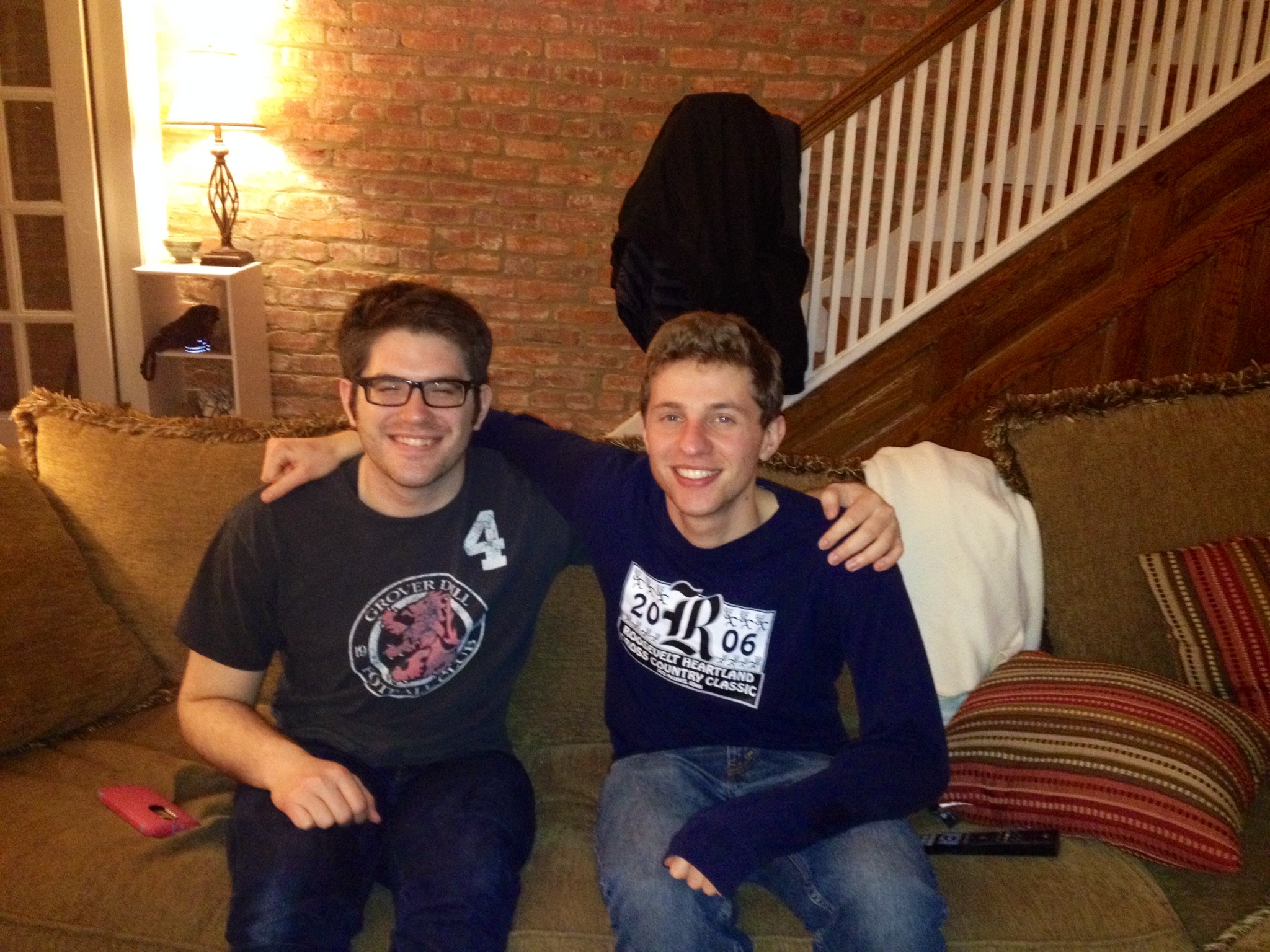
Great to be visiting Noah a newcomer in DC — plus my sister and husband who sare old hands here. first stop the charming red brick row house Noah shares with three people in Columbia heights, including my dear old pal/ college roommate Myra’s son Dan! the house reminded me so much of my grandparents red brick row house in Easton Pennsylvania, but Noah’s neighborhood has a lot more going on.
We had a really good breakfast at a cheerful restaurant, Le Coupe, packed with people. Excellent lamb hash, eggs Benedict, hash browns, sautéed Brussels sprouts. Next stop: The Renwick Gallery which is part of the smithsonian and located kitty corner from the White House, for a fantastic show called Wonder (or Wonders) — site specific enormous installations by 9 different artists including Maya Lin and Tara Donovan. The show could also have been entitled “Mindblowing” — really astonishing work and great to see the place packed with all kinds of people and signs in each room that said “photography encouraged.”
Noah and I shared some good cheesecake at a bakery on 14th street in his neighborhood and later were joined by my sister, brother law and Noah’s roommate dan for Laotian food, also ion 14th street. Really fun day!
We found a fantastic bed and breakfast on dc that was almost too good to be true. And sadly it will bson non because it is closing to the public later this week. It’s the uptown intown uptown inn in the upper northwest neighborhood north of columbia heights. Gorgeous old mansion, red brick, with wood floors, elegant fireplaces and chandeliers, antique furniture and oil paintings. Beautiful Roos, for sleeping, sitting and eating. Delicious breakfast of double-stuffed potato topped with scrambled eggs, homemade blue berry Danish. The inn owner sandy is gracious and welcoming, the type of person you want to have your photo taken with as you leave, even though you have known her for only an hour.mshemis renting out the entire three story inn to harvard which will make it available to its alums. Bummer for the rest of us.
We had an excellent dinner last night at redwood in Bethesda. $35 price fix for 3 courses. I had grilled shrimp served with cucumbers, red onions and a jalapeño avocado yoghurt drizzled around the plate. Then crab cakes with grilled peaches, bok Choy and a light orange-colored peach sauce. Ice cream sundae for dessert.
Today we had a tour of the u.s. Capitol led by a fine young man who is an intern for senator Harkin. He’s also my son. That was fun. The new visitors center is a nice entryway. We loved all the wall paintings in the corridors. For lunch we had very good salads at sweet greens on a strip of restaurants behind the Capitol. It’s been a good trip.
I’m off to DC next week for a family get-together to celebrate my sister’s 50th birthday – and to check in on my son who is interning for a U.S. Senator so here’s my list of possible things to do when/if I have some free time:
– Newseum and Holocaust Museum. Never been to either.
– Martin Luther King statue on the Mall and visit to Vietnam War Memorial, which includes my husband’s brother’s name.
– The eastern market/U street corridor (recommendations from a friend who visited recently). I’ve been to Detroit’s Eastern Market but never DC’s. Didn’t know it existed. It in the Capitol Hill neighborhood and sounds like best time to visit is during the weekend market when there’s crafts, antiques as well as fresh produce.
The corridor runs from from 9th Street on the east to 18th Street and Florida Avenue on the west. Most of the area is part of the larger Shaw neighborhood, with the western end entering the Dupont Circle neighborhood. It is served by the U StreetWashington Metro station.
– Politics and Prose, a longtime favorite bookstore (that a friend now owns!)
– ellicott city, Md. I’m visiting a friend who lives there. Sounds like the five-block historic downtown is worth a wander.Fun facts: it was founded in 1772 and has the nation’s oldest railroad station.
I haven’t been to Washington D.C. in several years but I inevitably end up returning and when I do, here’s some suggestions from a recent NYTimes article about the Columbia Heights neighborhood in NW DC.




 TakeBetsywithyou