I have only been to the Indiana Dunes a few times but will soon have more time to explore it. High on my list is a visit to Cowles Bog, which a local recommended for its abundance of rarely seen wildlife. (“You’ll see thing you never saw before,” he told us.) We drove by the bog recently during a quick visit to see the “Century of Progress” homes nearby and learned that it offers a 4.7 mile hike “moderate to rugged with steep dune climbs in loose sand” and dogs are allowed. Its ponds, marsh, swamp, black oak woodland, and those dunes offer such a diversity of wildlife that it was named a National Natural Landmark in the 1960s.
It took us awhile to find them but the five “century of progress homes” produced for the 1933 Chicago world’s fair were worth the hunt. We drove west along the Indiana Dunes National shoreline until there they were. We parked our car (15 minutes allowed) at about 6:30 on a Saturday afternoon and walked right up to the homes, including the stunning “Florida Tropical House” right above the silky sand beach. The silhouette of the Chicago skyline rose like a distant Oz across the shimmering water of Lake Michigan. The “flamingo pink Art Deco” Florida house – designed to resemble an ocean-liner, was the only state-commissioned house, commissioned by Florida, to lure tourists. Word has it the Florida house is a navigational landmark for Lake Michigan boaters.
The five homes were relocated here after the fair. They were considered state-of-the-art at the time, with new-fangled options like air-conditioning and dishwashers. A real estate developer (who wanted to lure buyers to his new Beverly Shores resort community) bought five of them (not clear how many there were total) and had four shipped by barge to Indiana and one transported by truck. There’s an annual tour of them in September that sells out quickly when the tix go on sale. Apparently some are lived in by people subleasing them and using private funds to restore them.
The Indiana dunes is an odd mix of natural and industrial worlds, with beaches and wildlife areas (friends from here recommend Cowles bog trail for wildlife) but also a nuclear cooling tower and steel mills.
Wiebolt-Rostone House
The Wiebot-Rostone House’s experimental materials apparently didn’t prove up to snuff, although its very cool looking. Billed as a material that would never need repairs, Rostone was made of limestone, shale, and alkali. But it proved no match for harsh lake-effect weather (snow etc.) and the air pollution of its industrial neighbors (steel mills, refineries.) By the 1950s, it was deteriorating and recovered in Perma-stone, a concrete stucco. It was later restored with a new improved synthetic Rostone. Perhaps most astonishing is that the 120-130 ton house was transported by barge (it was the heaviest house moved).
Here’s more info from the National Park Service:
1933 Chicago World’s Fair Century of Progress Homes
The annual tour is held on the last weekend of September. The tour is sponsored by the non-profit organization Indiana Landmarks. Tickets go on sale early in August and usually sell out within one hour.For information on the exact tour date, ticket sale date, pricing, and all other information, please visit the Indiana Landmarks’ website.
The 1933 World’s Fair in Chicago—called the Century of Progress—offered millions of people in the depths of the Great Depression a hopeful vision that highlighted futuristic changes on the horizon. Developer Robert Bartlett brought a dozen buildings from the fair including five from the Homes and Industrial Arts housing exhibit that make up the Century of Progress Historic District. The buildings were moved by barge and truck to Beverly Shores, a resort community he was developing on the Indiana shore of Lake Michigan. You can visit the cluster of five landmarks on the annual Century of Progress home, sponsored by Indiana Landmarks in partnership with the National Park Service.
The tour admits you to the first floors of the Florida Tropical, Rostone, Armco-Ferro and Cypress houses. As you can tell by their names, the houses at the fair promoted products for residential living—Florida’s beachy appeal, and artificial stone, enameled steel, and cypress wood as building materials.
Four of the five houses looked wildly modern in 1933, so ahead of their time that they remain modern looking today. The Cypress House, honoring its material, looks like a rustic log cabin, albeit with modern amenities. To save the structures, Indiana Landmarks leased them from the National Park Service, then subleased four to people who have restored them in exchange for long-term leases.
The tour lasts a little over two hours and is guided by park rangers and volunteers who will provide histories and architectural overviews at each property.
Because there is no parking available in the historic district, your timed entry ticket includes shuttle transportation to the district from the Indiana Dunes Visitor Center, 1215 North State Road 49, Porter, IN, 46304. The private homes are clustered together on either side of Lake Front Drive within easy walking distance of one another.
Touring the historic homes requires walking and climbing stairs. If you require accommodation, please call Indiana Landmarks’ Northern Regional Office, 574-232-4534.
Tickets cost is $35/person, ($30/member of Indiana Landmarks or Dunes National Park Association) (2018 prices, subject to change).A Century of Progress – The 1933 World’s Fair HomesOver 85 years of wind, sand, and surf have battered the five World’s Fair houses located along Lake Front Drive in Beverly Shores, but their uniqueness has weathered the elements. With the theme of a Century of Progress, the houses were built for the 1933 Chicago World’s Fair to demonstrate modern architectural design, experimental materials, and new technologies such as central air conditioning and dishwashers.Four of the houses were brought to the dunes by barge in 1935 by real estate developer Robert Bartlett. The Cypress Log Cabin was dismantled at the fair and moved by truck. Bartlett hoped that the high profile houses would entice buyers to his new resort community of Beverly Shores. Today the houses are listed on the National Register of Historic Places and the houses have been leased by the non-profit organization Indiana Landmarks. Through this organization, private individuals or families have leased the homes and are rehabilitating them. Please respect these agreements by not trespassing on the properties.
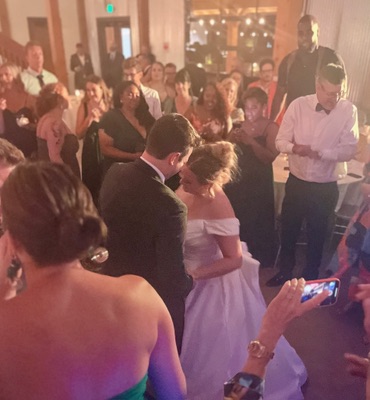
We danced the night away at my niece’s wedding, held at White Oak Farm in the countryside near Michigan City, Indiana, only 12 minutes from New Buffalo, Michigan, but one time zone away.The weather was dry (amen) and in the 80s, with some intense sunshine during the early part of the outdoor service on a stone patio between two barns – not the old rustic barns but new fancy barns, one with chandeliers, designed not for livestock but for events including weddings. Great people, service, food, dj, dancing.
The “barn”
The morning after, my sibs and I checked out of our respective airbnbs at 10 am (a bit challenging when you’ve gone to bed at 1:30 am) and met at Issa Vibe Cafe, a cheerful easygoing spot with large breakfast paninis (request mayo/aioli on the side; consider sharing) and coffee drinks. It was a good place to hangout and a perfect way to end our family gathering.
Noah, D and I did stop for some Michigan pothole ice cream at Oinks on the way out of New Buffalo. We’re talking very chocolate ice cream with oreo cookie crumbs and mini-peanut butter cups, so not suitable for our lab Millie, who was with us. Amazingly, another customer came over to our table with a little dish of vanilla ice cream for Millie. How kind was that?
I’ve passed through the Indiana Dunes many times while driving between Iowa and parts east including my home state of Michigan and beloved East Coast spots (Ithaca, NY; Easton PA etc.) and stopped briefly a time or two but never really explored. Michigan City struck me as fading. But I gather the place to eat is Bartlett’s and an interesting place to explore is the community of Beverly Shores. So duly noted here, for future reference. I’ve also heard, unfortunately, that the dunes have potentially deadly sinkholes – including at the main state park Mount Baldy, where the beach but not the massive dune (that I remember running up and down with our kids), recently reopened after a sinkhole situation that gobbled up a young boy (he survived…) More here.




 TakeBetsywithyou