Rome got overwhelming today, too many tourists (a crush of people in matching blue hats, at times), too much noise, too much trash, too many shops closed in the trendy Monti neighborhood (but hey, it was a Sunday.) Sometimes travel and the pressure to make every moment count in a magical faraway place can be too much. Not to mention so much walking.
Piazza di populi, with fabulous lion statues spitting out water into fountains
Nothing that some down time and an afternoon nap couldn’t fix. And a splurge tasting menu dinner (yes, I ate a wee bit of rabbit) in a less touristed neighborhood by the Piazza del Popolo at Mazapane, a small out of the way “it” restaurant with a rising Spanish chef. I’m glad I booked a few restaurants out of our very touristed Trastevere neighborhood, although unlike Paris there is no handy metro and we haven’t figured out the buses so we’ve taken taxis.
Two observations: we had mediocre pizza last night in a great people -watching outdoor snack bar in central storico and excellent pizza today in an awful location, in an empty back room of a pizza bar. And near the restaurant tonight we were happy to be rid of American and other tourists but the Italians were shopping at American stores (Gap, Sketchers, Lush, sephora, Nike)…nearer to the restaurant we seemed to be in a neighborhood with recent immigrants from the Middle East and Southeast Asia.
We also were impressed with the quality of the buskers, especially on the bridges in Trastevere. We met a shopkeeper today in the TESSTACIO neighborhood who is also a busker. He said buskers have to get a permit for the location where they want to play.
What a change Siena is from Urbino. It’s got a lot more stunning architecture and art but way more tourists. So it’s a trade off. Other than Rome, we’ve intentionally and successfully avoided places with long lines and busloads of touristsby going to more off the beaten track places. I would have waited until at least October to travel to Italy if I had not had a work gig here (the diary festival) in September. Friends are visiting in February. Smart!
Siena at night or dusk
When we arrived, we struggled to find a free parking spot, finally finding one at the second lot we tried about a 20 minute walk from our Airbnb, which meant a long schlep, pulling our suitcases on rough pavement, dodging other tourists everywhere. The first lot was a five minute walk.
Our drive east from Urbino to Cortona (the under the Tuscan Sun town) took about 3 hours through spectacular scenery. At one point we were driving in the fog high in the hills/mountains. We landed unexpectedly in Cortona, which looked beautiful but we soon realized it would not work as a quick lunch stop. Too much effort to get in and out. Starting with too many people trying to find parking and figure out the parking machines. This was the 2023 Italy-overrun-with-tourists (including us) I’d read about and dreaded.
Lovely Lucignano
All was not lost. We ended up in the lovely rustic village of Lucignano, where we found a quiet little restaurant for lunch Vizi e Virtu (Via Giacomo Matteotti 90) and chatted with an older French couple, the only other diners. The place reminded me of one of the sleepier Cotswolds villages in England.
In Sienna, we are staying at a shabby chic Airbnb with lots of charm and character near the Magnificent Duomo but a little too centrally located. Although the town empties of many tourists in the evening, some high-spirited folks are still out-and-about and loud at 1 a.m. and even 2 a.m. and garbage pickup or street cleaning (??) happens at about 5 a.m., which sounded like an airplane landing atop us. And there is construction next door during the day, which we learned is for some sort of part tomorrow. It’s 10 pm and people are still outside discussing the construction for the party which looks like three wood teepees.
Siena street scenes
Suffice to say, I got little sleep last night and may not tonight eithe. So I felt jet lagged today. Such is life, occasionally, when traveling. It was great to visit the Duomo and Il campo at night, all lit up and the Duomo deserted. And I loved being here to walk in the early morning when the streets are empty.
Amazing duomo floors
But…we joined a succession of long lines to see the duomo. One huge tour group after another, American, English, German, Italian from what I could tell. We were told to start early, at 10 am but by 2 pm the duomo was much less crowded. Apparently it didn’t help that it’s a Friday (always busy) and one of the rare times when the mosaics on the duomo floor are all uncovered. And they are incredible. So is everything else in the duomo.
Dinner was excellent around the corner at restaurant San Desidero (next time we’ll eat inside, with the lively crowd, instead of at one of th quiet but very atmospheric outdoor tables on a little alley leading up to the duomo.) Lunch also fab today at Morbidi Deli (Fagioli/warm beans, spinach and squid, sliced pork…items I chose by following the lead of other customers, an old travelers trick). After, pastries at another famous place, the bakery Nanini (the rustic Sienese fruit bread makes a delicious breakfast eaten in our Airbnb) and in the early afternoon we enjoyed people watching at Il campo, while drinking beer (dirck) and eating gelato (me) at a crowded cafe. On our last night, with lightening adding drama to an already dramatic setting, we discovered the restaurant I’d been looking for – trattoria antica Papai, which was indeed behind Il Compo. And it was excellent. I found my chicken liver crostini! We also stopped at a very old fashioned cheese and meat shop Al Palazzo Chigiana (antica pizzicheria since 1889) on Via di citta 93/95 the woman behind the counter sliced us several regional cheeses to takeaway. When we wandered into her shop, she was making an amazing platter with cheese and sliced meats for a young couple who ate it on a tray, sitting at a makeshift table in the shop, with a jug of wine. Great idea.
Duomo interiors
I forgot to mention that except for some minor rain sprinkles, the weather has been perfect this trip, with highs in the mid-80s to mid-70s. (Which is another reason this is still high tourist season, although not as high as June-August.) All said, I’d pick off-season for my next visit to Tuscan hotspots and try to find more out of the way lodging in town.
For a change of scenery, we drove about 45 minutes west to the Adriatic coast, passing through two small walled villages high on a cliff with medieval castles (casteldimezzo, fiorenzuola di focara) overlooking the seaside. The area is very lightly touristed, and feels somewhat wild. It’s a nature preserve. We saw a few walkers/hikers and some very hardy cyclists (including one with one leg) who were navigating major uphills and downhills.
Lunch (second course)
This was the prettiest part. It was followed by two large sprawling relatively unattractive coastal cities, (pescara, Fano).
More lunch
But in Fano we found Da Maria an amazing trattoria serving fresh seafood that I’d read about, run by a mother (Maria) and daughter. Unassuming on the outside, inside it was very old world with funky decor and a patio with strung seashells hanging down from the ceiling over a handful of tables. There’s no menu. You just get one amazing fresh seafood catch after another. We were served polenta topped with sautéed pieces of shrimp, an enormous platter of steamed white fish, shrimp, langoustine, clams, followed by a fish and seafood stew in a tomato broth. Way too much food (and 50 euro a person but it would be way more in the states… or Rome) but delicious and nice change from all the meat we’ve been eating.
This plain Jane Tuscan town doesn’t have the stunning hilltop location, high stone walls, duomos, or frescos by famous artists that its more touristed neighbors have. Which makes it even better as the location of an archive and little museum, dedicated to the diaries and other unpublished autobiographical writing of ordinary people.
Over the past four days, it was remarkable to see this sleepy town fill up with hundreds of diary enthusiasts who sat through dramatic diary readings and diary-inspired theatre productions and interviews with diarists with nary a soul nodding off (except me, since it was all in Italian).
The festival winner
We joined a hundred plus people for Sunday lunch (when in Tuscany!) in the same restaurant we ate at on Friday for dinner. The food kept on coming, family style, five courses and I had to quit after the pasta course. (#3?) My stomach rebelled. . . The set meal was illuminating because it showed us what the custom is here. We can barely do pasta and a side vegetable and shared dessert, especially midday.
About 500 people crowded into a semi- open air auditorium for the final ceremony, the Pieve Prize event awarded to the best newly submitted diary or memoir or correspondence, which went past the 2 hour scheduled time. The eight finalist donors sat on the stage and a radio personality interviewed each finalist, plus there was a dramatic reading of their submission (that they or a family member wrote) by two actors accompanied by live music. It was hot and long but people’s enthusiasm never seemed to waver. Impressive.
The winner!Media coverage
The winner was finally announced, a young woman who wrote a memoir, not a diary, about having a devastating stroke at age 30 and five years of recovery. She discreetly wiped tears from her eyes as the audience applauded and photos were snapped. She wins 1,000 euros and her writing will be published and who know, it may be among the other published diaries/memoirs in the museum gift shop that festival goers were buying and sticking in their diary archive and museum book bags. Even before the winner was announced, copies of a regional newspaper were available with a multi-page special section on the festival highlighting the finalists and printing excerpts of their writing. Amazing to see such a fuss made over the humble diary (and it’s kissing cousins, the memoir and letters). And a wonderful way to preserve Italy’s culture and heritage and memory of “ordinary” Italians.The day after the festival, we toured the archive itself, full of thousands of handwritten diaries, memoirs and letters. The town had returned to its work-a-day nature with a street market in the central piazza.
Urbino’s main attraction did not disappoint. The duke’s palace is fit for, um, a duke with a lovely, colonnaded main courtyard. Part museum, part palace, the Palazzo Ducale is a vast place, with one high-ceiled, vaulted-ceiling room filed with famous or famous-looking artwork after another – I’ve become a Piero della Francesca fan.
Piero Della Francesca masterpiece
There are two small and beautiful paintings of his in the palace and a famous Raphael painting, Portrait of a Gentlewoman.(Raphael was born here.) Beyond that, there are many huge oil paintings with Christian scenes (and at least one that the explainer beside it notes its anti-Semitic content, the old evil Jewish moneylender.)
The duke, Federico da Montefeltro, was a renaissance man/mercenary who used his war-got gains to beautify this city that became his power base. His palace now also is home to the Galleria Nazionale delle Marche.
Dukes study
There are also enormous tapestries, carved and inlaid wood wall reliefs (the dukes relatively small study with “trompe l’oeil marquetry panelling” is stunning), plaster reliefs over the enormous fireplaces. I thought we’d missed the reliefs of cherubs with gold penises that the Rick Steves guide mentioned but then realized I took a photo of dirck in front of them. Phew!
Dirck alongside Cherubs with golden penises
We’ve seen very few American tourists here. Or tourists in general. One nice Canadian named Ken stopped to say hello when he heard our English. The skies cleared today and there were beautiful views of the countryside beyond the stucco tiles roofs and domes of this walled city. We had quite the trek to our car, which us parked in far away free space that required walking up very steep streets ( think Ithaca with brick streets.) on the way back, we caught our breath at the wide open park by the fortress. More stunning views.
Outside of our AirbnbDifferent story inside our AirbnbRooms with views at our Airbnb
Two regional foods have won my heart. A thin flat bread from le Marche (the region including Urbino) called crescia that is sort of like a multilayered tortilla, served with cheese and sliced meats and a sharp crumbly white cheese called fossa from the neighbors Emilia Romagna region.
Dinner was at the homey and popular La Trattoria Del Leone near the central piazza, where we tried some unfamiliar foods typical of this area including olives encased in meat and deep fried, served with sour cream; passatelli (a rough looking pasta made with a dough of bread crumbs, eggs and Parmesan) cooked and served in meat broth, sliced well seasoned pork with potatoes and a dessert that was sort of like strudel, served with fresh cream.
What a different place we are in today. We said a sad goodbye to our rustic Tuscan retreat and drove east to Urbino, a walled city that feels very different than the others we visited. It’s a college town and apparently we arrived on graduation day so students wore Olive leave crowns reminiscent of Ancient Greece with goofy clothing from suits decorated with cartoon characters to a blow up fat suit. They were literally dancing the Macarena in the central historic plaza.
Approaching San Leo San Leo
Our Airbnb is in an ancient building in the walled city on a narrow passageway along the outer ramparts but it is ultra sleek white and black contemporary Italian inside with a sprawling white leather couch, a giant portrait of a sneering Amy Winehouse, sleek white handleless cabinets, a very modern kitchen under a curving brick archway, interesting light fixtures.
Grads dance in Urbino
We stopped along the way in the fortress town of San Leo also which has a spectacular setting almost in the clouds, it’s a tiny place with a huge dramatic castle high on a mountaintop, a small ancient town square with a few churches. Our only issue was we couldn’t seem to get down off the hilltop. A large potato festival that drew hundreds of people to a nearby village blocked the road to Urbino, but we finally figured out an alternative that took us around many an isolated hairpin turn.
We drove about 45 minutes on crazy narrow winding roads high in the Tuscan hills to the major city in these parts, Arezzo, which has a large medieval center with huge museums, monuments, bell towers and of course, churches with major works of art, most notably frescoes by Piero della Francesca, the 15th century fresco painter who was born and lived in this area. Fun fact, Arezzo is also where the Oscar winning movie life is Beautiful was filmed.
Dirck does the duomo
The area was very well laid out for tourists. This time we parked outside the high city walls and took two escalators up the hill and through an opening in the wall to the tourist office, which sent us on our way with a good map and brochure in English.
First stop, the Basilica of San Francisco where the major della Francesca murals are floor to ceiling in the church nave behind the altar. The scenes of Romans converting to Christianity are very vivid and colorful. They feel almost contemporary. The panel depicting the “torture of the Jew” (Judas) was a little spooky. we walked awhile down below the famous buildings in the city shopping area, which is closed off to cars, with wide open passageways with trendy shops. A well-helped city.
Our lunch issue was solved by the discovery of a small Tuscan speciality food shop on Corso Italia where we picked up some prosciutto, salami, cheese and flat homemade rosemary crackers. Perfect for a picnic on a bench in the park surrounding the fortezza Medicea (fortress),., after walking through the beautiful 13th century main square Piazza grande, with its famous Logge Vasari, a long building built in 1573 with an arched passageway. then onto see the duomo., which has a Della Francesca fresco ( less Impressive than the San Francisco church.
Strange Barbie art at exhibit near the duomo
This afternoon, we had our agritourismo to ourselves and lounged around the pool, surrounded on all sides by high wooded hills. It felt like we’d been air dropped into this little secluded clearing in the woods.
As I had hoped, yesterday’s sleepy “Italian City of the Diary” was today full of diary fans attending the 39th annual diary/autobiography festival in the small town of Pieve Santo Stefano. A big tent filled the small central piazza and maybe 200-250 people sat in plastic chairs listening to people on stage talk in animated Italian about, we presume, diaries and related autobiographical writing. Sadly we understood none of it.
There were two African-looking people on the stage and two others, possibly Hispanic. They were the winners of the “migrant prize” which interestingly is a relatively new prize designed to add more diversityand the migrant experience. I wish I understood their entries, which were read by actors on stage. Interesting idea.
We met Italians from all over who came to volunteer and/or attend the festival. Milan, Rome, Firenze, Puglia (a one day trip, the young volunteer told me). One volunteer from Milan told me she’s been volunteering during the festival for 20 years, after donating an ancestor’s diary. The Puglia woman got hooked after using the archive to research her thesis, using diaries written by uneducated people, as she put it. Two teachers we ate dinner with said they were attending because they’d like to have their students write diaries and were particularly interested in the migrants’ writings.
Italian Diary Archive
Another man, a retired professor, at our table from Sienna said he’d previously been one of the “expert judges” for the big prize for best new submission that comes at the festival’s end. His wife said, oh no, when I asked if one of the the criteria was the writing quality. No, the writing is all very humble, she said. Originality was more the criteria. This being Italy, a dinner at a local restaurant, Il Portico, was offered to attendees and many partook, eating family style. It was a fun way to meet people, language notwithstanding.
Anghiari by day
In the morning we explored the gorgeous hilltop walled medieval city of anghiari, wandering through winding narrow passageways, peeking into beautiful gated gardens, looking out across the valley from on high over the 12th century wall as dark clouds moved in and but we’re followed by sun. Did a little shopping at a famous local 19th century fabric maker Bussati. And learned the hard way that we must eat lunch out by 2:30, otherwise the restaurants are closed. Problem is we had a huge breakfast at our Airbnb (such problems) so weren’t hungry until 2:30.
We ended up going to a grocery store, getting cheese, prosciutto and bread and picnicking in the car when showers moved through briefly. In Rome people didn’t seem to eat lunch until 2. We were told the further south you go in Italy, the later people eat. We returned to the town a day later for Saturday night dinner at the very atmospheric Il Feudo del Vicario. We parked at the bottom of the huge wall surrounding the town and to our surprise we walked through a lit corridor to an elevator that plopped us on the upper outer ramparts of this ancient city. Didn’t expect that.
Wow! This is the lesser known Tuscany we didn’t see much of the last time we were in this area, in 1989. It’s almost backwoods Tuscany. No major tourist towns in the immediate vicinity. biggest name one is Arezzo. Instead, there are small unassuming villages (lama, fragaiolo) at the edge of isolated narrow roads winding up and up a steep hillside and then down and around a valley. Stunning and a little scary to navigate in a car but dirck did very well, stick shift and all.
A first stop Pieve Santo Stefano, Italy’s improbable and impressive “city of the Diary,” with a fantastic, evocative, high-tech immersive “little diary museum” in a 16th century building, a diary archive busting at the seams with donations of unpublished diaries, memoirs and correspondence by ordinary people across Italy, and beyond. And an annual diary festival, which is what drew me here. Remarkable really what they’ve done hin this badly bombed town during WW2. They’ve rebuilt it as a place of memory, honoring the people who were here and elsewhere in Italy’s destroyed or surviving hamlets. more festival to come.
Top of Tuscany (with village cat) – Caprese Michelangelo Caprese Michelangelo
Meanwhile we are staying in this Tuscan paradise, Bio Agritourismo Il Vigno overlooking a wooded green valley where the mist is shrouding the treetops this morning. It’s a small cluster of beautifully restored but still rustic umber-colored stone buildings turned into a b&b run by an arty, engaging couple. Cyrus trees, succulents, olive trees, apple trees, lavender, and hearty red and pink roses. I smell rosemary too but don’t see it. A bunch of Germans are in one of the stone buildings but they leave soon and we will be the only and last guests for the season. We were kindly upgraded to a huge suite with old armoires, giant rough wooden beams across the ceiling, cool red tile floors, white stucco walls, thick wood shutters atop windows that have stunning views. (There’s a pool on the hillside too and a ceramics studio.) this couldn’t be more different than bustling Roma. The thrifty car rental guy at the Rome airport also upgraded us (do we look in need of any upgrade?) so we’re driving a wonderfully roomy fiat 500 sedan that takes the narrow bumpy roads well so far.
Dinner tonight was excellent at Le Cerra in the lovely village of Caprese Michelangelo where the famous artist was born (and soon moved to Firenze.) Spinach and ricotta ravioli in ragu sauce. Delicious. Dirck is marveling at the 7 euro bottle of local red wine we had last night. Our meal was 85 euro. Way cheaper than Rome.
I bumped into some people I know at the Jewish museum and synagogue here and they almost acted like they knew me too. They didn’t. They are a famous band – – the LA band Haim! And they couldn’t have been nicer. Two of three Haim sisters Alana and Danielle were there, not Esme…Just being tourists in Rome after playing a concert in London. We chatted for quite awhile and it felt like I’d bumped into old friends. They’re adorable. (Do I sound like a Jewish mother or what?)
Me and Haim (Alana and Danielle, no Esme)
The synagogue, btw, is well worth a visit. Built in 1901, gorgeous high-domed, stenciled. Apparently there are about 14,000 Jewish people in Italy. The pope was not initially a fan. He saw to it that the two gates into the Jewish ghetto were locked at night in the 1500s but things improved and John Paul (the polish 20th century one) visited the synagogue.
Roscioli …best takeaway!
The museum had some interesting ancient relics too. We ate an excellent crispy fried carcoifi/artichoke, melon and prosciutto, cacio de pepper with ricotta and Parmesan nearby in the Jewish ghetto at SoraMargharita, a lively hole in the wall overlooking a pretty courtyard.
Notice the turtles crawling in at the top …piazza mattei fountain
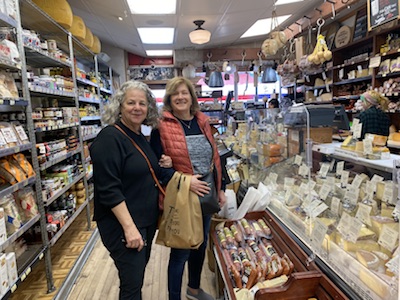
We visited some old favorites in central storico (via giulia, via giubbonari for shopping; campo de fieri market, roscioli salumeria and pizza takeaway, ibiz Leather shop where dirck bought a belt and I tried to remember where the purse I bought there 9 years ago is back in Chicago. (They would have cleaned it if I brought. Next trip.) we stopped for a drink in a lovely little piazza Mattei with its sweet 1598 sculpture and water fountain with nude dancers and climbing turtles.
Sora margherita ( crispy grilled artichoke) in Jewish ghetto Synagogue
We walked along the river lined with high plane/sycamore trees to the Testaccio market but wrong timing..,the market was closed, as were the shops. Dinner was far afield near the Vatican at the excellent Romanè, sort of akin to the rising chef bistros we went to in Paris. We wanted to bust out of our lovely but touristed neighborhood and eat where locals eat. Best pasta amitriana ever. And fun laid back atmosphere. We arrived at 8. Lots of people came an hour later.
Campo dei fiori and palazzo/art space on via giulia