About 1.5 hours south of Pittsburgh, we stopped at the site of the flight that crashed into farm land on 9/11/01, averting even more devastation in Washington D.C. (The terrorists were likely targeting the U.S. Capitol, or maybe the White House.)
The weather was fittingly gloomy, cold and rainy. The hardest part of the visit was listening to telephone messages that three passengers made to their families from the plane when they knew they would likely die. The plane had been hijacked by suicide terrorists, other planes had already crashed into the world trade Center Towers and the crew and passengers of flight 93 decided to thwart the hijackers plan to crash into the U.S. Capitol …which is a stone’s throw from where we are sleeping tonight, in an Airbnb carriage house in the Capitol East neighborhood, around the block from our son’s apartment. Flight 93 crashed in the tiny rural hamlet of Shanksville, killing all 40 passengers and crew aboard.
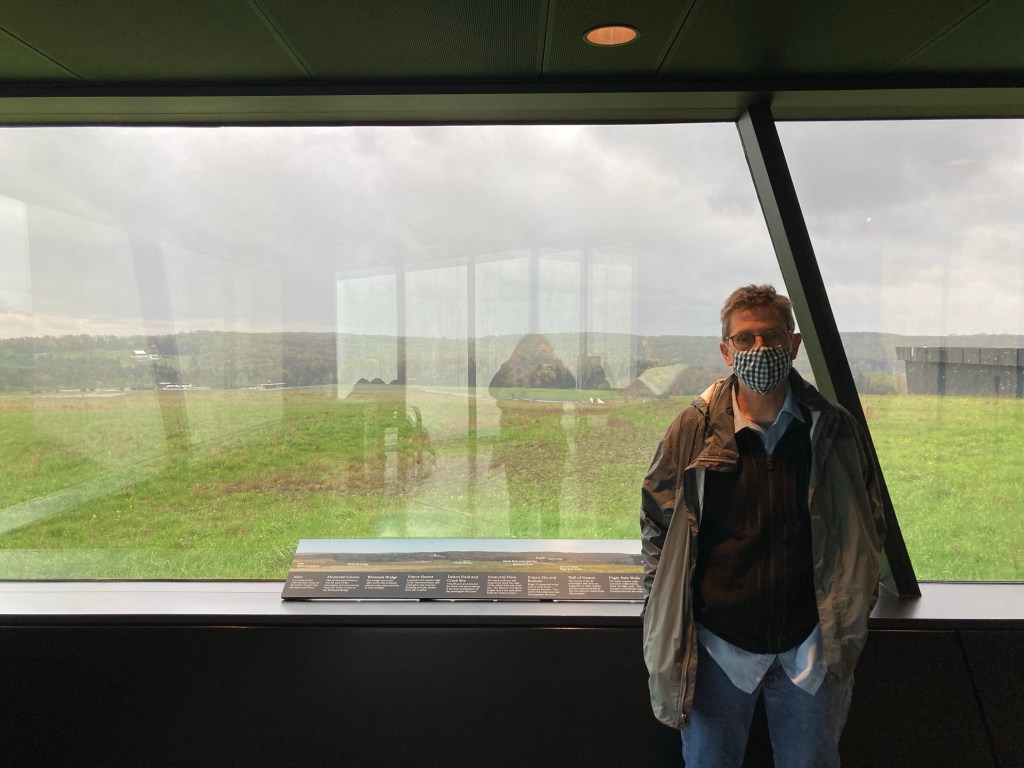
The memorial overlooking the flight 93 crash site.
The weather gradually cleared and we had blue sunny skies punctuated by the occasional slow moving dark cloud filled with showers and wind, nothing that kept us from bike riding all over with Noah. We started the morning at Eastern Market which is a block away from our well-situated and well-appointed Airbnb on 8th street near Independence (Noah’s street.) I fell for a delicious French pastry I’d never heard of, a kouign-amann ( “queen a-man) “a cross between a croissant and a palmier, with layer after layer of buttery, flaky pastry on the inside, yet caramelized with ever-so-slightly-burnt sugar on the outside,” according to Wikipedia.
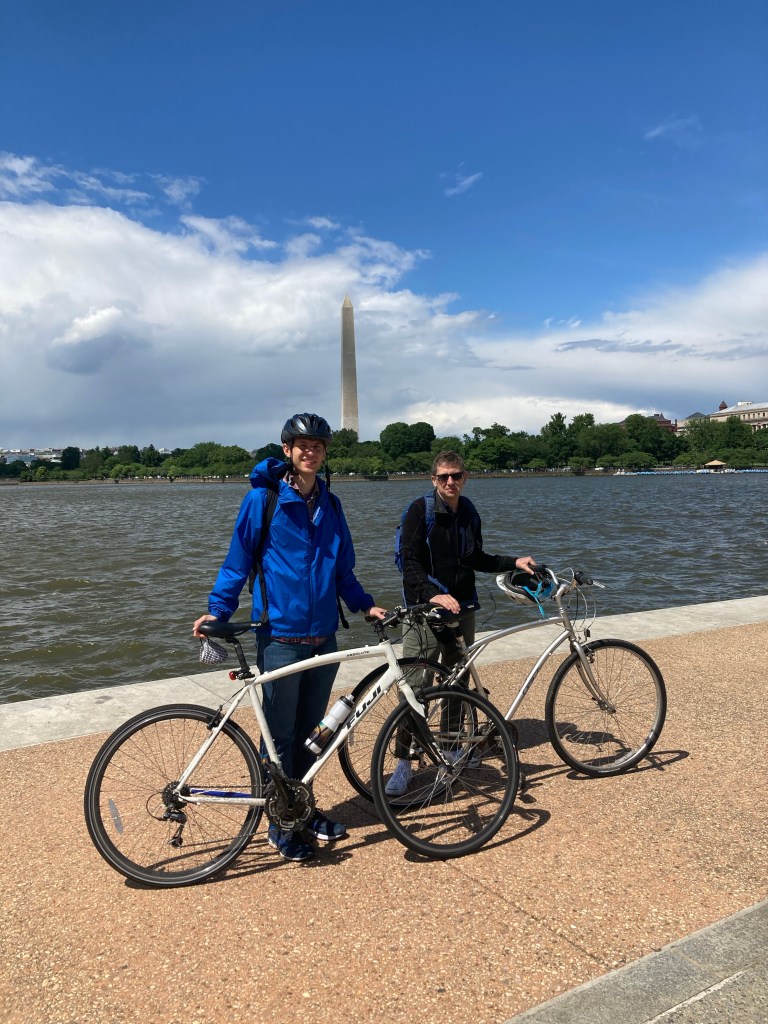
We rode in Noah’s lovely CapitolHill neighborhood, admiring the spring blossoms and old architecture. How strange to have the US Capitol as part of your neighborhood. I couldn’t help but think about the Trump rioters and the Shanksville 9/11 heroes as we passed that august building, now surrounded by a black fence and concrete Jersey barriers. So many threats. Next we glided onto the mall, past the smithsonian museums, the Washington monument and American U. college graduates in their robes posing by the Lincoln Memorial. We rode onto the Jefferson Memorial, covered in scaffolding and looked across the water at the MLK Memorial. We rode around Hains Point or some such which has a golf course and then over to the Wharf development that felt very un- DC, with high rises and trendy restaurants along the riverfront. We had Cuban coffee at Colada Cuban cafe.
After biking,dirck and I drove to Georgetown for a quick stop and purchase st the Allbirds (shoes) store, not far from a good burger place we got food from our first night called Good stuff Eatery. Dinner Was take out from a Chinese Korean place in Noah’s neighborhood called Chi Ko.
Very full and fun day seeing a variety of provoking art on a cool sunny Thursday. We began at a Croatian Catholic Church (St. Nicholas) in Millvale for a docent-led tour of the amazing murals inside painted between the world wars (1938, 1941) by Maxo Vanka, an Austrian painter with ties to Croatia. We were early so we drove up an impossibly steep one-lane road to a handful of houses clinging to the hillside, with spectacular views of the old brick mill, modest homes and river tucked in the valley.
The Vanka Murals are strikingly contemporary, with scenes of modern war, proud socialism and uncharacteristically (for churches we are told) strong females. The murals cover all the walls and high-domed ceiling and are in the process of being restored. Tours are offered on Saturday. We lucked into a Thursday tour, thanks to a bigger group that had booked and came 1/2 hour late.
Our Airbnb street in Lawrenceville Vanka murals Vanka murals
Next stop, a fresh fried fish sandwich at the Original Oyster House downtown on Market Square which gave us a chance to admire the interesting architecture, old and new, downtown. The fish tasted very fresh and fun to eat inside (yes, inside…post-vaccines) an old tavern with vintage photos of Miss America pageants and Pirates baseball.
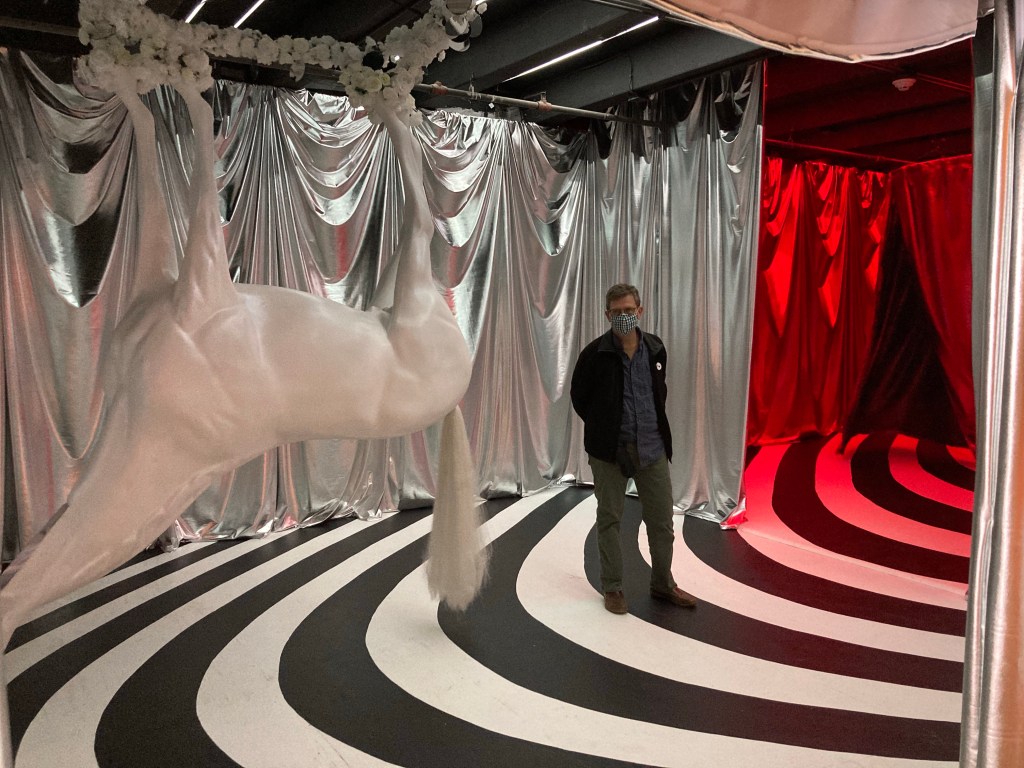
The Mattress Factory is in the lovely Mexican War Streets neighborhood, with gorgeous restored homes lining the streets. Fancier than Lawrenceville, not as fancy as Squirrel Hill. The museum specializes in “immersive” art and that it was, which was a bit challenging to navigate at times with my broken foot because we were sometimes plunged into complete darkness and had to navigate tricky steps and dark narrow passageways. Some artists we recognized – James Turrell and Yayoi Kusama.
Kusama polka dot and mirrors = infinity room
Beyond the four floors of the factory building are two neighborhood houses nearby, also with immersive installations. One installation takes up the entire three floors of the house, with holes cut in the floors so you can look up or down at the adjacent floor. Another had a Small piano hoisted awkwardly in the air on ropes and a song composed for the piece you could play on your phone.
Covid is also inspiring some strange art, this museum suggests.
Covid artVanka muralsMattress factory
We did a little browsing at sweet independent shops along Butler street. (Pastries at la gourmandine, buttercream) Quite a few have limited hours, perhaps due to the pandemic. People are good about wearing masks and/or reminding you to put yours on if you forget. (Mine hangs on a chord around my neck for easy in and off.)
We met old (younger) friends Dan and Elizabeth for dinner in a tented space outside Spirit, a performance space in Lawrenceville located in a former Moose Lodge.
With steep narrow streets lined with narrow row houses and so many iron bridges, hills and valleys, Pittsburgh struck me at first as a giant Easton, as in the river town on the other side of Pennsylvania, where my mother grew up.
We went first to ride the atmospheric funicular that climbs Mount Washington at a steep incline (hence the name, the Duquesne Incline), traveling inside an old wooden cable car. As promised, the view of the city fanning out across the valley below and up the opposite hillsides, at the convergence of three rivers, is spectacular. We returned at night to Grandview Avenue, which is lined with viewing platforms to see the city adorned with lights. Dazzling.
Grand view from the overlook along Grandview Avenue
We finally found the concentration of old warehouses and ethnic food purveyors along Penn Avenue in the Strip District and I hobbled along (my foot is broken) to window shop. (We stopped at a huge candy store, grandpa Joes to pick up some hard-to-find Royal Crown Sours.) Next stop, Squirrel hill, the fancy and yes, hilly, area with non-attached big brick houses and past the various Carnegie Museums.
Beer en masse
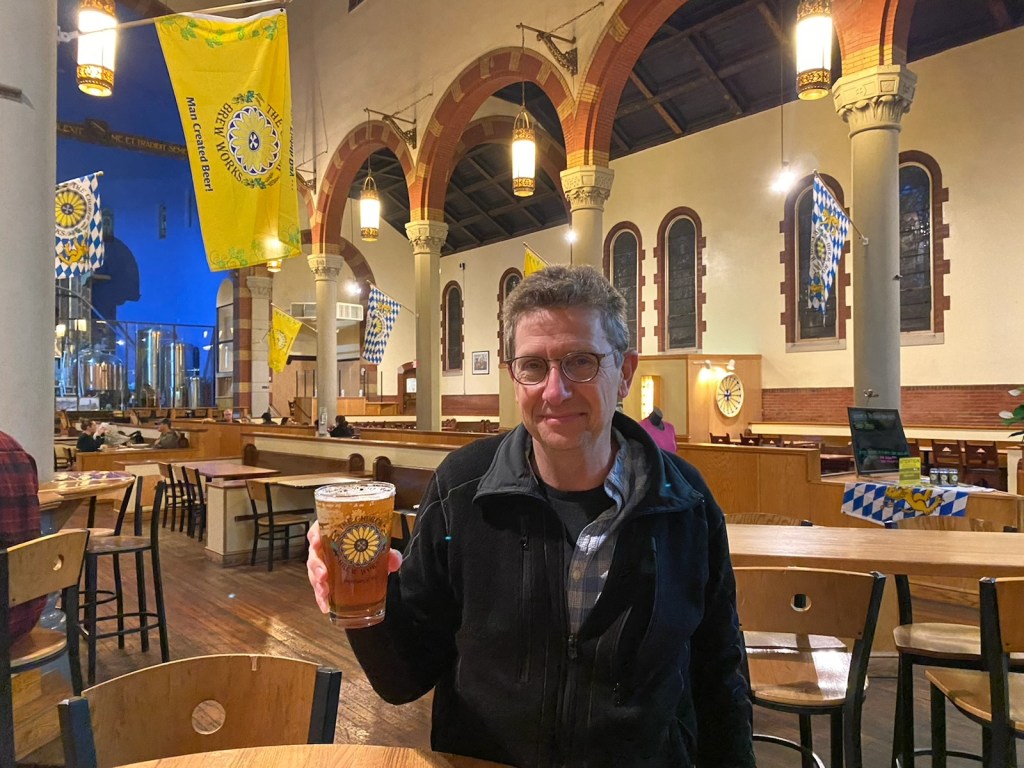
Our Airbnb is one of those narrow row houses in Lawrenceville with long caramel-colored wood plank floors and an old red brick fireplace. The street reminds me of my grandmother’s street in Easton (except it has hipster shops and restaurants a block a way on Butler Street). We entered through a little gate on the side of the white wooden row house and walked down a narrow alleyway to the back door. Dinner was good takeout pizza (pandemic style) from Driftwood Oven and then off to church for a beer. No joke. There’s a place called The Church BrewWorks in a lovely old high ceilinged Romanesque church in Lawrenceville. Dirck’s brother figured it counts as mass attendance.
(From early November) Reality set in as we drove home to Iowa from Bentonville. Our balmy weather suddenly turned cold and rainy. We listened to too much news about our awful current president denying the results of the election that booted him. And his awful Republican enablers. We also were clearly heading back into major Covid spread territory in Iowa.
But I am cheered by Biden’s steady leadership and ability to withstand Trump’s provocations. We stopped in the small Missouri town of Adrian to pick up a late lunch in Pecan country (and apparently in Trump country too,judging from the yard signs). We were the only folks wearing masks at Byrd’s Pecan Delights. fortunately we were also almost the only people in there. Not to be confused with Byrd’s Hoot Owl Pecans (great name), a farmers market in nearby Butler, Mo. Solid sandwich fare (chicken salad with, yes, pecans; a BLT) and bought some candied pecans for gifts and a slice of incredibly sweet chocolate pecan pie. Stopped at Gates in Kansas City for ribs to go and Dirck’s receipt came up with a STAR on it so he got a $10 bill. Only took 35 years of Gates visits to get that lucky! before we left Bentonville, we took me more bike ride, ending up for coffee at The Meteor, a cool little place in a bike shop near the Momentary. (Another one nearby is called theairport.)
Because of Covid, I booked an Airbnb with a kitchen and dining space so we have eaten all but one of our meals dans Airbnb, on a little wooden deck at a turquoise-colored metal table overlooking a sloping lawn with trees and a big stone mansion in the distance. We ordered takeaway from Oven & Tap, which made for two dinners – excellent flash-fried edamame, fried chicken and a margarita pizza. We had to wait a half hour beyond our pickup time, but other than lousy service, no complaints about the food! We also got excellent bread (orchard bread, rosemary polenta bread) from Ferrere, a bakery in Kansas City’s quality Hill neighborhood (near bluebird cafe)which has served us well.
Crystal Bridges’ North Forest Lights did not disappoint. At our scheduled time (8:15) we joined a socially distanced crowd to walk 1.5 miles along a lit path in the dark woods, stopping at 5 installations that combine music, lights, trees and sometime sculpture. It was mesmerizing. The woods was also dotted with sculpture, illuminated by lights. Loved this!
Today we rode bikes to Crystal Bridges proper and showed our timed tickets on my phone to get in. The museum is free. We paid $ 12 per person for an interesting show of photography by Ansel Adams and a host of contemporary landscape photographers. It took me awhile to figure out how to best see the art, given we must wear masks. I thought contacts would be best but after getting warm riding my bike, my vision was blurry with the contacts so I switched to glasses. Next issue, my glasses kept fogging up so I’d have to wait until the fog cleared to see the photos. I finally figured out a way to put my mask a little lower on my nose so my glasses didn’t fog. For the most part, other people kept their distance but every once in awhile some clueless person would get too close. I just moved away. We did eat lunch in the museum’s cafeteria because there were only a few tables with people, we found a table far from everyone, the space is huge with high high ceilings and glorious views of the ravine and yellow and orange leaves on the trees.
As a travel writer (and as a traveler), I seek out the places that feel emblematic of the place I’m visiting, with a storied history and local cuisine, with atmosphere, character and grit. Some of those places, sadly, have been felled by the pandemic as I learned in a NYTimes story yesterday. Oddly, we drove past The Rieger restaurant in Kansas City during a day trip there on Saturday and vowed to return once we can to eat at a place that not only had inventive food but allegedly a bathroom that gangster Al Capone once peed in. Sadly it is no more, as the NYTimes story reported. I had been to three of the nine restaurants mentioned in the story – including the Brookville Hotel in Abilene and the Cake Cafe in New Orleans.
End of an Era in Kansas
I first went to the Brookville Hotel – which specialized in fried chicken and biscuits – in the mid-1980s when I lived in Wichita. The 1.5 hour drive to the tiny worn town of Brookville was worth it, to eat in the old tumbledown hotel that was mostly (or maybe completely) a restaurant by that time. I took many a visitor there as well, since it was so evocative of old time Kansas. A lot of atmosphere was lost when the restaurant moved to a faux hotel recreation on the edge of Interstate 70 in Abilene but the chicken and biscuits were still great. Our memory is the wait staff only asked two questions: What kind of salad dressing do you want? What do you want to drink? Otherwise the order was chicken and biscuits.
I wandered into the Cake Cafe a few years ago while exploring the Marigny and Bywater districts. It was a cheerful alternative feeling coffee house, painted yellow on a quiet corner. Very cozy and they were advertising their NOLA-classic King Cakes with the little plastic baby in them. I had only an orange juice, resisting the tempting pastries (which I now regret) and sat outside, back in the pre-pandemic days when you didn’t do this for your health and safety.
The pandemic has caused so much devastation – first and foremost, deaths and lasting health consequences for people, but also devastation to businesses and livelihoods, some that make a place distinctive. On a happier note, we did get carryout at two Kansas City classics that appear to be hanging in there — ribs from Gates BBQ and a chicken dinner with cinnamon buns (not biscuits) at Stroud’s. We need to remember to keep patronizing these places, helping them to survive.
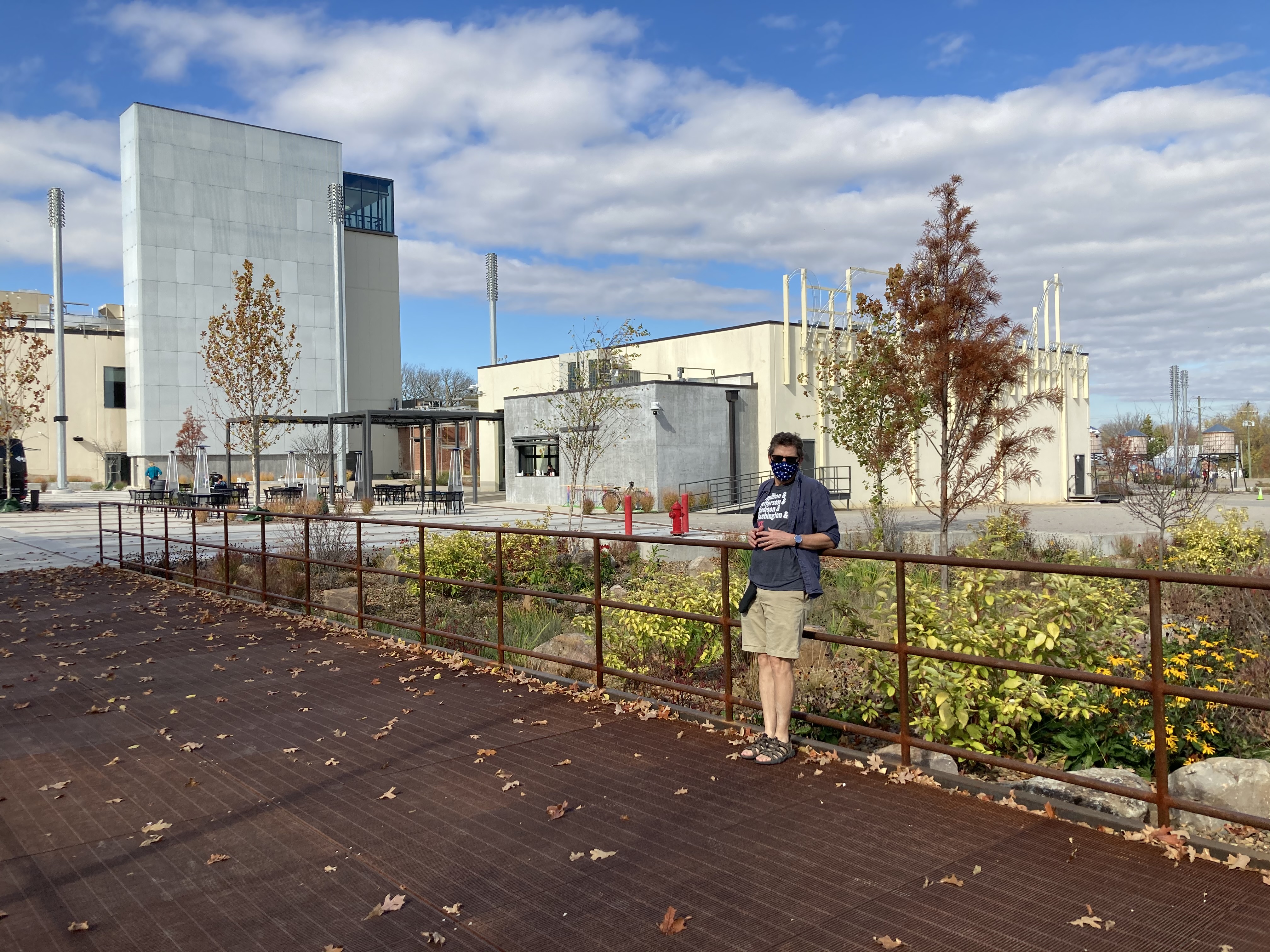
Sorry for the confused posts. WordPress is mucking up. Anyway, here is Dirck at The Momentary, a contemporary art space in Bentonville. Below is a scene at North Forest Lights, a spectacular sound and light show in the forest north of Crystal Bridges Museum, here.
On our third visit, Bentonville continues to intrigue us. It’s an unlikely mix of small town and boom town, of traditional values and cutting edge contemporary art, of dare devil mountain bikers and artsy looking visitors, hymns played on the 5 p.m. Sunday church bells and a wild Nick Cave avant-garde installation at an industrial chic museum in a former Velvetta cheese factory.
With Covid raging across the land (Arkansas is slightly less beet red than Iowa on the Covid map…although it may as well be the political map too), this has been an easy place to social distance. We rode our bikes up down and around the Razorback Greenway trail that is right near our Airbnb and runs north-south, curving through dense hilly woods along a ravine by Crystal Bridges museum, past sculpture along the “art trail” and paralleling a crazy off-road dirt trail with jumps and platforms that draws daredevil teens and adults.
In town, the trail skirts the pristine town square, lined with well-tended old brick buildings, and heads through neighborhoods with a remarkable mix of architecture, from tiny unassuming shacks and ranch houses to massive elegant old mansions and new modern mansions that sit close to the street but are block-deep and high, lots of tin, wood, porches. Some newbies tower over their smaller older neighbors. One house in our neighborhood must be four times the size of its neighbor.
Our Airbnb is just northeast of the square in what seems like the newer part of town on NE 2nd St., which feels a little more rural with huge lots than the east side. We are behind our Airbnb owner’s attractive ranch house, in a spacious studio apartment tacked onto a barn-like garage. It is country chic inside and incredibly well-equipped, down to the homemade marshmallows, Hershey bar and graham crackers for s’mores, using the brick fire pit in our very private back yard.
We also have an outdoor deck where we have eaten all our meals because it has been so incredibly warm (and we are not eating out during a pandemic). Our view looks out onto woods and a ravine. Past the ravine is an intriguing stone mansion with a French mansard roof. We finally walked around the block to see it. Turns out it’s even more enormous than we thought, on a street with three more huge tasteful houses with private electronic gates. As D says, we are in Hamptons Territory here, which is weird because this is, or used to be, small town northwest Arkansas. We assume many of the new fancy homes being built all over town are for Walmart bigwigs.
I haven’t even gotten to the museums, which is why we came here. We biked about five minutes south to The Momentary, the dramatic industrial cool museum that opened last spring as a hipster offshoot of Crystal Bridges Museum. It’s an industrial retrofit, with poured concrete walls and large high-ceilinged spaces for huge installations so it was well-suited to Nick Cave’s over-the-top concoctions. We started in one large room filled with dangling cut tin ornaments in many colors and shapes, that grew and shrank and shined with the breeze.
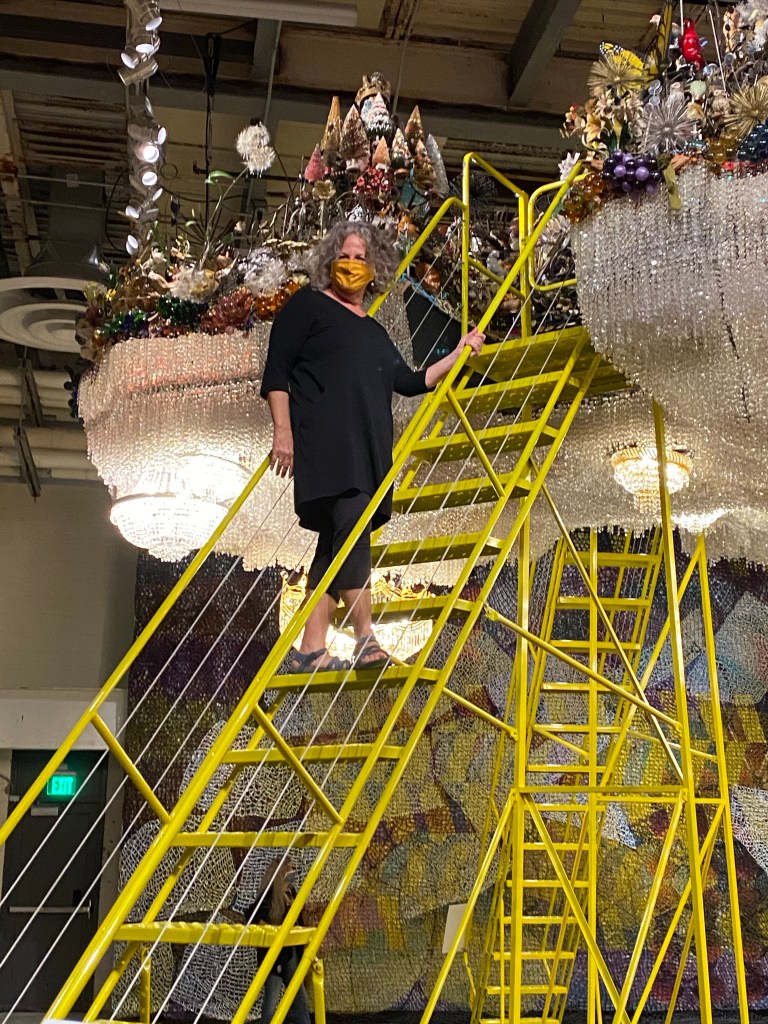
The main attraction is an enormous hodge podge of kitschy stuff – – ceramic birds, beads, old sambo sculptures and black-faced jockey lawn ornaments (the very un-PC ones) crowded astop an enormous tacky chandelier. To see it up close, we could climb one of three yellow metal ladders to a small clearing. Given Covid, we had to wipe our hands with a sanitary wipe before and after climbing. We also went to another viewing platform on a balcony, which we had all to our own. (There were few visitors to begin with.)
Outside, on a vast lawn with a huge tarp/tent, there was supposed to be activities like yoga and meditation but they never seemed to materialize, even though I signed up for something called sound and light. Circles were drawn on the lawn to help people sit six feet apart. We rode bikes to a nearby former industrial space, that had a few shops and food place, including 8th street market which was mostly closed on a Sunday. We walked through one space called Holler where a few young people were playing shuffleboard on a glossy wood floor in the middle of a space lined with a bar and tables to eat burgers and ramen ordered on a computer screen. Not sure where the food was coming from. There were a few food trucks outside. We went in one lovely shop specializing in textiles and wool, with beautiful indigo dyed cloth and paper like we saw in Japan.
We rode around the market district surrounded The Momentary , another interesting mix of old housing and new contemporary homes. Then we rode north on the razorback greenway trail through the prettiest stretch, winding through the woods past and north of crystal bridges. A bit hairy to navigate at times with strollers and mountain bikers on crazy trails parallel to our more sedate trail. The northern bit of the trail that leads to a small lake was closed due to construction. We ended up taking another trail (north Walton) back. Although it runs parallel to highway 71, most of the time we were hidden in the woods and it was far less crowded than the Razorback greenway. Once we got to town, We rode on a combination of what felt like country roads and trails. Later this evening we took a long walk, admiring the mix of architecture and homes east and west of the square.
(From our September trip) We drove 6.5 hours south through gorgeous wide open country, ranch land , Indian reservations and South Dakota Badlands to Valentine, Nebraska, just over the South Dakota line and from there 40 minutes east to Sparks, NE where we are suddenly in a huge cabin (sunny brook cabin) by the side of the river — quite a change from the past three nights lodging where we had only a room to ourselves and the rest was shared space.
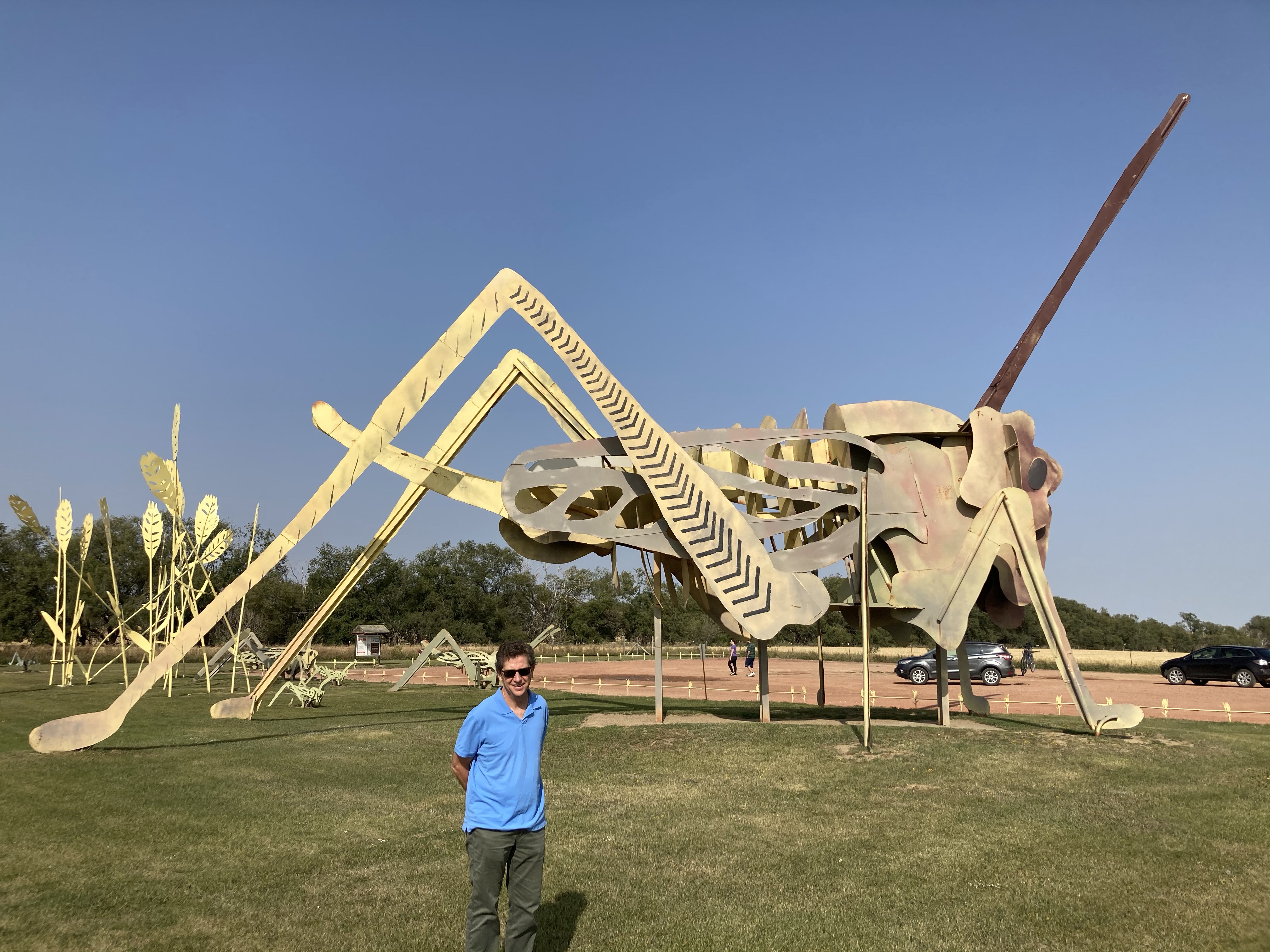
A highlight was the early part of our trip when we drove down a two-lane highway south from I-94 to Regent, ND through vast open fields of pasture, sunflowers and corn. The road was dotted with about six huge fantastic cut metal-and-welded metal sculptures, designed by a guy looking for a way to boost the economy of his small struggling town of Regent. It seemed to work because we weren’t the only ones opting for this road (there were other options) and pulling off every few miles to stare in wonder at massive metal sculptures — a grasshopper, flock of geese, fantasy fish, a farm family and of course Teddy Roosevelt on a bucking horse. Regent has a handful of worn buildings, several empty, one with a local history museum and one with a good gift shop where we bought a small replica of one of the EnchantedHighway’s metal sculptures. That will spice up our garden back in Iowa.
We made a u-turn in the small northern South Dakota (that’s confusing terminology) town of Lemmon, after driving past a local butcher, LemmonMade.
Me: Wait,wait, slow down, what was that?
Dirck: (half-heartedly) you want me to turn back?
Me: Yes please.
Dirck: (3/4ths-heartedly) Okay.
Turned out to be a great find. We loaded up on fresh brats, ground meat and teriyaki beef jerky— from what smelled outside like very nearby livestock. When in the Dakotas…
In South Dakota, we found a tiny picnic area by a small lake to eat lunch (now starring the beef jerky) and continued on almost empty two-lane highway through several reservations (standing rock, Cheyenne river, pine ridge, and rosebud.) We saw only a few signs that we were in tribal territory including a handmade sign reading “Indigenous Lives Matter,” a casino area inside a gas station/convenience store and a Covid -19 checkpoint at the Pine Ridge Reservation manned by several no-nonsense Native Americans wearing masks, the only masks we saw during our 6-hour drive. (We didn’t go through the checkpoint and probably couldn’t. Tribal communities have been hard hit by the virus and are taking it seriously. The checkpoint was a sign we were driving the wrong direction. Fortunately briefly). We also passed a fat ass tractor flying a Trump 2020 flag and a few other trump signs.
Now we are in our rustic cabin by the Niobrara River, which we discovered has no plates, cups or silverware – apparently removed due to Covid. This place isn’t cheap so not good. We fortunately were warned to bring our own bedding and towels, also a preventative Covid measure, which doesn’t make that much sense science-wise. We had some plastic plates and plastic ware in the car so we managed to eat our brats (purchased at the roadside butcher in Lemmon, ND.) We also wisely grocery-shopped at the IGA in Valentine before the 40-minute drive to this remote location. It’s on a beautiful isolated bend in the river which we will paddle on tomorrow morning.











 TakeBetsywithyou