 We should have set aside more time but in three hours we still managed to visit four distinctive barns in Central Iowa (Story and Marshall Counties) on a spectacularly beautiful early Autumn day. Thanks to the Iowa Barn Foundation for making this opportunity possible, free of charge (although I now realize I need to make a donation to support the foundation’s worthy work of preserving Iowa’s old barns, and in the process, its rural heritage and agricultural history.)
 The hardest part of the two-day fall tour — held annually statewide (the spring tour focuses on one geographic region) — was deciding where to go since there are so many barns on display. The Foundation breaks the state into nine geographic regions, which is a helpful start. I looked at the regions closest to Des Moines (central and south central) to see how many barns are listed and their locations. I thought we’d head southeast to Madison County but a few minutes into the drive, as I was looking closer at the Foundation’s list, I realized that Story and Marshall Counties had some particularly cool barns and a few were within miles of each other so we could see several in an afternoon. My patient driver (Dirck) switched course and we drove northeast instead.
Some other tour-goers I met told me that the Foundation used to provide maps showing the specific locations of the barns/farms, which would be helpful. Without that, some tour-goers now map out their tour in advance — which is a smart idea and an improvement upon my last-minute geographical plotting. Although in remote locations, we found the barns easily, thanks to GPS and 911 emergency system requirements that the smallest of gravel roads have names or at least numbers.
The four barns we visited differed in terms of architecture and degree of restoration — although they were all similarly situated, on remote gravel roads in the countryside, usually beside a pretty old farmhouse and a prosaic modern metal shed that has largely replaced traditional barns. As my resident ag expert explained, old barns weren’t built for today’s agriculture. They don’t have big enough doors or enough space for large machinery. And today’s livestock hang out outside, unless they’re stuck in big metal confinement sheds.
The experience of visiting each barn also differed. At the first barn in the small town of Fernald, north of Colo, – a rare square barn built in 1875 and restored in 2004 – we pulled up to a farmstead with no signs of life, but the door was open to the pretty red-painted wood barn with a limestone foundation, accented by nearby pink and orange asters. Great that we could walk right in, where we found a sign-in book and a table laden with plastic containers full of sweets – sweet rolls, Kringla, cup cakes, cookies, brownies, chocolates. No invitation to partake and no place to donate. I couldn’t resist trying a few sweets – including a decadent peanut cluster and German Sweet Chocolate brownie.
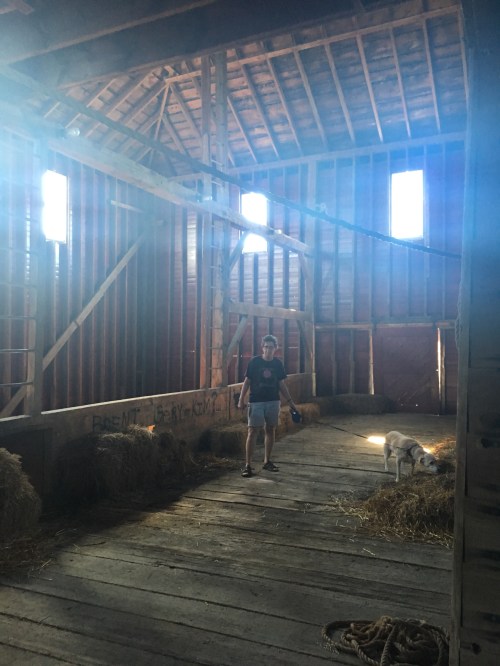 Built on a farm bought by the Handsaker family in 1853, the square barn inside was very rustic — they all were, with late afternoon yellow light filtering in through the windows and spaces between the wood plank walls, spotlighting the interior’s sturdy latticework of wooden beams. (Because the barns were built before electricity, and electric lights. they often have lots of windows and natural light.) It was refreshing to wander around with no directions or posted cautions couched in legalese (i.e. warnings about taking your life into your own hands by walking on narrow rickety steps up to the barn’s second floor hay loft or wandering on the sometimes less that solid feeling wood planks of the second floor, past openings with sheer drops to the bottom floor.) The downside is that these barns were definitely not built to be disabled-accessible. We brought our dog Millie along and had to keep her on a leash to make sure she didn’t do anything stupid/harmful.
Two women later pulled up from Pottawatomie County (near Council Bluffs, about two hours west) and they appeared to be tour veterans. I got the impression they pick a different region to tour each year. One woman has received a grant from the foundation to restore her grandfather’s 1905 barn near Oakland, Iowa. I need to find out more about the Foundation’s grant-making but I gather it awards grants for restoration that recipients must match – and they also must agree to open their barn to public view during the tour. I also gather the Foundation lives on private donations. One barn owner told us they got a $50,000 grant. I don’t know what the max or min or average is. Or how much that covers of what can be very costly restoration projects.

 At the second barn we visited in Colo –a more traditional straight-walled barn built in 1885 — we joined four other people (three from Ames, one from Nevada – the state, not the small Iowa town near Ames) on a casual tour mid-stream led by the young owner who along with his wife has taken on the barn restoration as a hobby after moving to the farmstead a few years ago. Unlike some owners we met, they’re not farmers. They both work in Ames but wanted to live out in the country on an acreage. They do have some cattle and pumpkins growing in the garden and a beautiful Victorian farm house with a tasteful modern day addition. Their partially red-painted barn in on the National Historic Register and they are doing intensive labor to rebuilt the inside to near original state, with plank-and-batten siding/paneling (aka board-and-batten or wainscoting that alternates wide boards and narrow wooden strips called battens) and using original materials (white oak, pine, cottonwood) which has meant finding and bringing back wood from Wisconsin by rail and then by truck, as well as wood found online (“I’m a Craig’s list junkie,” he told us.) They are taking advantage of modern-day technology by using power tools rather than hand drills.
Unlike some of the owners, these owners did not grow up with or inherit their barn/farm so they have spent considerable time trying to figure out what various bits of the barn were used for and what materials they need to restore it. They hope to have the job done in a few years.
“I really do love doing this kind of stuff – I don’t golf or play softball so I get out here to use my brain for a different purpose. I read a lot,” he told us. Noting how the heavy wooden timbers are help together with wooden pegs (not nails) at the joints, he said, “When you think about all the ingenuity back then, it’s kind of staggering. It’s basically like a wood ship built, upside down.”
The Barn Foundation’s website (full of interesting material) includes a piece by the previous owner written for the 2015 all-state barn tour, with great historical info: The barn was built by an Irish family (the Mulcahys) who bought the land in 1872 from the federal government and they owned it until 1999 when it was bought, improbably, by a young couple from New York City who wanted to raise their kids on a farm. They started with the renovation- pouring a new foundation, putting on a wood shingle roof, and hiring “frame straighteners to square the roof.” Without this, the barn would have collapsed. The next owner (and author of this history) from Texas found the barn in distress, a decade after its renovation. He started another restoration, with a matching grant from the Iowa Barn Foundation. He loved the “old world air” of the farmstead, which includes other 19th-century burilindgs including two corn cribs, two chicken houses and a coal building. Interestingly, he notes: “I did not restore the barn to perfection; I believe one loses the historical essence of something when you replace all the parts with new. To that end, I’ve kept the original siding on the barn, warts and all. The barn has a sound foundation, roof, good doors and windows, plus nice red paint with white trim work. It looks like a structure that has survived the test of time and will for many years to come.”

 The third barn (on Elmnolle Farm in State Center) is a massive round barn (65 foot diameter), made of peeling white-painted wood and a stucco roof, built in 1919 from a pre-cut kit designed and made to order in Davenport, Iowa. It cost $6000. I’ve seen a few round barns from the road but they are even cooler inside. They feel almost like cathedrals, the ceiling is so high and curved. There is a massive (12 x 35) clay block silo in the middle (built with blocks from Lansing, Michigan), surrounded by 13 dairy cow stanchions, five double horse stalls, two box stalls, two grain rooms, a milk room and tack room. Truly a “general purpose barn.” The barn is topped by a large round cupola with windows, louvers and a conical roof.
Although oddly round, the barn still has a classic inverted U-shaped, gambrel roof, aka “Dutch or barn-style roof,” which wikipedia tells me is a symmetrical two-sided roof with two slopes on each side, the first slope shallow the second steep, which is good for water run-off (preventing mold and mildew) but not as good as other roof styles at withstanding heavy snow or high winds. But the owner told us the barn’s overall round shape was, at the time, considered sturdier and better able to withstand strong winds than a straight-sided barn.
Considered experimental, back in the day, it was interesting to learn how the barn was laid out, like theater-in-the-round, for agriculture – apparently round barns were thought to make more sense space-wise than a more traditional barn, providing more storage and a circular layout so it’s easier to get to things than having to walk down long narrow corridors. This barn was part of a century farm, which means the same family has owned it for 100 years. The woman showing us around turned out to owner of a parked nearby with the Georgia plates. She and her husband live there and here, on the farm first owned by her grandfather (“he was a little forward-thinking” she replied when I asked if people thought he was crazy to build a round barn) and then her father (born the farm in 1916) and then her (born on the farm in 1941).
“As a little girl I loved to tag along behind my dad,” she recalls, although girls and women didn’t do as much farm work in those days as they do today. “I finally go to do a few things” including stacking hay. “It was scratchy and it was dirty.”
The round barn needs a new roof and shingles – no small or cheap task – and a new second-level floor, a bigger project than the maintenance effort they envisioned when they applied for their first grant of $50,000. They have been encouraged to apply for another.
 The fourth barn, red-painted wood, restored in 2006, had a lovely little cupola at the top and the owners had a thick scrapbook full of family photos and mementos from the many years the barn has been in the family. One was a hand drawn map with the names and locations of various horses that bunked in the barn. The cupola says 1906 on it but apparently that marks the date when the barn was moved, a little back from its original location nearer the road. The owner didn’t know how old the barn was but said it was on the property when his grandfather bought the farm in 1893. The owner pointed out handprints in the cement floor – made by his grandfather as a child and his sister. Although the barn is now empty, he said it used to house milk cows and hay bales. And the current owners kids kept goats, horses, sheep and pigs in the barn.

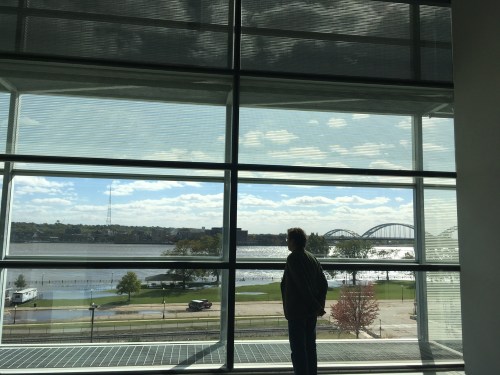 Finally made it to the Figge Museum, thanks to the Des Moines Art Center’s Docent program. I enjoyed the French Moderns show, a traveling exhibit from the Brooklyn Museum, but also enjoyed the fabulous outsider art of William Hawkins, an exhibit of John Bloom (liked his rural scenes much more than the work of his known wife Isobel.) The Figge building, the first new major U.S. commission for English architect David Chipperfield (whose latest commission is an addition to the Met in NYC) is stunning. It’s clad in white see-through glass with huge windows looking out to the Mississippi and high white ceilings inside.
 We stayed at the renovated historic Hotel Blackhawk which was organized by the tour, otherwise I would stick with a much less expensive Airbnb, although the hotel had some charming features including an old-fashioned atrium lobby and a funky bowling alley /bar in the basement. I’m also curious about the artsy Current Hotel, which has a fantastic rooftop bar called Up, with an outdoor patio with stupendous views of the river and lock and dam. We bumped into the Democratic Gubernatorial candidate Fred Hubbell who was preparing for a debate today. We wished him well!
 Dinner was very good at The Faithful Pilot, about a half hour drive north in LeClaire. Three others joined us and we were all happy with our meals and each other. We all had small plates. Dirck and I had excellent pork belly with potatoes plus mussels in a light tomato sauce. Glad we booked ahead. Small place and busy. It has a cool view of the old riverboat beached behind a glass wall in the local history museum and a cozy atmosphere, with an occasional train rumbling past, near the riverbank.

 During our adventure on the 18th annual barn tour offered by the Iowa Barn Foundation last weekend, we found some unadvertised sights including an old motel, cafe and vintage “service station” along Iowa’s stretch of the famous Lincoln Highway, the nation’s first transcontinental road for automobiles connecting the east and west coasts, opened in 1913. (Fun fact: it was also the first national memorial to President Abraham Lincoln, predating D.C.’s Washington Memorial by several years.)
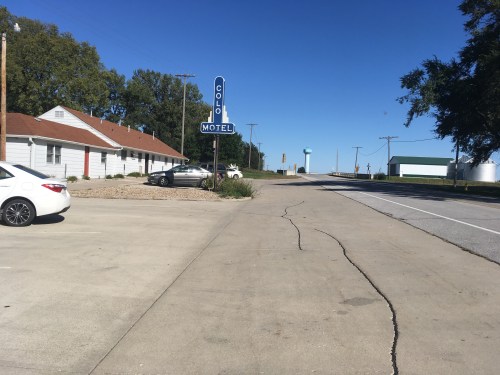
 The plain white Colo Motel looks pretty basic. Rooms run about $50 a night. The Niland’s Cafe looks like it has been restored or redone in a nostalgic vein, complete with a sign outside advertising “hot coffee and Kool cigarettes.” It was closed when we arrived (open until 2 p.m. on Sundays) but we peaked inside through the windows and it looks like a time capsule. Word has it the food is pretty good. I’d like to return.
 The restored 1940’s era “service station” definitely is no longer functional. The pumps are vintage fire-engine red contraptions and the gas costs 17 and 8/10ths cents a gallon, including tax. One of the explanatory plaques placed around the crossroads let us know that Reed’s Standard Service Station operated from the 1930’s until 1967. It replaced an earlier station nearby opened in the late 1920’s. The station’s design includes a flared roof line, large canopy and other features linked to the Arts and Crafts design movement of the early 20th century.
 We also happened upon a tiny pioneer cemetery on the edge of the road, near the town of Rhodes, surrounded by what appeared to be a fledgling Christmas tree farm. Some of the grey/white marble stones were so worn, we couldn’t make out the engraving. But several mentioned pioneers from the 1860’s, including one that read “1869 Still born dau”…which I presume was a still born daughter.
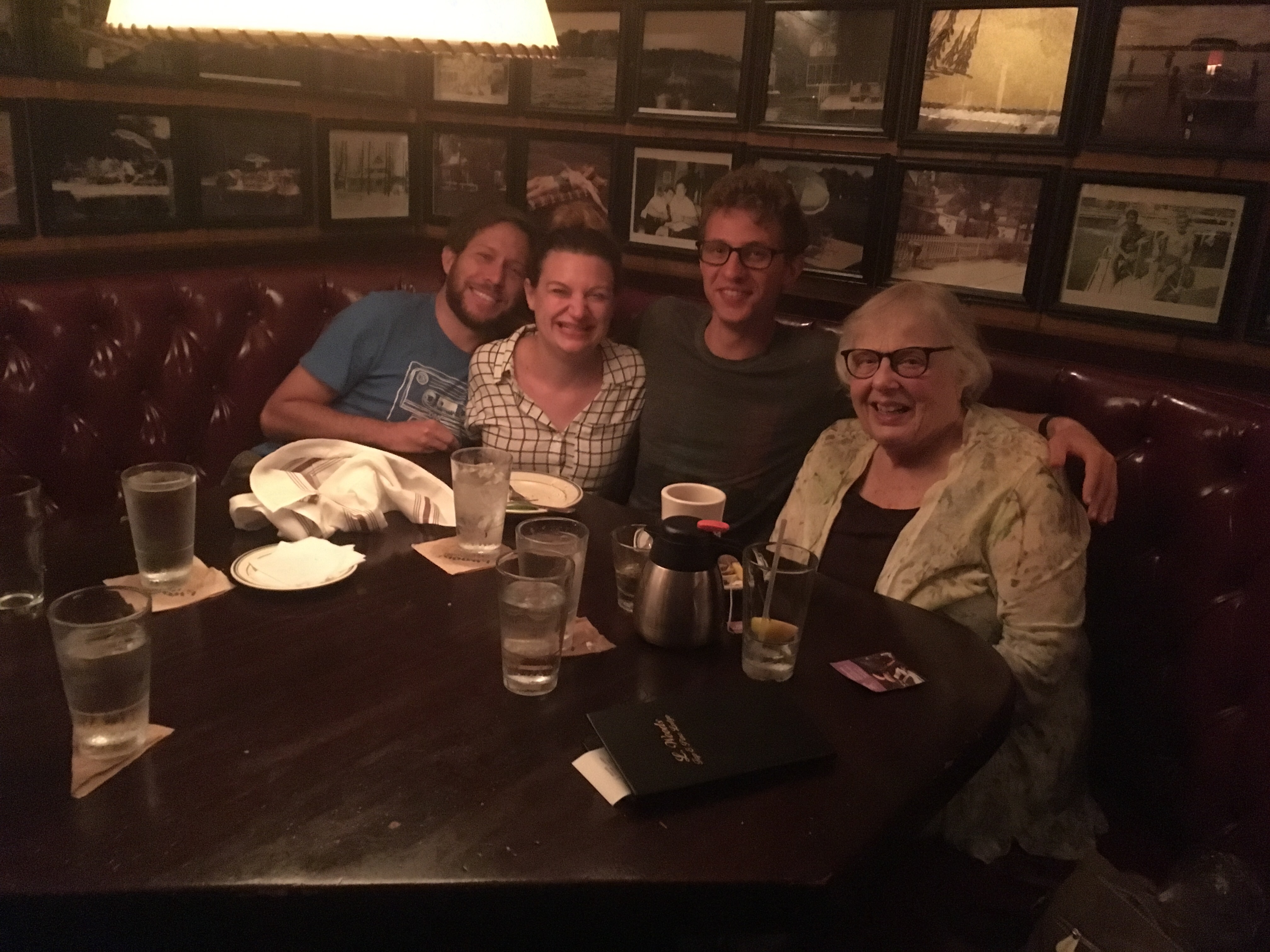


 Kids played in the sand, small groups (black and white, although not mixed) sipped drinks at outdoor tables, two bands played an stages near muscle cars on display (a fraction of the vintage cars participating in the annual Dream Cruise further north on Woodward Avenue). Barbara forgot her purse at our table, walked back to it after a few minutes and there it was waiting for her, all items accounted for. Gives you hope for Detroit’s continued renaissance.
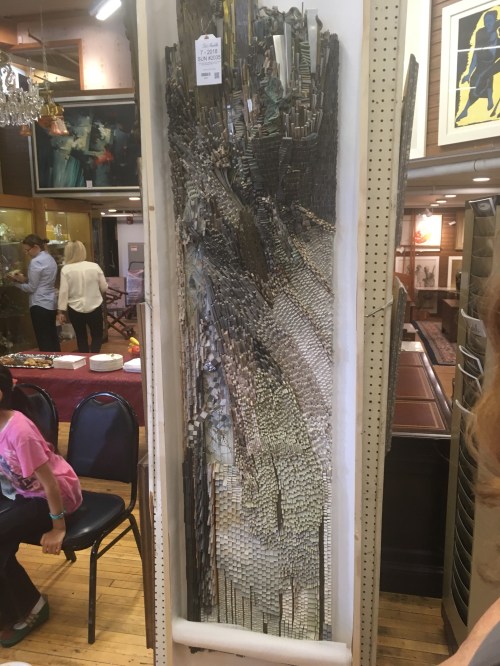
 We also wandered into Moosejaws, a Detroit outdoors store, among several inviting cafes and shops nearby and more to come — a big Shopping Center is rising soon on the site of the famous old Hudson’s Department Store that I used to go to with my mom in the 1960s and 70s. We also dropped in at a famous old auction house across from RenCen and by far the best piece for sale was a piece by Glen Michaels, father of a high school friend.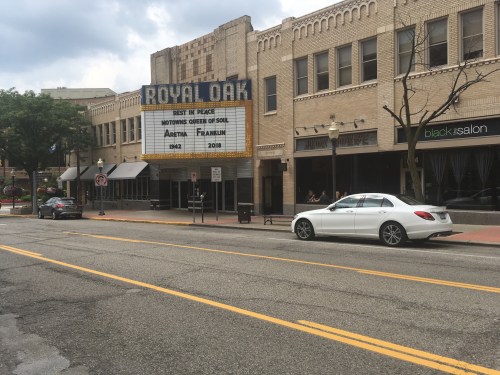


 We had good Indian food at Priya near Troy, including onion badjis (which the restaurant called onion pakora) and dosa, a southern Indian crepe, plus more traditional fare like saag and shrimp tikka masala. Then onto Rays ice cream in royal oak where the kiddie scoop I got was just as enormous as the regular scoop. Not complaining.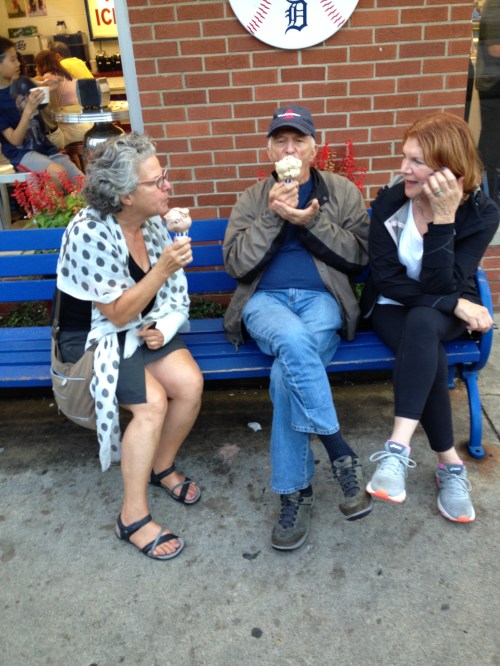

 TakeBetsywithyou