Amazingly enough, there was no line and no customers at the Sixt car rental office on a residential side street near LaGuardia Airport on Thanksgiving Day. We sailed right in and right out. In minutes we were driving a very large GMC Acadia SUV. Not the compact car we reserved (or paid for) but very comfortable and clean.
This Sixt experience was a marked improvement over recent rentals with Budget during Thanksgiving, when we had to deal with painfully long lines and rigamarole. This is the second time in recent months that we have had an excellent experience with Sixt (the earlier time was October in Bari, Italy) so we will definitely be return customers if the price allows! Apparently sixt is a German company founded in 1912 and made a deal in 2020 with Lyft so people can use the Lyft app to rent a Sixt car.
I’m not the only happy camper.
SIXT Named Best Rental Car Company in USA Today Awards
Written onboard: This isn’t exactly a “fast train” – it’s making several stops between Bari (in Puglia) and Rome but it’s 4.5 hours, faster than other trains we spotted that took 6 or 7 hours. And the price is right — 16 euro (about $20). The train left about 10 minutes late. It’s a good thing we booked ahead. The seats are comfortable but train is full and there’s not a ton of leg room. I am trying to avoid footsie with the long legged young man across the table from us, who occasionally nuzzles his female companion.
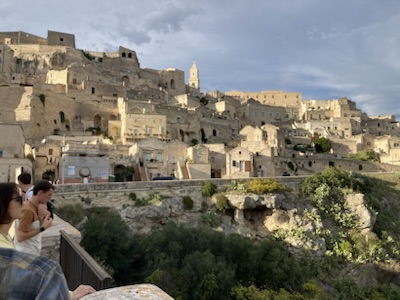
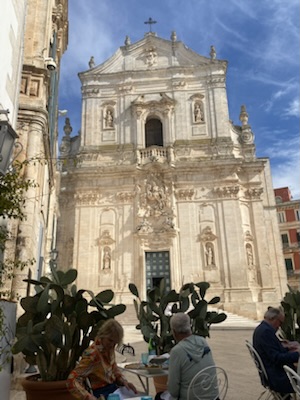
Matera cathedral
There is supposed to be Wi-Fi but it’s spotty. Initially the train was moving in the direction of our seats, north along the Adriatic coast but after a few stops we’ve now moving backwards, northwest through mountains.
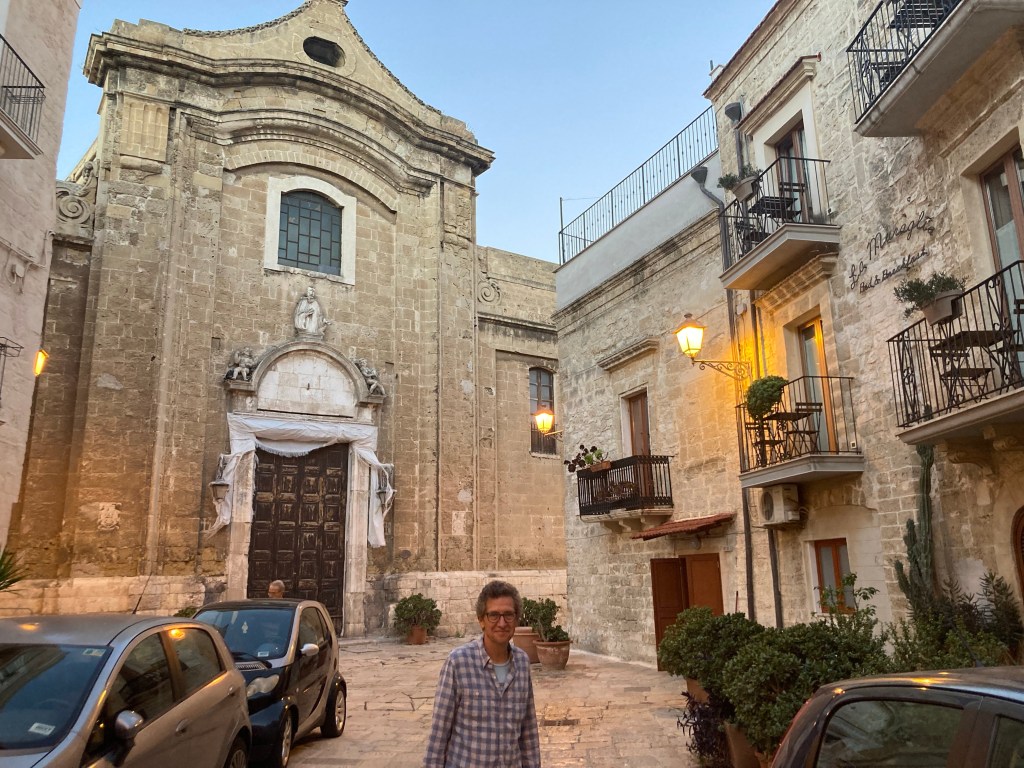
Bari vecchio (old town)
I am glad we finally made it to Puglia. Matera was the highlight, which is technically in Basilicata, not Puglia. It’s unlike any place I’ve ever been and, better yet, we felt like we got to know people there (our guides, Airbnb host) who offered insights about life there. Our little trulli house worked well. It was interesting to be the only tourists in a little Puglian backwater. We didn’t see the Adriatic coastal resort towns like Polignano properly or get north to the gargano pennusula or south to Otranto or other Salento region spots in Italy’s heel. Next trip.
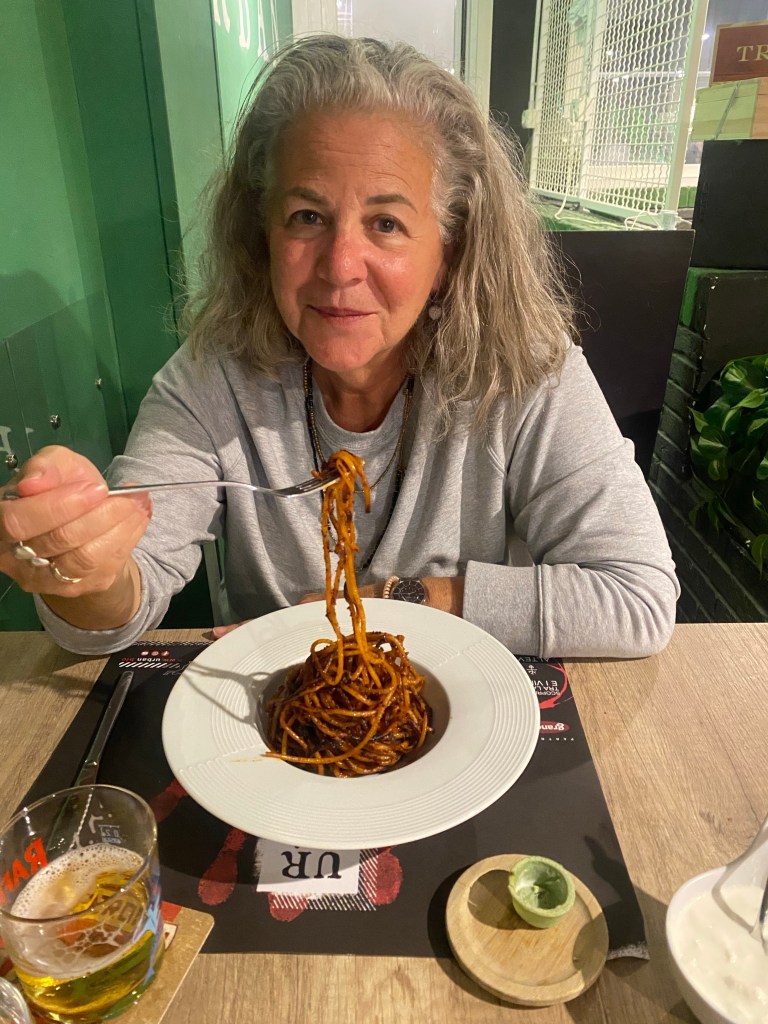
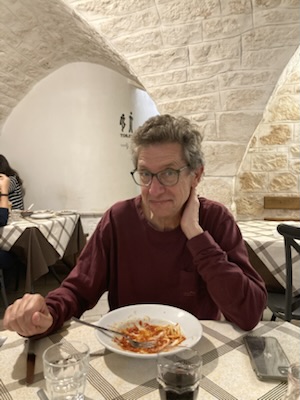
Assassin pasta in Bari
Next trip, we also will have an international drivers license, the lack of which almost messed up our trip because our original rental car agency wouldn’t give us the car we’d reserved. Puglia is hard to explore without a car, especially val d’itrea’s pretty backroads (where our trulli was located). Train service is limited. Fortunately we found another rental agency nearby that would rent us a car. We also got an international license online but word has it a physical copy, beyond a digital copy, is required. Apparently the license rules changed recently because we have never had this issue. (And the car rental company did not properly warn us.) We rented in France last year and in Italy two years ago with US licenses and passports.
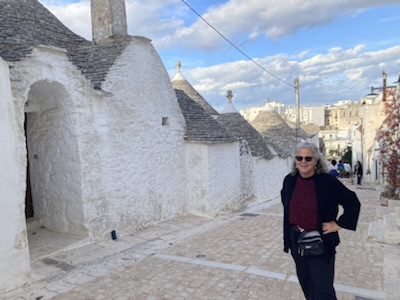
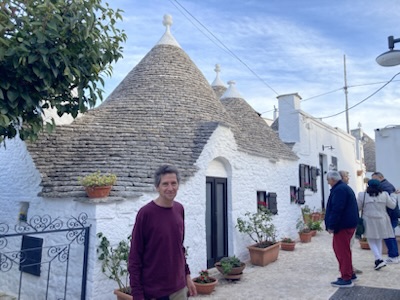
Trulli and me
This was the first trip that I used my new global entry and it did little good. I know this because dirck has yet to receive even an interview for his global entry (while mine took only a few weeks). So I used TSA preselect to depart and global entry to return. In both cases, Dirck was only a few minutes later using regular check-in, which also no longer requires that shoes be removed. So I see little benefit to global entry so far. Maybe during busier holiday travel when lines are longer it will pay off.
One of our guides in Matera, Silvio, offers his services and rental property to others. Below is contact info:
Least but not last: in case you or your friends are coming here in Basilicata and you want to explore not only Matera but also the surrounding areas of the Basilicata Region, please contact me because I have a Penthouse in Bernalda (between Matera and Metaponto Beach for 6 people: https://www.guidearoundmatera.it/index.php/en/b-b-2)
Silvio SCOCUZZA Professional Tour Guide Italian, English & German for Basilicata & Puglia Technical Director of Travel Agency – Travel Advisor Tel. +39 3924725785 – PIVA/VAT 01281750776
“You’ve been here before,” the woman behind the desk at our favorite eccentric and economical Rome hotel in Trastevere — casa di Santa Francesca Romana said as we checked in. Yes, we have. This is our third stay here. Even the Wi-Fi remembered me. It’s a very Catholic place, a former convent still owned by the Vatican, we think. We have a surprisingly nice room, larger than I remember in the past. We couldn’t get in during our early days in Rome this trip but glad to be back.
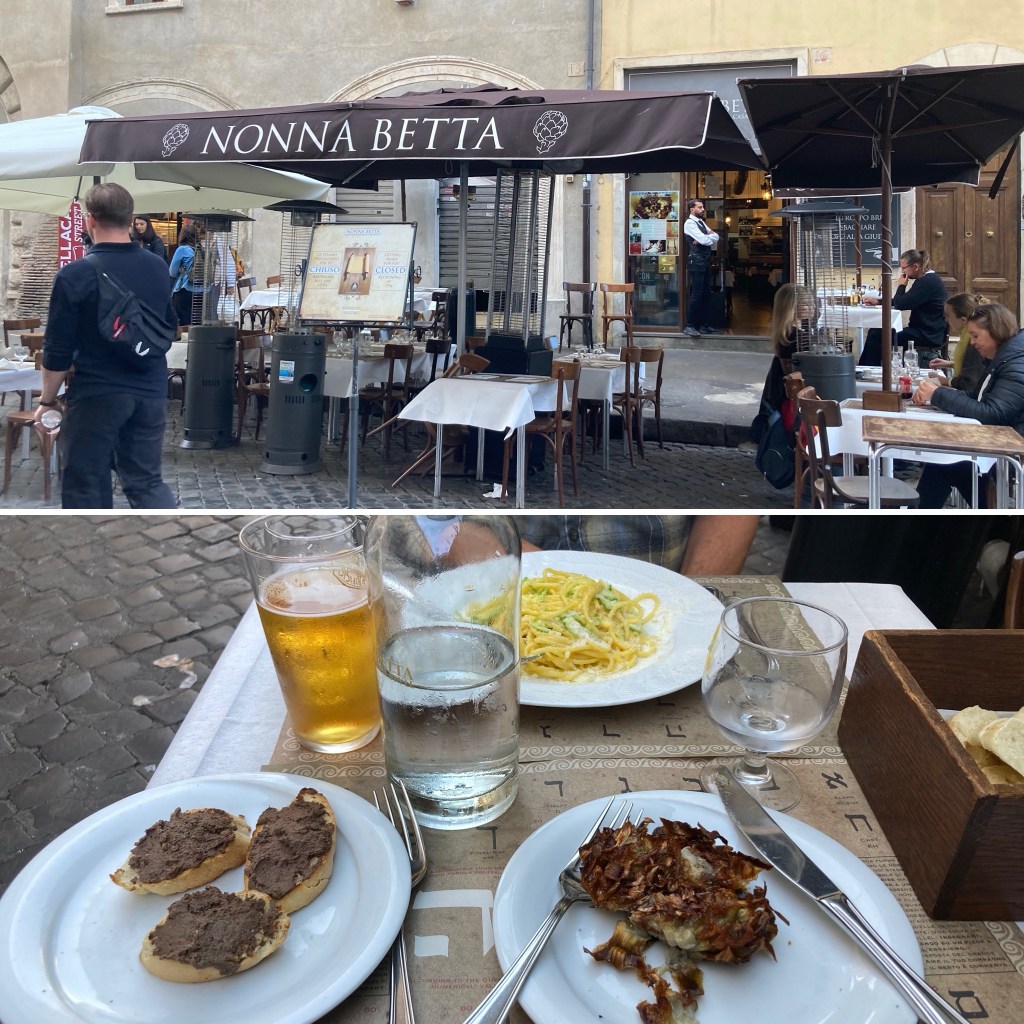
The weather continues to be gorgeous- sunny, low 70s, so we did what we like to do most in Rome: walk, eat, windowshop. First stop the nearby former Jewish ghetto where we had excellent food at Nonna Bette, a kosher restaurant – fantastic grilled artichoke (carcofi), chopped liver/crostini, carbonara with zucchini, ricotta cheesecake. Then on to windowshop in center storico on a few streets (via del Pelegríno and di Monserrato) dottedwithinteresting boutiques, design shops, cafes and bakeries.
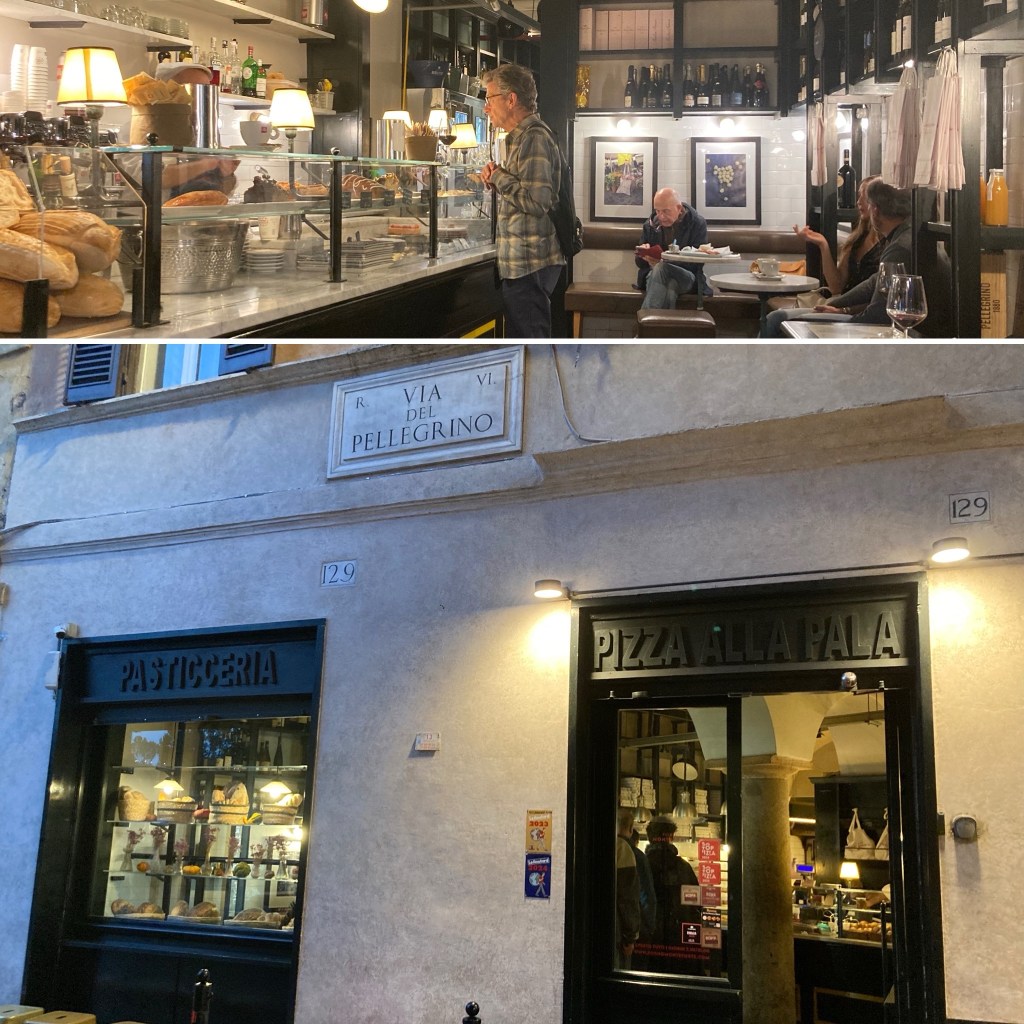
Monteforte pane e vino
We chanced upon the atmospheric monteforte pane e vino (via del Pellegrino, 129) which has amazing looking bread, pizza and pastries but we stuck to wine and cappuccino.
Very thin crust pizza
Tonight was thin crust hipster pizza at L’elementare in Trastevere. My favorite was the deep fried clump of lasagna. The place was packed, mostly with Italians! We wandered over to the Tiber river and found a large group dancing on the Sisto bridge as a busker played YMCA! Love this city.
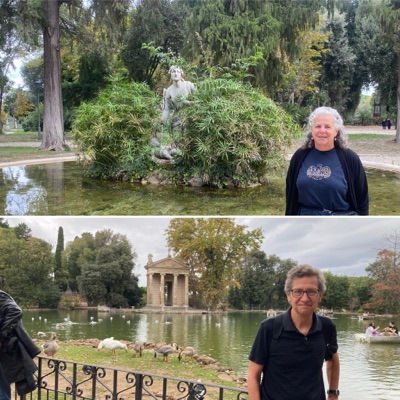
Resuming post on day 2: The rain finally came, the first significant rain of our 16 days here and even then, not heavy rain, and it didn’t come until 3 pm which gave us time to wander around the elegant Borghese Gardens and then down the Spanish steps (which neither of us had visited since we were students) and then down via Margutta which has some art galleries (none very good), outdoor gallery stalls and design shops.
Spanish steps
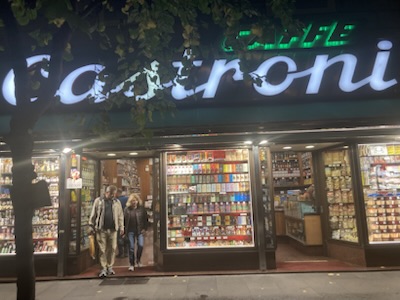
We stopped for an overpriced orange juice and espresso at a cafe overlooking the piazza de populi, which offered a welcome rest and good people watching. Then we meandered back to our hotel (about a half hour walk…we taxied to the gardens), stopping at a well-populated osteria on a small street (l’osteria di memmo Santori on via Dei Soldati,) for one last plate of pasta. We ended up briefly visiting a holocaust museum (free, but we made a donation) in the old Jewish ghetto which had wrenching stories from Italian concentration camp survivors. Dinner tonight was at garbarini, a deli by day that becomes a dinner spot by night, located in the Upscale Prati neighborhood. Fun to be the only non-Italians there.we found a huge speciality food store, Castroni, next door. Goodbye Rome. We’ll be back.
I can’t tell you all the names of the places we visited during our two days because we paid for two personal guides, Silvio to take us around the maze of streets that wind up and down and around this magical town; Cosimo to help us navigate the trails on the other side of the canyon, dotted with caves. Both were excellent! As I suspected, Matera is not a place that I wanted to figure out all on my own. Let the professionals do it!
Day View from our Airbnb
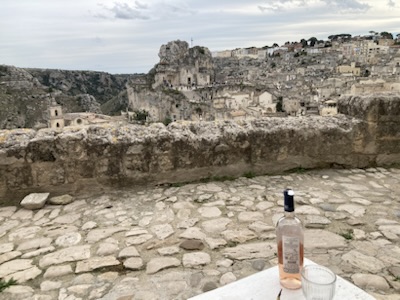
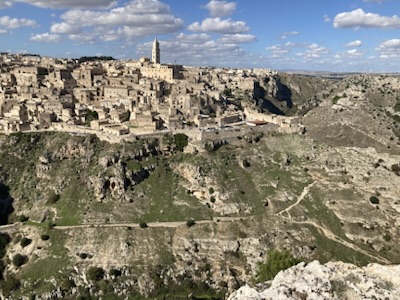
Matera is otherworldly, especially at night when the caves and stone buildings built above the caves are lit up. Our Airbnb has an astonishing view from on high, looking out at a hillside above a canyon the lit-up sassi (stone caves and buildings built into and on top of the caves) and the dramatic church Santa Maria de idris (circa the 14th century) built into an enormous towering rock. The place is a self-contained canyon, hidden from the world beyond. Matera’s history goes back to the Stone Age. Today it has two historic “sasso districts.” (Our Airbnb is in Sasso Caveoso.)
Bari
We ditched our car in a paid lot (no parking in the old town/sasso districts) and made the trek with our roller bags past the duomo and down down down slick stone steps to our Airbnb built around a cave but not in a cave now offered by luxury hotels. (Too claustrophobic.) The steps required to get around (up and down) town are shiny and slick, a bit scary to navigate. I wonder how many broken legs and wrenched knees this town sees.
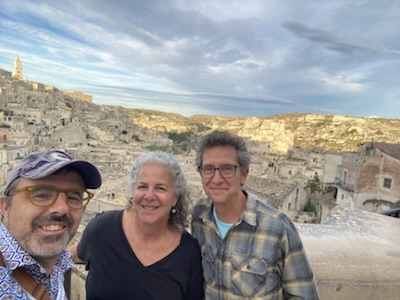
Selfie with Silvio
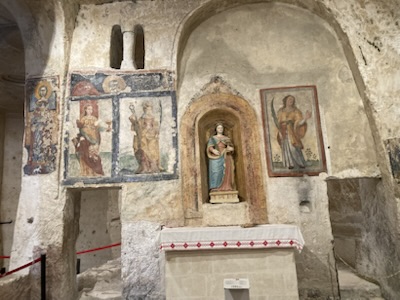
I found our great guides from a story about Matera that I happened to chance upon in the Financial Times. (I rarely see or read the FT so it was fated that I find these guides!) Silvio took us to various highlights including a beautiful ancient cave church (Santa Lucia alle Malve) that still has some bright ancient murals painted on stone walls.
Santa Lucia alle Malve (cave church)
The baroque duomo was smaller but more ornate than Lecce’s, to our surprise, dripping in gold that reminded me (alas) of today’s White House. The cave churches were the most fascinating, especially the smaller one, Santa Lucia alle Malve (circa the 9th century) which had a few remnants of frescos. (There’s a bizarre breastfeeding Madonna —the breast is located on her shoulder.)
We also visited a replica of a cave home, where people lived in squalor, sharing their cave with their animals and manure until the 1950s and early 60s when the government was shamed into moving them into better housing. the story of Matera’s rebirth is recent and remarkable. After the government moved people out of the sassi, the area was largely abandoned and considered a dangerous no-go area, with drugs and crime. but gradually people started rediscovering and restoring the sassi. Getting UNESCO world heritage status in 1993 was a boost, so was Mel Gibson’s creepy film about Christ which was,partially shot in Matera (deemed a perfect biblical stand in).
Cave house
We spent two nights in Matera and enjoyed having one day to just kick around and wander. (We visited the Duomo.) On our last morning, we went on a four hour walk and talk across the canyon in the archeological park, guided by lovely Cosimo, a 44-year old Matera native who offered all kinds of information on life in Matera now and long ago.
With Cosimo in a cave church in archeological park
It was also great to stand on the other side of the canyon that we had looked at for two days and see our Airbnb location from afar. Our Swedish-born Airbnb host was old school – she met us in person! (No anonymous lock box with code.) It was fun to get to know her, her restored sassi is beautiful and she had fantastic suggestions for where to eat and shop.
Airbni8kAk9A hostView of sassi from the other side!
We ate well. Dinner on night one was at La Lopa, a fashionable spot which in addition to traditional fare has a clever movie reel in the bottom floor with highlights from movies shot here including the James Bond film “No Time to Die.” Our food was even better on night two at Osteria Belvedere al Vecchio Frantoio, a less fashionable but welcoming traditional trattoria where we had superb fried zucchini flowers (which I have never made right) and a matera version of lasagne, light on the cheese but featuring eggplant, tiny meatballs and little slices of salami. Really delicious.
For lunch, we shopped in and near a fruit and vegetable market in the newer part of town, picking up local cheese (caciacavalla), salami, delicious eggplant focaccia, and dried crispy red peppers (eaten here like potato chips) which we ate outside our Airbnb with the stupendous view. We met various tourists who happened by including an outgoing South African guy. Two other food finds (thanks to our Airbnb host) Ridola Cafe for breakfast and I vizi degli angeli – laboratorio de gelateria artigianale (yes, superb gelato).
Matera movies
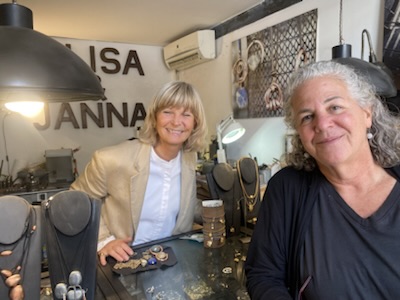
We did some early winter holidays shopping at several nice stores. Turns out our lovely Swedish Airbnb host also owns a jewelry store I’d admired before I knew it was her’s, called Elisa &Janna near the Duomo. ( In a strange coincidence, the Airbnb host lived years ago on the same street in London as our longtime pals there.😳)
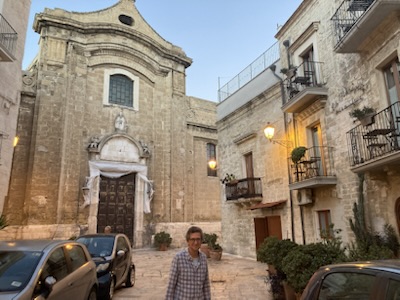
We ended the day in Bari, a relatively easy drive hour long drive from Matera and are staying at a easy in and out Airbnb near the train station, where we leave in the morning on a train back to Rome. We explored the Bari Vecchio (old town) with its narrow alleyways and massive ancient chur hs (sound familiar) and had the city’s famous assassin’s pasta at a hip place near the university. The pasta is not boiled but instead fried to crispiness. Wasn’t as hot as I feared and I liked the church.
Some AI basics re:Matera
Matera is considered one of the oldest settlements, often cited as the third oldest after Aleppo and Jericho, with evidence of habitation dating back over 10,000 years. Matera is a continuously inhabited city in southern Italy, known for its ancient cave dwellings carved into rock.
Age: Evidence of settlement in Matera dates back over 10,000 years, with some sources citing the existence of prehistoric cave dwellings from the Paleolithic era.
Inhabitation: The city is notable for its Sassi, or “stones,” which are ancient cave dwellings that were inhabited for millennia before being evacuated in the mid-20th century due to poor living conditions.
Modern status: The Sassi have since been restored and now house modern amenities, acting as hotels, restaurants, museums, and homes, while still showcasing the city’s ancient history.
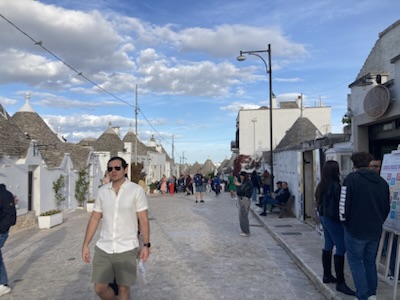
We went for contrast today, knowing which town we’d like most but also finding some to like about both. Alberobello is a major tourist town, famous for its overwhelming number of trullis, earning it recognition as a UNESCO heritage site. As expected it was packed with tourists who wandered up the main trulli-lined drag, past bored shopkeepers standing in front of tacky gift shops. But it was also possible to wander along parallel streets that had fewer tourists and shops, so you could be properly astonished by the profusion of these charming little conical-shaped, Mediterranean dry-stone huts with grey stone roofs and thick bases of whitewashed stacked limestone.
Trulli galore
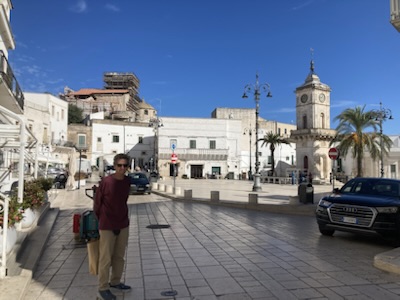
Ceglie Messapica, by comparison, is lesser known, with fewer tourists, no trullis and only a handful of noteable buildings. But it’s one of the Puglia’s oldest continuously inhabited towns, dating back to pre-Roman days (hence the name, related to Mesopotamia). Its charm is that it feels like a real place. We loved wandering down the centro storico’s quiet narrow whitewashed passageways and small piazzas. Surprisingly, we found a great gift shop with Puglia-made products including handpainted shirts and cloth breadbaskets, and a good neighborhood clothing store on a quiet side street where dirck and I both bought a shirt from a talented saleswoman.
The Puglia Guys helped again, with parking tips and restaurants. Ceglie Messapica is a food town. We went for simple, basic fare at Osteria Pugliese, eating orecchiette or spaghetti with tomato sauce and Parmesan cheese in a tiny stone dining room off an alley where we were the only tourists. The pasta is thicker and more Al dente than back home. The orecchiette is almost like small dumplings. Our bill, including wine for one, was 22 euros ($25). We began our visit at Caffe Centrale, circa 1861, famous for its pastries, including a soft brownish Biscotto Cegliese, which has earned “Slow Food” protected status, a big deal here. It’s made from ground almonds, local cherry jam (which saves it from being too sweet) with a dab of lemon zest or cinnamon.
Note amusing toilet signs below
One happy discovery, a little late: our car has a USB A port in the back seat so our phones and GPS remained operational! The drive from ceglie to alberobello via Locorotondo was gorgeous, along narrow winding roads lined with dry stone walls, past bright green fields with silvery olive trees and fall colored vineyards. And of course the occasional Trulli.
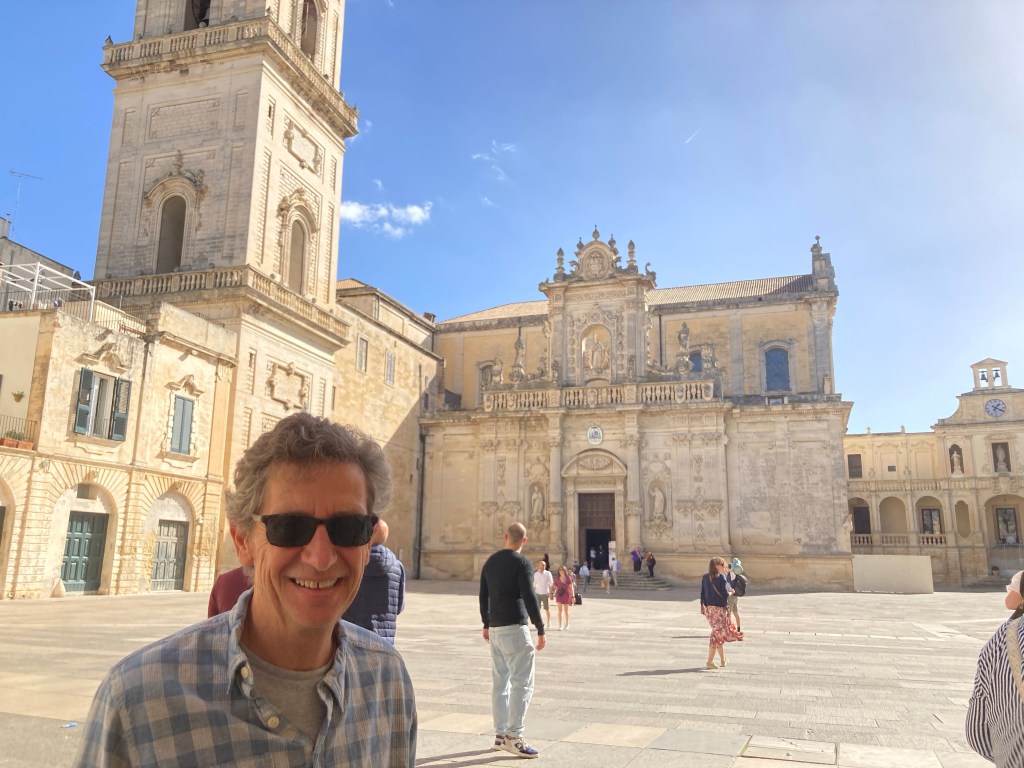
I can see why Lecce is sometimes called the Florence of Puglia. It is full of huge stunning churches and stylish shops and restaurants. We bought an 11 euro ticket to see three of the main churches, all ornate Baroque: the 16th century cathedral/duomo (and crypt), the 1738 church of Santa chiara (with a ceiling that looks wooden but is paper mache); and the 16th/17th century basilica Santa Croce, made of Lecce stone, some intricately carved to resemble lace or embroidery, which was my favorite. Lecce’s aristocratic families competed with each other to commission the most detailed altar. (Hence there are 17 altars.)
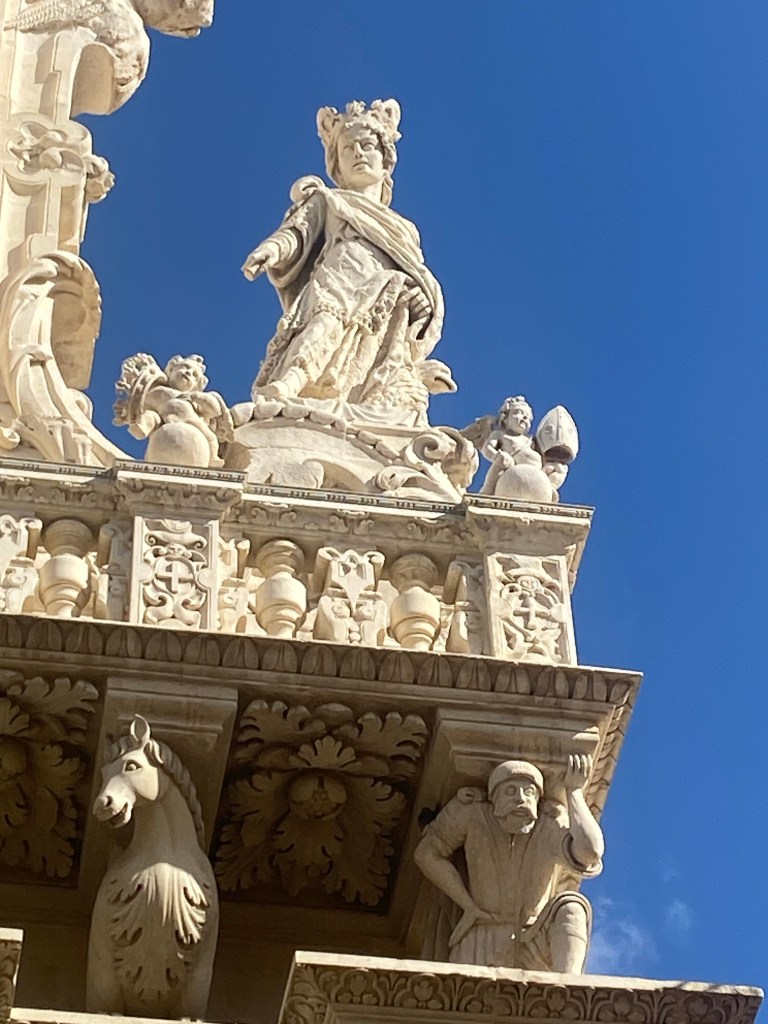
Basilica heavy load
The baroque exterior facade has entertaining sculptures of animals, including a few humans, holding up the building. Inside, I was amused by the upside down cherubs/angels holding up some of the building with their chubby little feet. Next to the Basilica is a Jewish museum, on the site of a former synagogue. Found it interesting that this city of 100-some churches once had a sizable Jewish population. (An aside: We have noticed several Palestinian flags and Pro Gaza signs throughout our trip in Italy.)
Dirck at the Duomo
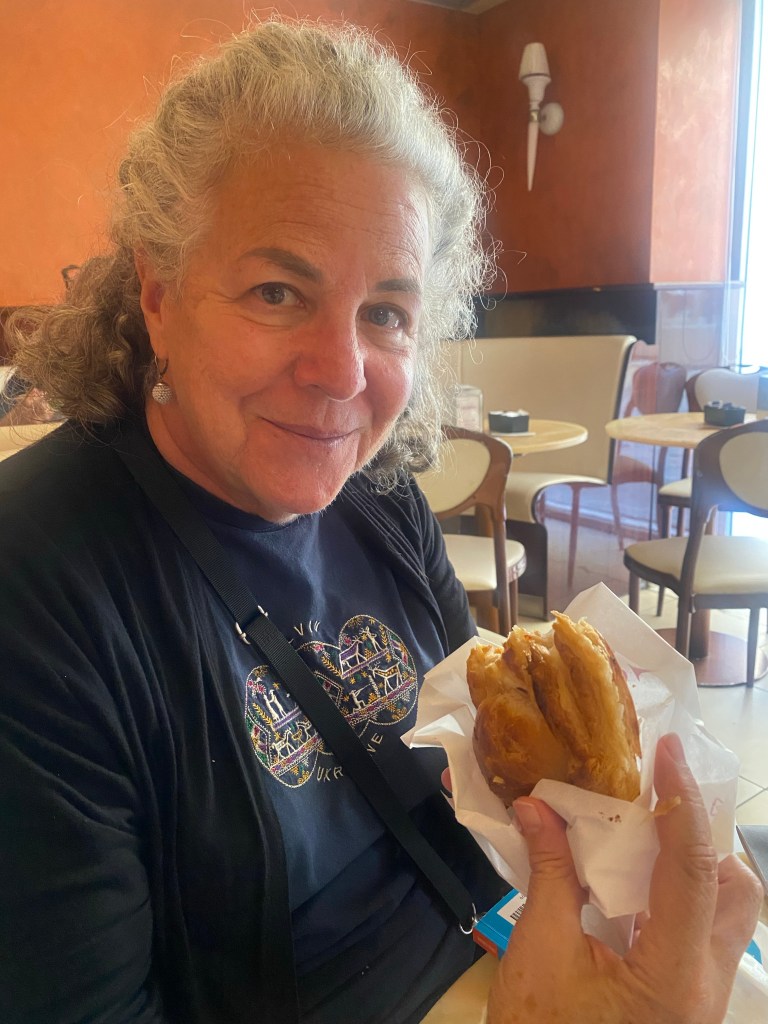
Thx again to Puglia guys.com for helping us find another restaurant off the beaten tourist track, this one a stylish contemporary place with few tourists called 300 Mila. But we also enjoyed a major tourist hotspot near the Roman Amphitheater in the huge piazza sant ‘Oronzo— Cafe Alvino where I tried the cafe Leccese (expresso shot with almond syrup served over ice), and two traditional foods – pasticciotto (too sweet for us) and the savory rustica (a delicious hot-from-the-oven puff pastry pocket filled with creamy bechamel, mozzarella and Pomodoro.)
Cafe alvino with rustica.
Pugliaguys.com also helped us find free parking. The drive along the autostrada was, sadly, not scenic. We couldn’t see the Adriatic over the high concrete median. We tried to take a more scenic route back but kept making wrong turns.
At 300mila
Didn’t help that our phone (with essential GPS) was dying and sometimes the internet crapped out. Next trip we need to have a USB C adapter for our old school USB A phones so we can use the charger in the car!
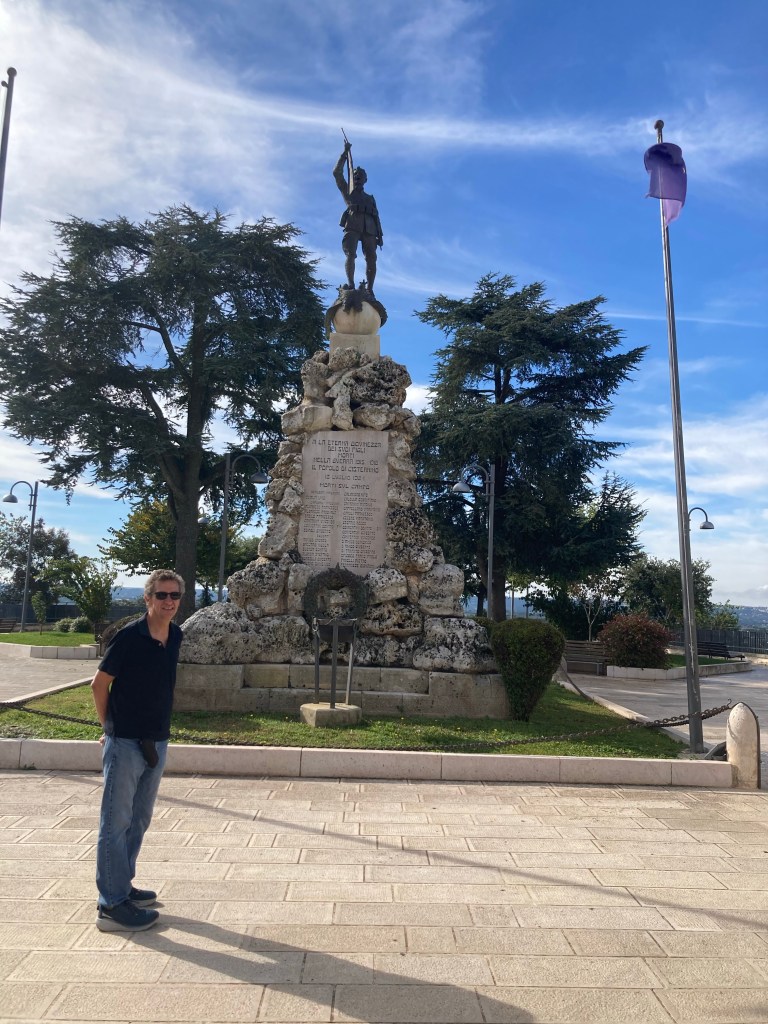
To be honest, the small hilltop towns are starting to blur in my mind. Cisterna may be my favorite to date, because it’s a lovely small village that seemed relatively untouristed. We did a quick walk through the narrow passage ways, most lined with residences or the occasional taverna but few tacky tourist shops. (I found another gorgeous shop with ceramics.)
Cisterna butcher and St. Lucia, patron saint of eyesight (hence eyeballs on plattter)
There are also several overlooks with spectacular views of the valle d’Itria , dotted with trulli complexes, some dripping with purple or red borgenvia. Dirck navigated some crazy scenic narrow lanes today, lined with high dry stone walls, in front of vineyard and olive trees. And he drove on the unscenic autostrada along the sea, which was a bit hairy at times, with cars entering from the right on lanes that soon ended so they had to merge, leaving us unclear how to get out of their way. We later noted they seem to stop before merging.
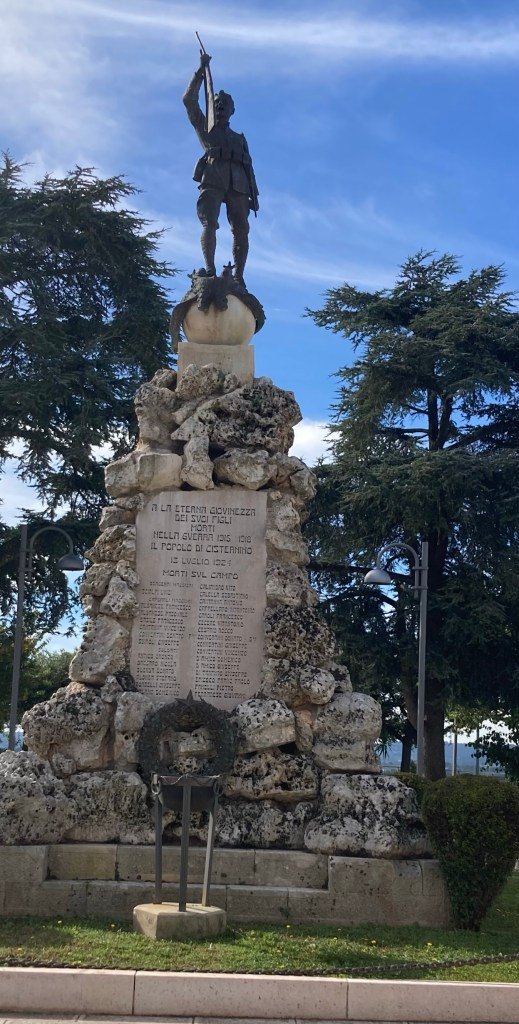
Cisterna poignant war monument
Ostuni is said to be the most famous “white city“ with daily limestone and plaster buildings but it was too touristy for us. Fortunately we found Fave e Fogghje, a fantastic restaurant away from the crowds, where we dined on Puglian specialties while listening to rockabilly tunes and chatting with a sweet young couple visiting from Verona. (The woman was from Sardinia, which she recommended we visit!) We also met a Canadian/Austrian couple traveling with their 8 month old baby Emma. We’ve been surprised to find several parents traveling with babies or elementary school age kids.
Fave e fogghje in Ostuni
We have pugliaguys.com to thank for our restaurant find. An an American woman yesterday in Martina Franca who highly recommended the website. It’s full of itineraries and restaurants and even parking suggestions. Invaluable!!
We tried several classic Apulian dishes: Fave E Fogghe (broad bean purée with greens sautéed in oil and garlic…looked like creamy mashed potatoes. Delicous.), Bombette Arrosto (Double-cooked pork bombette stuffed with pancetta and caciocavallo cheese with sautéed potatoes and stewed turnip tops). Too much for me, and almost for meat-loving dirck and Orecchiette con le cime di raps (the local pasta shaped like little ears with broccoli rabe and some sort of light bright green sauce . delicous.)
Ostuni
Dessert was a remarkable concoction: Mousse Puglia (With lemon jelly, chocolate glaze and black cherry on olive oil biscuit). meant to look like an apple, complete with a chocolate stem. It was a white mouse and cake mix, coated in a violet cherry glaze with blobs of tart lemon curd hidden inside on a bed of crushed almonds and chocolate. (This was the first place we saw horse in the salumi counter. It looked like cacciatore pork sausage but I was told otherwise.
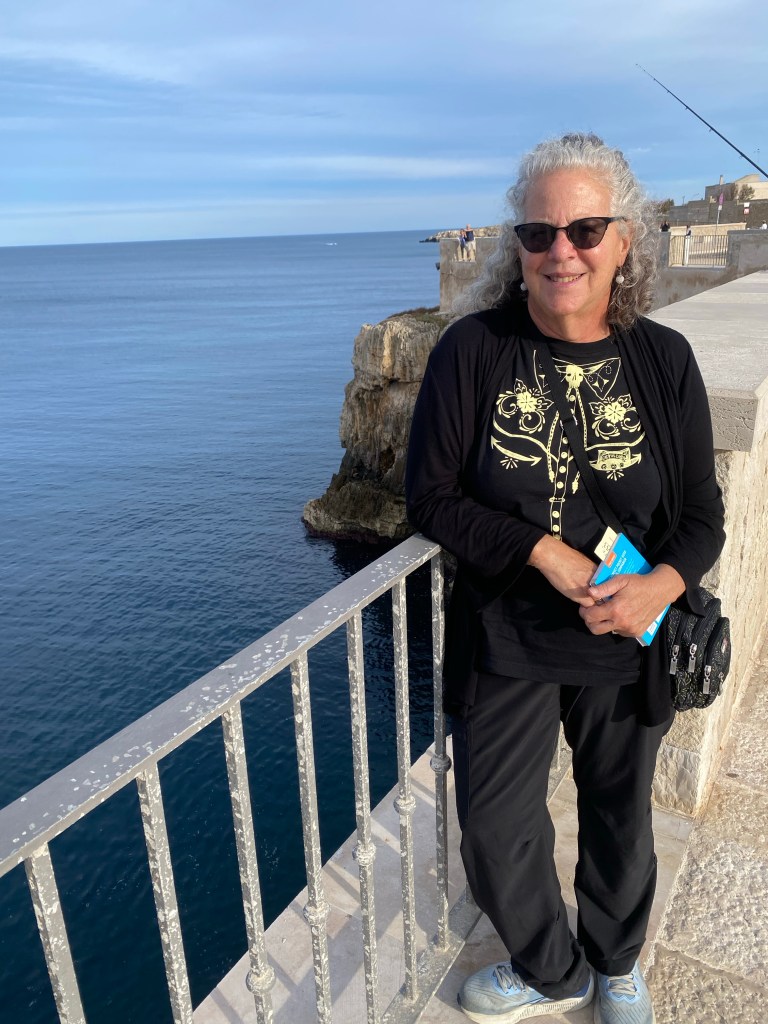
Cliffs, Adriatic, me @ Polignano
We drove to the Adriatic resort towns of Polignano a Mare and Monopoli but didn’t do them justice. We didn’t have the energy to navigate another city center. We did walk along the west end of the seaside walk in Polignano, above rocky cliffs with the occasional small speedboat with tourists looking at the cliffs from the water.
I have not found the Adriatic Sea towns as spectacular as say, amalfi coast or cinque terrace or Sicily. (We visited some further north two years ago, driving from Urbino.) They are more wild and feel more desolate at times, with crumbling stone structures or worn concrete high rises. (But again, we didn’t make it to the more historic and famous parts of these Puglia towns so don’t trust me on this.)
The FlixBus from Naples to Bari was easy, on time, cheaper and faster than the train. Felt akin to the Megabus. The trickiest part was finding the pickup spot at the sprawling Napoli central train station. We had an address that didn’t really exist. It would have been simpler to tell us the stop is at the “bus terminal” (so labeled ) next to the train station. The bus departed on time. It was a three hour trip, one hour shorter than the train, which also required a connection.
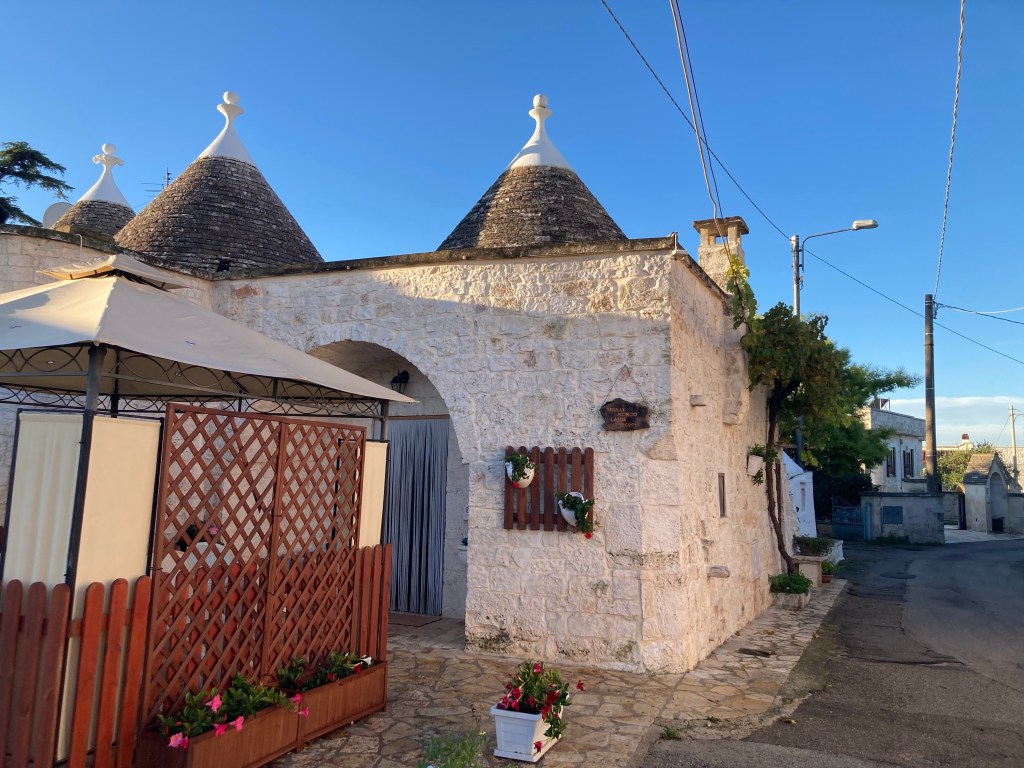
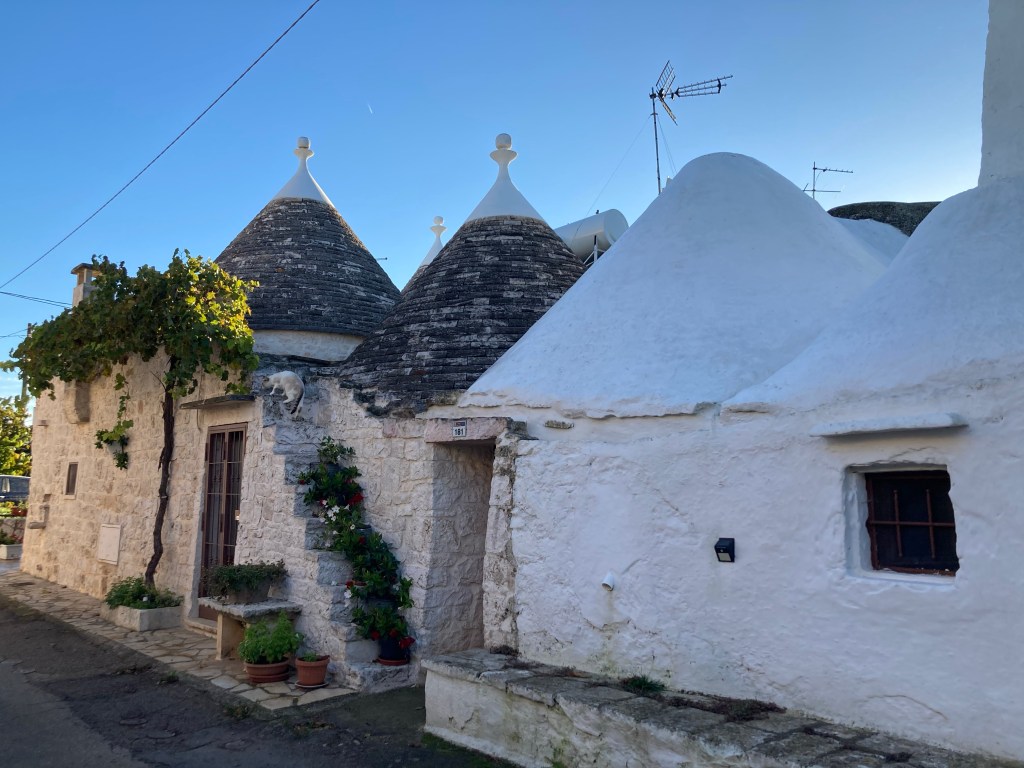
Our trulli side view (spot the cat?)
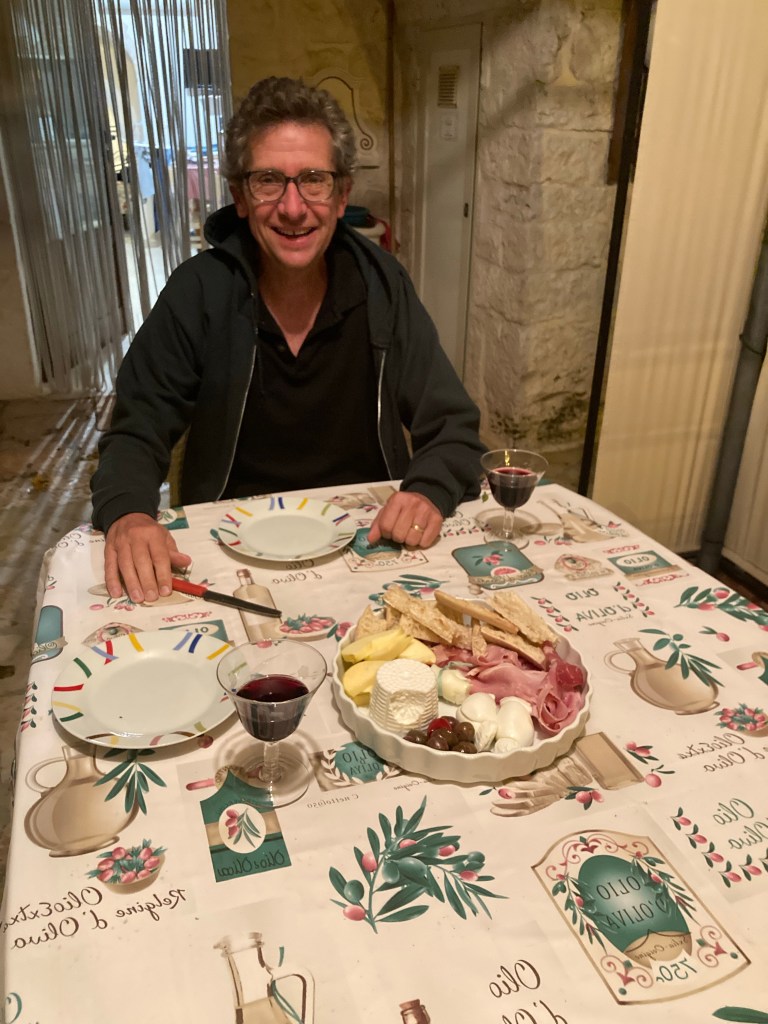
While the bus was fine, renting a car was unexpectedly not fine but more about that another time. We did eventually get a car, after an excellent lunch of local cold cuts and cheeses at mercantilenove, at the edge of Bari’s old town (Bari Vecchia), in piazza mercantile near the Adriatic.
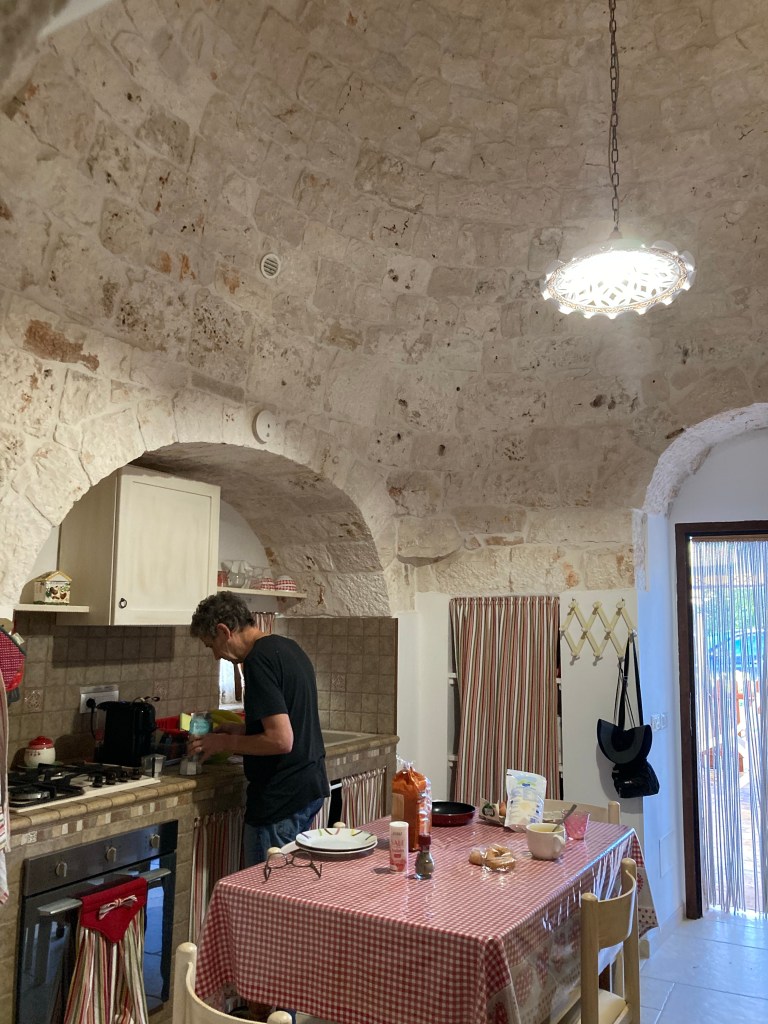
Trulli life, with bialetti coffee
Next: a rather stressful drive southwest of Bari in the drizzle to a small village Borgo Lamie di Olimpia about Five km north of Locorotondo where we finally found the trulli (a traditional conical-shaped building) Airbnb that we are staying in for a few days. thank god for a rare business and landmark, Bar Lamie, where we met our Airbnb proprietor, who walked us about a block to our trulli. Later, D and I walked in the drizzle back to the bar where we were greeted by some gregarious locals and had a well-deserved Peroni.
Lunch in Bari at Mercantile Nove
A day later, we drove to two beautiful hill stop ancient cities, Locorotondo and Martina Franca.
Both towns are lovely, high on a hilltop with white buildings lining narrow passageways opening into piazzas. We got lost a lot.
Finding the old part of town is often tricky. We tried following “Centrale storico” or bullet signs but they often disappeared. then we got lost rambling through the tiny found our car…and information offices with free city maps.)
Locorotondo
Parking was another issue. Yet again we encountered parking meter machines that didn’t work. One took our money but failed to give us a slip to put on our dash. We learned that spots with blue lines means you must pay to park; white lines are free, and yellow lines require a parking permit. We also learned how to decipher what hours we do or don’t have to pay in a blue line spot. (In Martina Franca we spent about a half hour trying to get the parking machine to work, long enough that it became 1 p.m. when parking switched to free until 4 pm.)
Lunch in front of Martina Franca
We had a lovely lunch at Garibaldi Bistrot/restaurant in the piazza overlooking the huge baroque church in Martina Franca, founded in the 10th century and famed for Baroque buildings. Delicious Pasta with local mushrooms in a light cheese/cream sauce and spaghetti in a red sauce with fresh tuna, capers, olives.
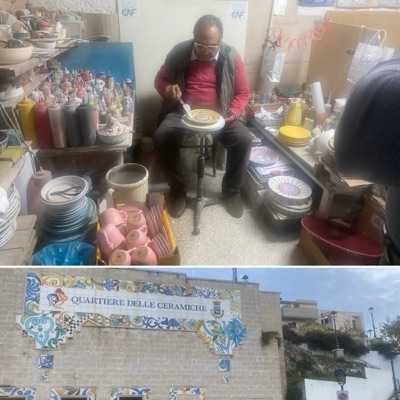
In the late afternoon we drove about 35 minutes south to a grittier town famous for ceramics called Grottaglie, near the Ioanian sea side of Puglia. We finally found a parking spot right in front of the best known ceramics shop (on a street lined with shops) Nicola Fasano, where we bought two contemporary pieces (not the traditional Italian ceramics.) Even bettter, the owner, who comes from a long line of ceramicist owners took us and a few others on a tour of the manufacturing shop in nearby caves. He told us he’s been hard hit by Chinese copycats, and now works particularly hard to produce original pieces not easy copied. At one point he sat at a spinning wheel that he used to decorate several plates, sort of like an old fashioned Spirograph or spatter art. It was mesmerizing. I later learned from a Vogue Australia article that the shop’s customers have included Francis Ford Coppola and Armani.
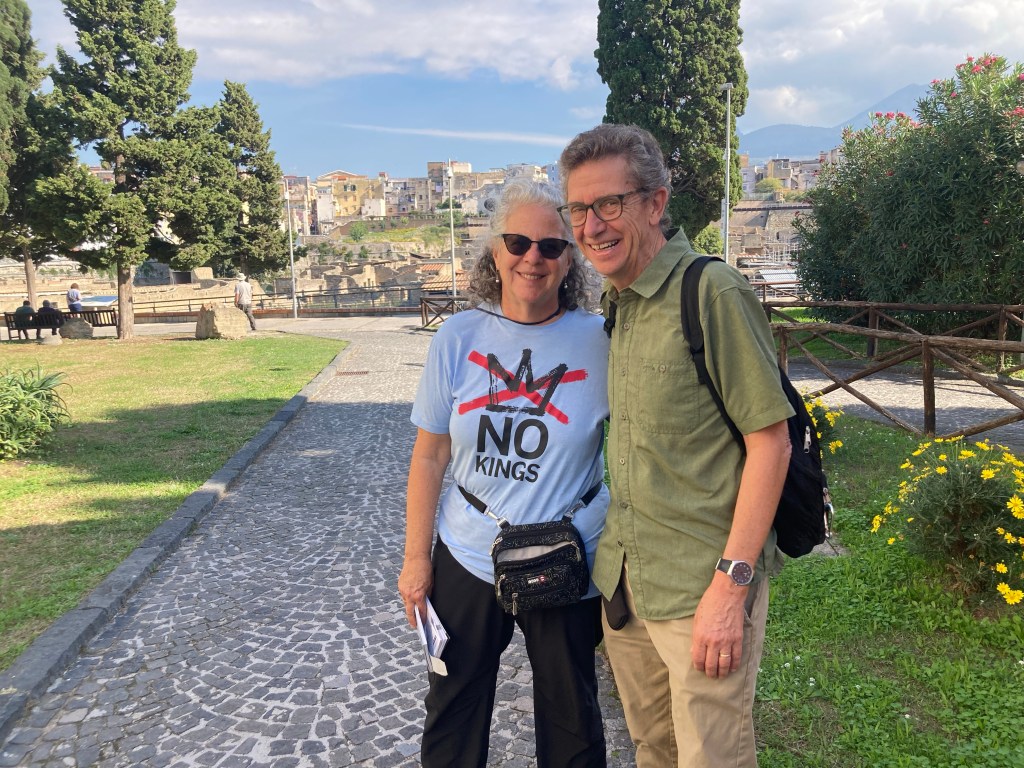
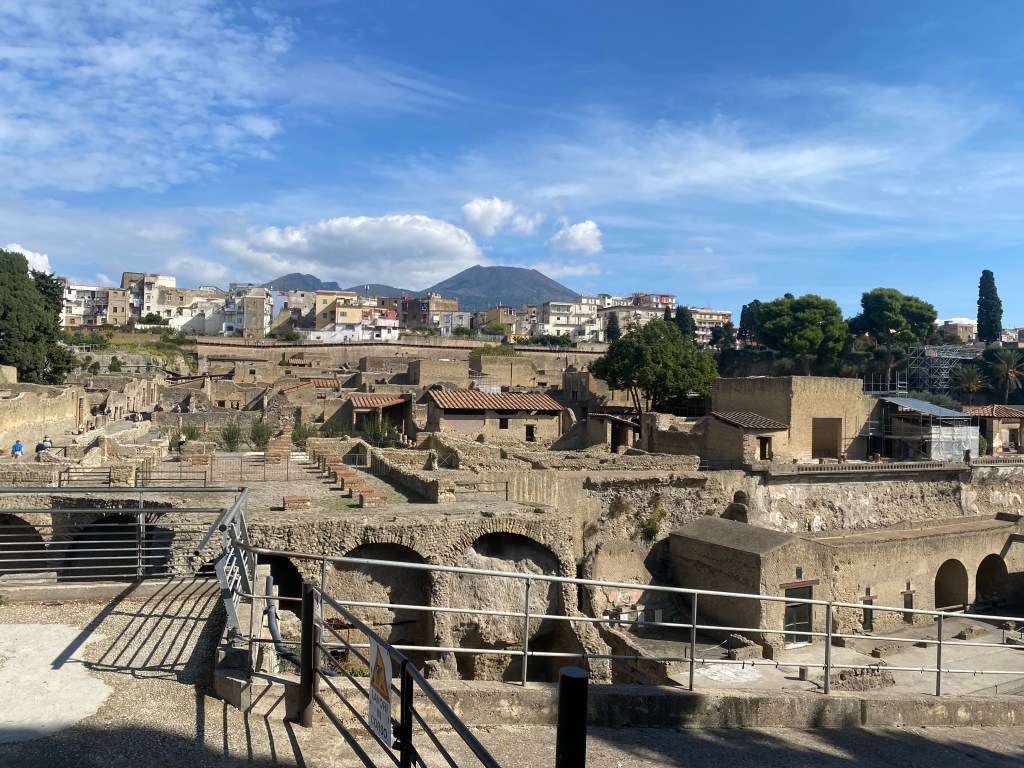
Getting to the ancient ruin of Herculaneum was fairly easy: metro line one to Garibaldi and then the rickety (as promised) circumventa train to Ercolano (Italian spelling) Scavi stop. (Rick Steves gave us a rare bum steer, writing that there were two Ercolano stops but no big deal, we backtracked one stop.)
Not Halloween decorations
The ruin is well-designed, with a cool little museum to start, showing the ancient artifacts found on the site that resemble modern-day utensils (tweezers, jewelry, colanders, pans): ancient Italians R Us! It also juxtaposed the items with artistic renderings found in frescos or other artwork. Then on to the site itself, compact and easy to visit, unlike the massive and more famous Pompeii nearby (which I visited in 1982). You can really get a feel for the place, with its remnants of houses along one street and shops on another, including a wine shop with a fresco of the wine prices! A few buildings retain patches of their original frescos in bright umber and orange and red. What a sight this place must have been in its prime.
Back in Naples, we went searching for the funiculars leading to San Marino and found two of the three after many wrong turns and bum steers. The Montesano funicular is a little more interesting because you’re not in a tunnel the entire time.
Dinner was at ristorante Al 53 on the piazza Dante – heavy pastas, tasty but a little oily. Several large groups of 10-12 Italians were dining there on a Monday night. we had fun trying to guess the relationship between people dining at one big table. Work colleagues from a design firm? Or academics hosting a renown scholar?
Outside the station in lenu and Lila’s neighborhood (otherwise no mention of them anywhere)
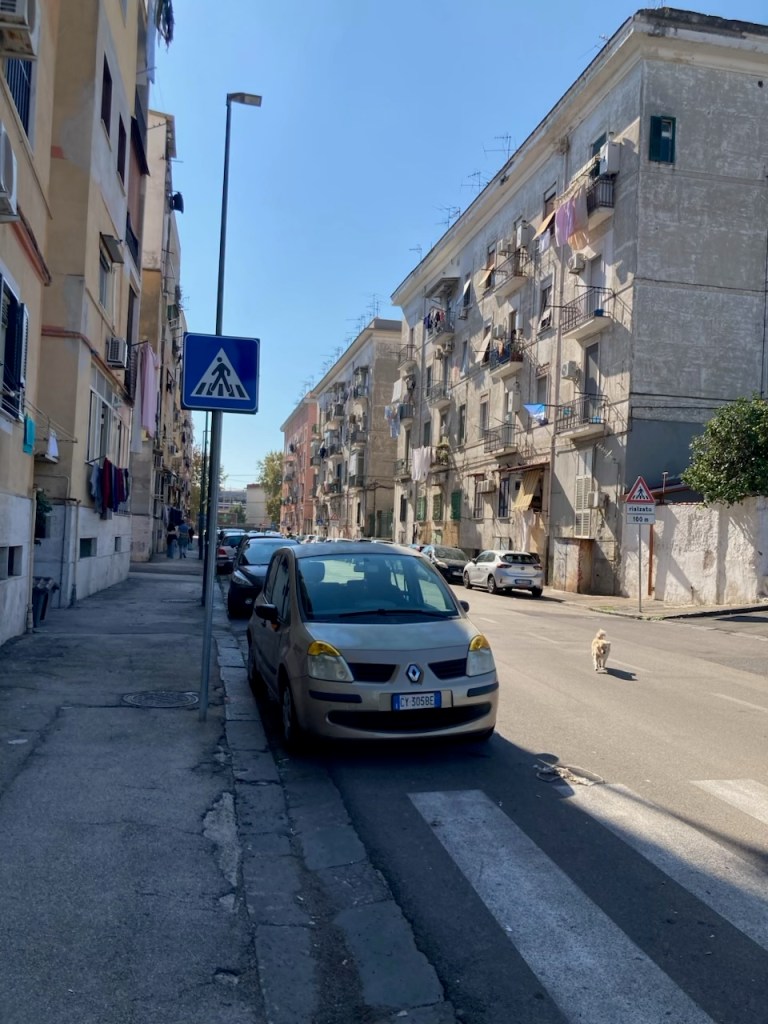
We trekked out to a gritty industrial part of Naples that was beyond our tourist map to visit the neighborhood that was depicted as the 1940s childhood home of lenu and Lila, the protagonists of Elena Ferrante’s Neapolitan Quartet or as we call them My Brilliant Friend novels and the evocative tv series).
Rionne LuzzattiPiazza Dei martiri
Rione Luzzatti is a rough and tough place, think American public housing projects of the 1980s, worn concrete high rises with laundry hanging down, an unfriendly dog barking at us, but kids playing soccer and old men talking in a park. From there, for the full contrast, we took line 2 to near Piazza Dei Martiri where Lila and family sold their fancy handmade shoes. Felt like a Neapolitan version of Madison Avenue.
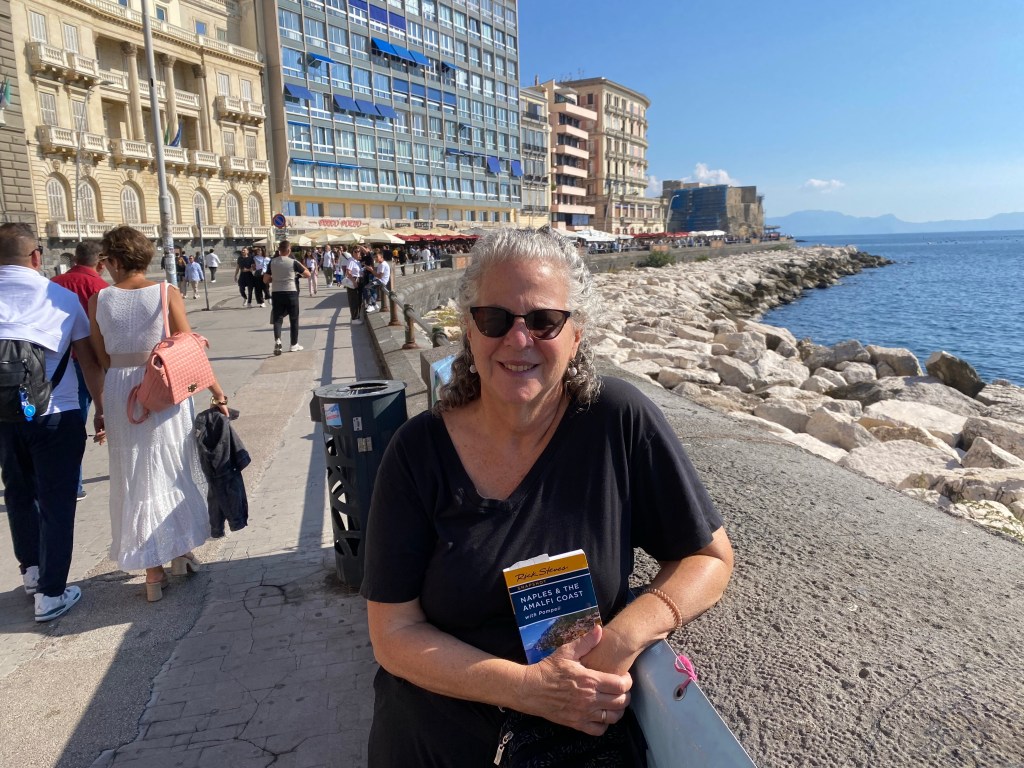
Lungomare
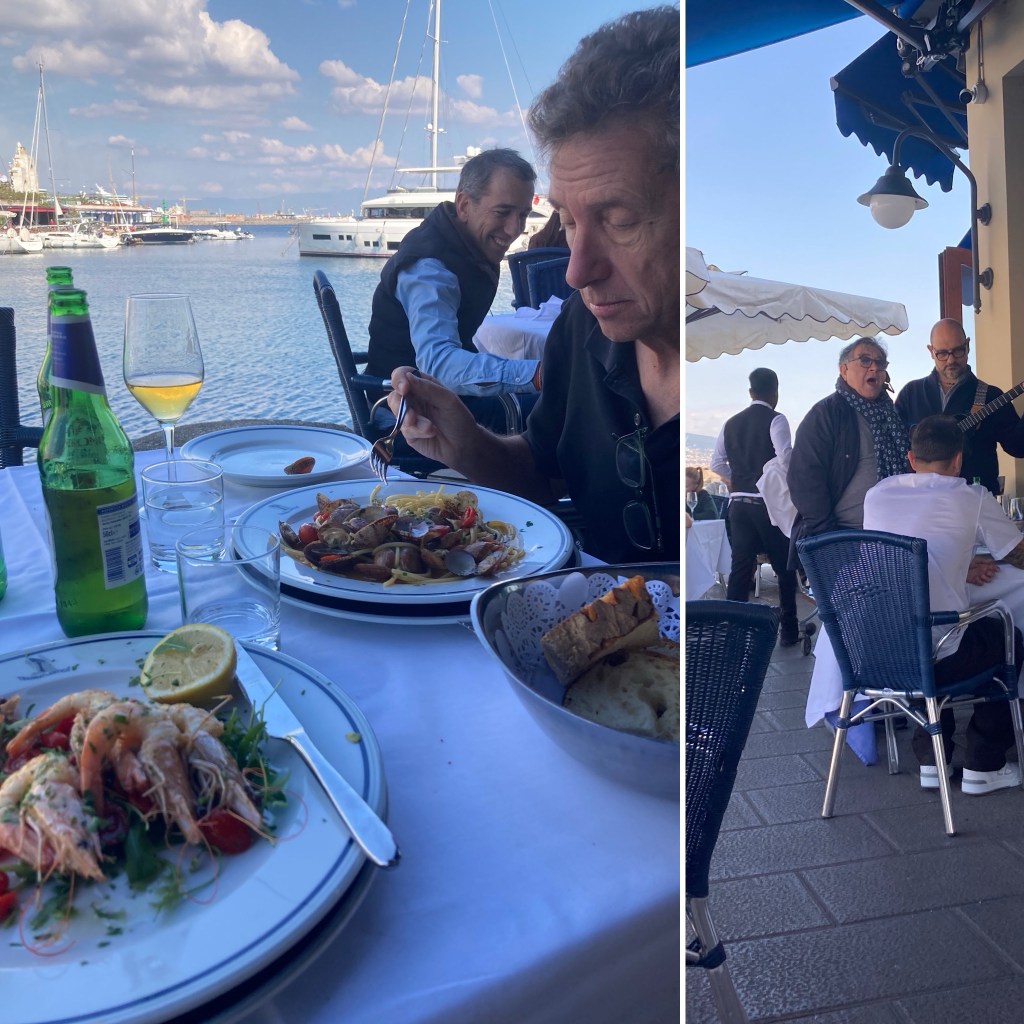
Onto the gorgeous waterfront promenade (lungomare) where much of Naples seemed to be strolling on a perfect Sunday afternoon. We ended up on a little fisherman’s wharf, Borgo marinero, at a pricey but lovely seafood restaurant transatlantico where we had outstanding spaghetti vongole (clams, white wine sauce), listened to a traveling singer-guitarist duo serenading tables (inspiring at least one couple to get up and dance), watching boys catch fish and boats drive in from the shimmering sea along a little channel lined with large fancy hotels and apartment buildings.
Lungomare vongole
Dinner was at a hipster pizza place in Sanita called concettina ai tre santi but I didn’t eat. Had a sudden bout of nausea and dizziness (fatigue-induced I‘m guessing.) but fortunately a night’s sleep seemed the cure!
A few travel tips:
Use your credit card or debit card to use Metro Lines, tapping in at the turnstile and out at a machine on threw all (sometimes). The machines rarely worked with a credit card or cash. Or buy the tix from a news stand, if advertised.
Line 1 is the real deal subway. Line 2 is more of a train and doesn’t operate as smoothly.
We tried two of the three funiculars up to San Marino but they were very hard to find and mostly no views offered except a tunnel in the mountain. Montesano funicular did offer a few views but we spent about 45 minutes looking for the entrance, getting several bum steers from various people.
We never felt at risk in Naples, despite its reputation. (We did make sure our wallets were secured.) The streets were full of life and people.
























 TakeBetsywithyou