May 31, 2025 11:30 pm
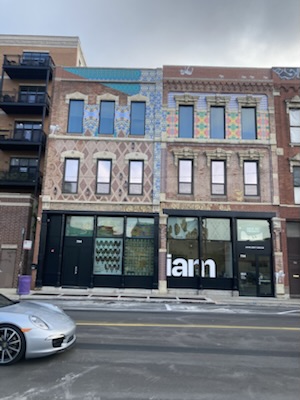
Two years ago, not long after we moved to Chicago, my brother and I visited Intuit in a blinding rainstorm that made it hard to see where we were. The art museum was charmingly scruffy, in a 19th-century brick building with worn wooden floors and battered walls that seemed well-suited for the museum’s collection of quirky and eclectic artwork by “self-taught” (and intuitive) artists. Soon after our visit the museum closed for renovation and expansion. It just reopened and I’m pleased to report that it’s even better – retaining its essential scruffiness but bigger and brighter, with white panels covering much of the still-worn walls and the original worn wood floor gently restored (or so it seemed.)
All the better to showcase its often eccentric artwork found in the permanent collection pieces and a special exhibit “Catalyst: Im/migration and Self-Taught Art in Chicago” featuring a diverse selection of artwork by 22 immigrant and migrant self-taught artists who came to Chicago from all over the world (Poland, Ukraine, Honduras, Mexico…). It’s fantastic and timely, given the unwarranted and obnoxious demonization of im/migrants by our current unbearable president. Among my favorites — elegant art deco-ish decorative objects made from unlikely prosaic material — a dental equipment company’s discarded metal. The artist, Stanley Szwarc, who immigrated to the US from Poland in 1977, worked at the company.

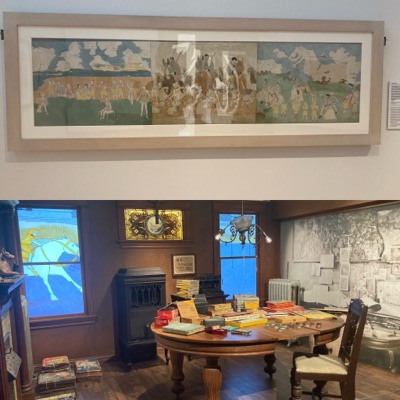
The museum’s permanent collection also includes the work of self-taught Chicago artist Henry Darger, (1892-1973) who lived near us in Lincoln Park in a one-room third-floor apartment and produced often cartoon-like work. Orphaned as a young boy, he landed in the awful-named Asylum for Feeble-Minded Children in Lincoln, Illinois. In Chicago, he worked by day as a hospital janitor, by night for forty years as an artist and writer, producing a massive illustrated novel set in an imaginary world with lots of clouds, storms, fire and seven heroines – the Vivian Girls – who led armies to defeat child-enslaving foes. He often traced figures from newspapers, magazines and kids coloring books, painting and collaging. Fortunately his landlords discovered and preserved his work, and his living room/studio contents (Pepto Bismol bottles, stacks of magazines, many shoes). The museum offers a reimaging of Darger’s studio with some of his original furniture and art materials.
We met the museum’s enthusiastic president/ceo who showed us a bright new classroom space in the rear of the building where outreach programs are provided to teachers and students. The museum’s gift shop has also been spiffed up, but has the same interesting offerings. I’m a longtime fan of this art by ordinary (sometimes psychologically challenged) people, not academy/trained artists, variously (and awkwardly) known as outsider, naive, primitive, folk, or self-taught. Also don’t miss a visit to the bathrooms, yes, bathrooms – donated by Kohler (the bathroom fixture company) with fantastic arty light fixtures.
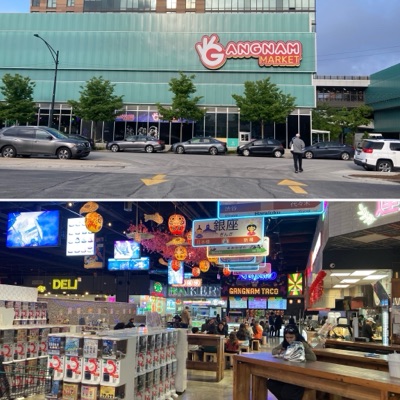
Looking out the windows of Intuit in Chicago, we could not miss a massive metal building across Milwaukee Avenue called Gangnam Market, which turned out to also be well worth a visit – part Korean food hall/arcade — Korean drinks here, Korean tacos there – and part upscale market. I also enjoyed browsing through the Asian candy, snacks and trinkets – exotic flavored Hi-Chews, KitKats (matcha tea, like we saw in Japan), chips (flavors: oyster, crawfish, cumin lamb skewer) Hello Kitty merch – and takeout Asian fare (seaweed, sushi, oniguri etc.) We’ll be back to try the Korean tacos, at a minimum.
Dinner was at Opart Thai House on Chicago Avenue — which lived up to its reputation. It’s a nothing-fancy interior with well-executed classics (pad thai, green curry with very fresh shrimp) and originals (to us) like a “peanut lovers” dish with chicken and vegetables coated in a thick peanutbutter-ish sauce. (It’s also BYOB, we learned.)
One of my earliest introductions to “outsider” was during the late 1980s in the amazing outsider art enclave of Lucas, Kansas – home to “The Garden of Eden” — a bizarre concrete log cabin with a yard full of giant sculptures with biblical and populist themes (Adam and Eve and the serpent; the farmer being crucified by the banker, lawyer, etc.). From this came a museum of outsider art that became affiliated with the Smithsonian and a public restroom/public art project resembling a giant toilet with intricate mosaics. All in a tiny windswept town in the middle of nowhere. In another Kansas small town, near Kansas City, I met another remarkable self-taught artists known as Grandma Layton, who started drawing in her older age when wishes had mental health issues and produced searing portraits of herself and husband. She gave me a signed poster of one of her paintings that I treasure, especially since her work was not sold, at least back in the 1980s. Baltimore also has a terrific outsider art museum that I visited, sneaking away from a work meeting to make sure I didn’t miss it!
Posted by betsyrubiner
Categories: Chicago, DINING, Illinois
Tags: Chicago, Chicago restaurant, Intuit Art Museum
Mobile Site | Full Site
Get a free blog at WordPress.com Theme: WordPress Mobile Edition by Alex King.
Hello!
if I may ask, did you ever encounter Henry Darger?
By Danny Fain on June 1, 2025 at 5:40 pm
No I did not.
By betsyrubiner on June 1, 2025 at 6:25 pm